
Mount Semeru Eruption Column Reaches 1.3 km Above Peak
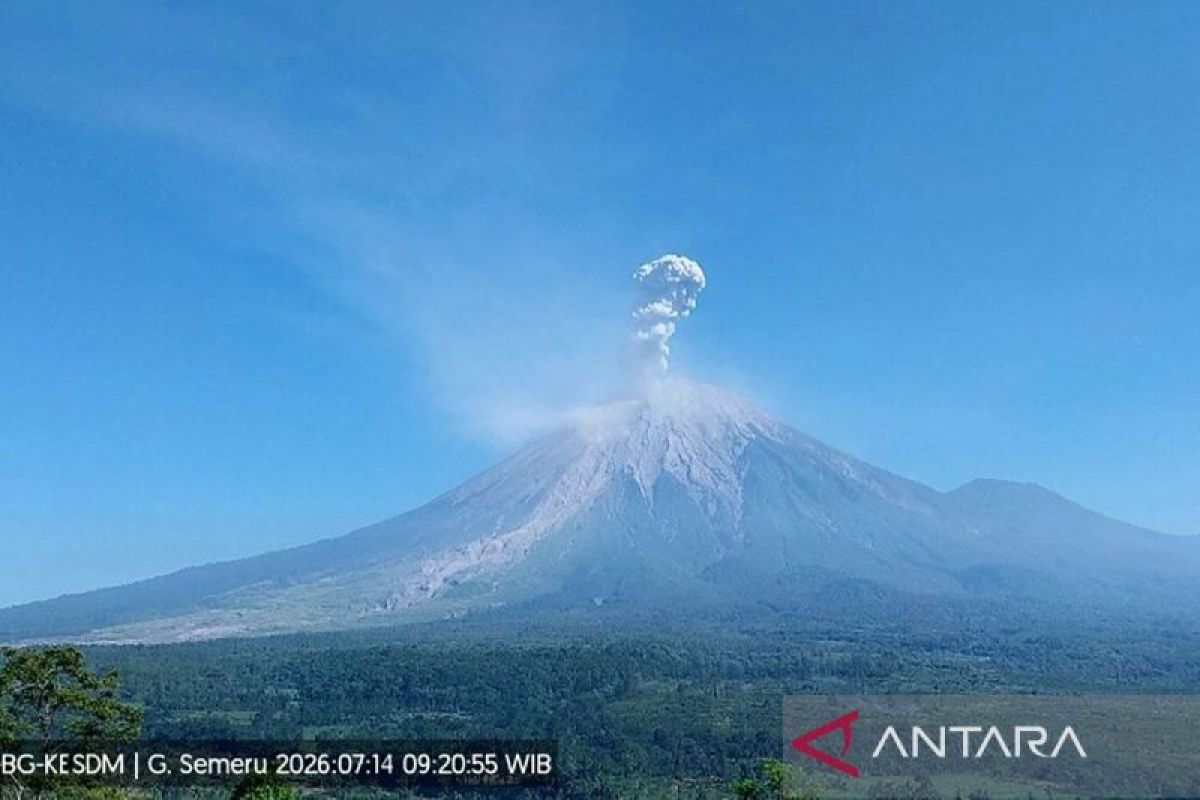
The eruption column height of Mount Semeru was observed at 1.3 kilometres above the peak, or 4,976 metres above sea level, twice on Tuesday morning, according to the Mount Semeru Observation Post in Sumberwuluh Village, Lumajang, East Java. The first eruption occurred at 05:39 WIB, with an ash column observed to be white to grey in colour with moderate intensity moving north. At the time the report was made, the eruption was still ongoing. “Then at 09:19 WIB, it erupted again with the same eruption height of 1.3 km. The ash column was observed to be white to grey with thick intensity heading northeast and east,” said Mount Semeru Observation Post Officer Sigit Rian Alfian in a written report received in Lumajang. He noted that the eruption of the highest mountain on Java Island was recorded on a seismograph with a maximum amplitude of 23 mm and a duration of 116 seconds. Mount Semeru was recorded as having erupted seven times on Tuesday from 00:32 WIB to 11:13 WIB, with eruption heights ranging from 800 metres to 1.3 km above the Mahameru peak. He explained that the volcanic activity of Mount Semeru is currently at Status Level III (Alert), with a recommendation that the public not conduct any activities in the southeast sector along Besuk Kobokan as far as 13 kilometres from the peak (eruption centre). Beyond that distance, he said, the public should not conduct activities within 500 metres of the riverbank (river border) along Besuk Kobokan, due to the potential for expansion of hot clouds and lava flows up to a distance of 17 kilometres from the peak. “The public is prohibited from conducting activities within a five-kilometre radius of the crater/peak of Mount Semeru because it is prone to the danger of rock projectiles (incandescent),” he said. He urged the public to be aware of the potential for hot clouds, lava avalanches, and lahars along the river/valley flows originating at the peak of Mount Semeru. “Especially along Besuk Kobokan, Besuk Bang, Besuk Kembar, and Besuk Sat, as well as the potential for lahars in small rivers that are tributaries of Besuk Kobokan,” said Sigit.