
Mount Anak Krakatau Records Its Fourth Eruption Today
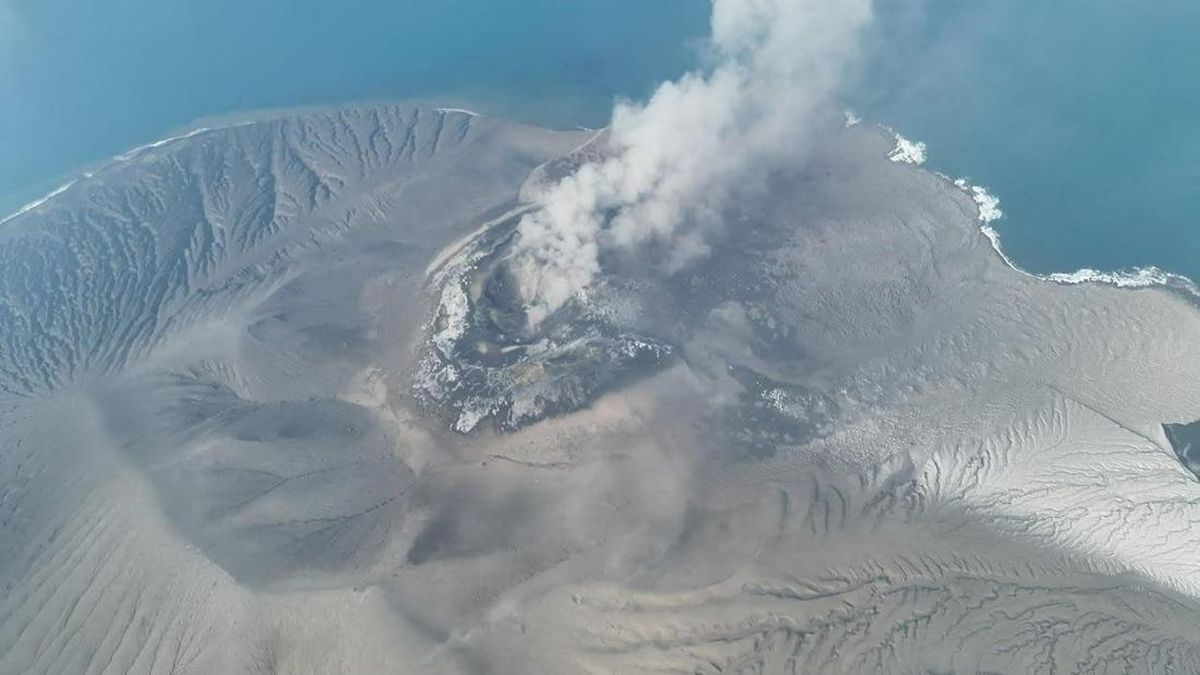
Mount Anak Krakatau (GAK) erupted again on Tuesday (8/9), from the early hours until midday local time. The volcano in the Sunda Strait erupted at least four times over the course of the day.
According to the Eruption Information page on Magma, the official volcanic monitoring platform of the Ministry of Energy and Mineral Resources (ESDM), the volcano in the Sunda Strait waters recorded its fourth eruption of the day at 11.34 Western Indonesia Time (WIB).
Based on a report by duty officer Deny Mardiono, the visual eruption was not observed during this event.
“This eruption was recorded on the seismograph with a maximum amplitude of 50 mm and a duration of 17 seconds,” he said, as quoted from the platform.
The volcano’s current status is Level III, or Alert (Siaga), following the first series of eruptions over the past weekend.
The first eruption of Anak Krakatau on Tuesday occurred in the early hours at 05.08 WIB.
“The visual eruption was not observed. This eruption was recorded on the seismograph with a maximum amplitude of 47 mm and a duration of 15 seconds,” according to a report quoted from the site.
The second eruption occurred about half an hour later.
“An eruption of Mount Anak Krakatau occurred on Tuesday, 8 September 2026, at 05.34 WIB. The visual eruption was not observed. This eruption was recorded on the seismograph with a maximum amplitude of 44 mm and a duration of 10 seconds,” the report stated.
The third eruption occurred around two hours later.
“An eruption of Mount Anak Krakatau occurred on Tuesday, 8 September 2026, at 07.49 WIB. The visual eruption was not observed. This eruption was recorded on the seismograph with a maximum amplitude of 48 mm and a duration of 19 seconds,” according to a report written by Anggi Nuryo Saputro on the platform.
Eruptions of Mount Ibu and Ile Lewotolok
In addition, Mount Ibu on Halmahera Island, North Maluku, and Mount Ile Lewotolok on Lembata Island, East Nusa Tenggara (NTT), were also reported to have erupted multiple times throughout the day. This was recorded in reports on the Eruption Information page of Magma, the official volcanic monitoring platform of the Ministry of ESDM.
Mount Ibu
From the early hours until midday, Mount Ibu was reported to have erupted seven times.
The latest eruption was reported at 12.01 Eastern Indonesia Time (WIT), or 10.01 WIB.
“The visual eruption was not observed. This eruption was recorded on the seismograph with a maximum amplitude of 28 mm and a duration of 44 seconds,” reported duty officer Darsono Haji Muhammad Nur, as quoted from the ESDM Magma site.
The volcano’s current status is Watch (Waspada), or Level II.
In the early hours, the volcano erupted at 00.36 WIT. The visual eruption was not observed. This eruption was recorded on the seismograph with a maximum amplitude of 28 mm and a duration of 54 seconds.
Then at 09.07 WIT, an eruption occurred, though the visual eruption was not observed. This eruption was recorded on the seismograph with a maximum amplitude of 15 mm and a duration of 42 seconds.
At 09.17 WIT, another eruption occurred, though the visual eruption was not observed.
“This eruption was recorded on the seismograph with a maximum amplitude of 28 mm and a duration of 60 seconds,” the duty officer wrote in a report on the platform.
At 11.13 WIT, an eruption also occurred, with the visual eruption not observed.
Subsequently, at 11.40 WIT, an eruption occurred with the visual eruption not observed. This eruption was recorded on the seismograph with a maximum amplitude of 28 mm and a duration of 48 seconds.
Ile Lewotolok
Mount Ile Lewotolok on Lembata Island, NTT, erupted at 06.35 Central Indonesia Time (WITA).
“The ash column was observed at approximately 800 m above the peak (around 2,223 m above sea level). The ash column was observed to be grey in colour with thick intensity, drifting towards the west,” according to a report by duty officer Yeremias Kristianto Pugel, quoted from the platform.
“This eruption was recorded on the seismograph with a maximum amplitude of 40 mm and a duration of 180 seconds,” he added.
The volcano’s current status is Watch (Waspada), or Level II.