
Mount Anak Krakatau Eruption: Could It Trigger a Megathrust Alert? An Expert Explains
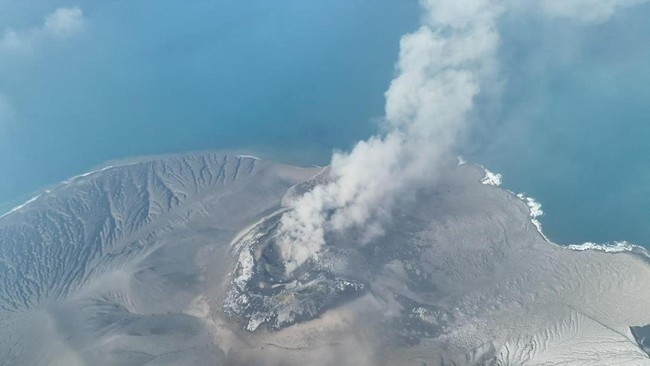
Jakarta, CNBC Indonesia – The Centre for Volcanology and Geological Hazard Mitigation (PVMBG) under the Geology Agency of the Ministry of Energy and Mineral Resources has officially announced that, after lasting approximately 25 hours, the continuous eruption episode of Mount Anak Krakatau that began on 4 September 2026 at 23.07 WIB ended on 6 September 2026 at 00.04 WIB.
Following this, activity returned to Strombian eruptions, which are characteristic of Mount Anak Krakatau’s current behaviour. This was according to a report released by PVMBG on Monday morning, 7 September 2026. It was emphasised that intensive visual and instrumental monitoring continues, and that the status and recommendations will be re-evaluated promptly should there be any significant change in activity.
This eruption of Mount Anak Krakatau drew attention because volcanic ash spread to various parts of West Java and also to Jakarta.
Moreover, this volcanic activity was also linked to a loud booming sound that startled residents of Bandung Raya and its surroundings in the early hours of Saturday (5 September 2026). However, the Meteorology, Climatology and Geophysics Agency (BMKG) later stated that it was unlikely the sound was transmitted from the eruption of Mount Anak Krakatau. According to the BMKG, the wind blowing from east to west at the time of the event reduced the likelihood of the eruption’s sound waves propagating towards Bandung Raya, so the source of the boom is strongly suspected to be something else that still requires in-depth study.
Could it trigger a Sunda Strait megathrust?
What about tectonic earthquakes? Could the eruption of Mount Anak Krakatau, located in the waters of the Sunda Strait between Java and Sumatra, trigger one? Indonesia does have a megathrust zone segment in the Sunda Strait.
The Sunda Strait megathrust segment has drawn attention because it is cited as one of the segments that has long failed to release its energy, raising fears that it could unleash its energy at any time and trigger a megathrust earthquake.
Daryono of the Indonesian Disaster Experts Association (IABI) explained that tectonic earthquakes are shaking caused by the shifting or rupture of rock layers in the Earth’s crust due to the movement of tectonic plates. Volcanic earthquakes, on the other hand, occur due to the movement of magma or the release of gas within the body of a volcano.
“Regarding the relationship between the two, volcanic earthquakes fundamentally do not possess enough energy to trigger a tectonic earthquake because the pressure they exert is only local in scope,” he told CNBC Indonesia on Monday (7 September 2026).
“Conversely, a large-scale tectonic earthquake is very capable of triggering a volcanic eruption, provided the volcano is already in an active state and its magma chamber is full, so that the shaking can break through the magma plug or trigger a release of gas,” Daryono added.
He also explained that, geographically, Mount Anak Krakatau sits in the Sunda Strait, an area close to the transition zone between the Sumatra Subduction zone and the Java Megathrust.
“Mount Anak Krakatau’s position is indeed within a vulnerable zone influenced by that regional tectonic setting. Therefore, if a powerful tremor from a tectonic earthquake in the Sunda Strait megathrust zone occurs, it could potentially set the magma in motion and accelerate an eruption of Mount Anak Krakatau if the volcano is active,” Daryono explained.
“However, this triggering relationship works in one direction only. Thus, volcanic activity at Mount Anak Krakatau cannot trigger the collapse or occurrence of a major tectonic earthquake in the Sunda Strait Megathrust Zone,” Daryono stressed.
He said the same theory applies to the seismic conditions of other volcanoes on the Indonesian mainland.
Update on Mount Anak Krakatau
PVMBG explained that, based on monitoring, during the period of 6–7 September 2026, Strombian eruptions were observed with black eruption columns reaching a maximum height of 300 metres above the summit. Instrumentally, 3 eruption earthquakes, 9 blowing earthquakes, 93 low-frequency earthquakes, 98 hybrid/multiphase earthquakes, and other volcanic seismic events were recorded.
The energy of the volcanic activity, based on RSAM values, rose on 5 September 2026 before declining again on 6 September 2026. Deformation data have not yet shown any significant change indicating a rapid increase in pressure.
“The end of the continuous eruption and the temporary return to a Strombian eruption pattern are interpreted, for now, as the end of one continuous eruption episode. However, volcanic activity dynamics remain high, and the possibility of another eruption in the near future still exists,” PVMBG stated.
“The main potential hazards are incandescent rock ejections, heavy ashfall, pyroclastic clouds, and lava flows should a continuous eruption occur again,” the PVMBG report stated.
It was stressed that the activity level of Mount Anak Krakatau currently remains at Level III (Alert).
“Members of the public, tourists, and maritime operators are not permitted to enter within a 3-kilometre radius of the centre of activity.”
“Residents of coastal areas of Banten and Lampung are urged to remain calm. The current eruptive activity is not triggering a tsunami, so people can carry on their activities as usual whilst continuing to follow official information and the directions of regional governments,” PVMBG emphasised.
The eruption of Mount Anak Krakatau does not trigger eruptions of other volcanoes
Meanwhile, Daryono stressed that eruptions of volcanoes occurring close together in time are a spatial and temporal coincidence.
“This is because Indonesia lies within an active plate subduction system with dozens of active volcanoes at Alert or Waspada status,” he explained.
“When several volcanoes happen to reach the threshold of gas and magma saturation at nearly the same time, they erupt independently without directly triggering one another,” he added.
Geologically, he explained, there is no direct magma channel connecting Mount Anak Krakatau with other volcanoes.
“Each volcano has its own magma chamber, conduit, and pressure system, separate from one another within the Earth’s crust. Each of these volcanoes has its own independent gas supply dynamics,” Daryono explained.
“A simultaneous increase in activity is a statistical coincidence of local dynamics at each volcano, such as the accumulation of internal gas pressure or magma crystallisation in each system, so an eruption at one volcano does not transfer pressure or ignite an eruption at another,” Daryono said.