
Mother Earth's Abundant Love for Her Children
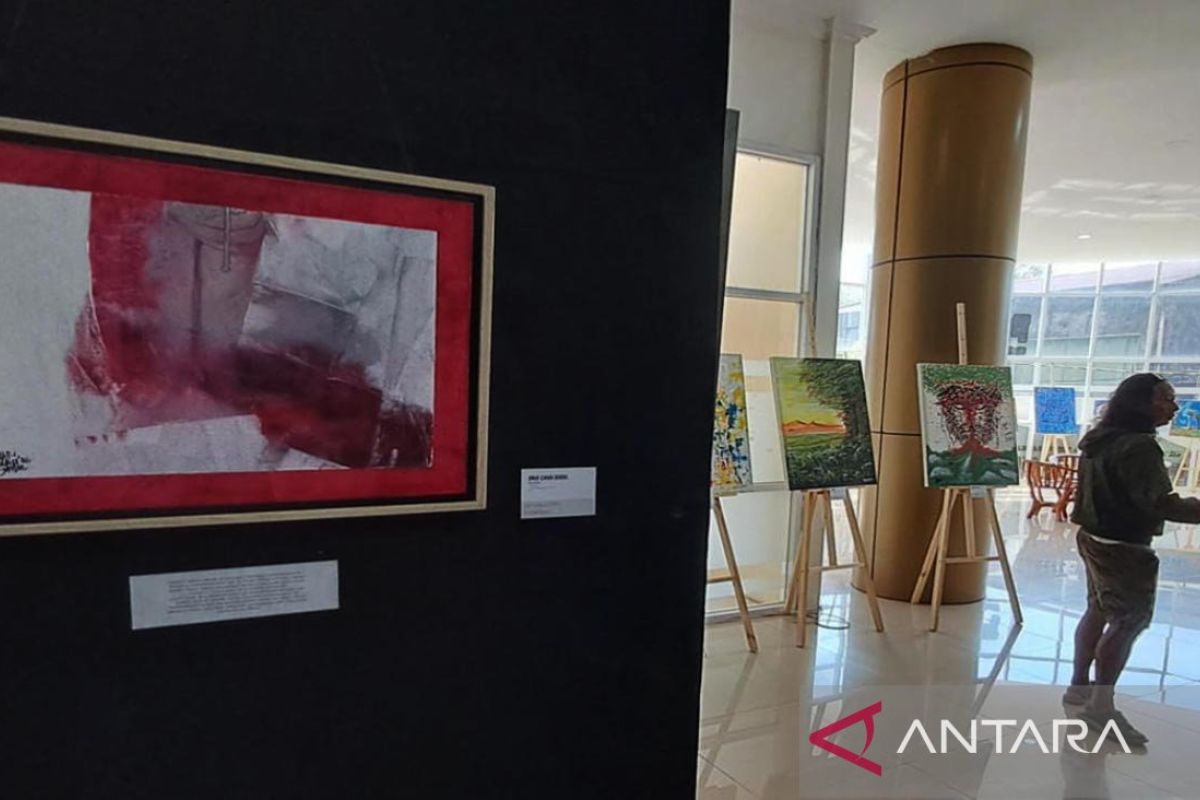
A painting titled ‘Ibu Pertiwi’ (Mother Earth), with a caption about visual homage to the steadfastness, sacrifice, and unconditional love of the motherland, reverses the common narrative that love for the country must be instilled in every child of the nation. By the artist Umar Iswadi Gundul, the 40x60 centimetre work is claimed to be a deep reflection on the homeland. The dynamics of national life are presented through a turbulent imagination using faint red brushstrokes over a white background that feels serene on the canvas. Explicitly, the painting invites the public to read that Ibu Pertiwi is a figure who loves the children of the nation. She seems to challenge her children to be intelligent in responding to the love of the one who gave them life.
The work is one of 54 paintings exhibited by 35 artists. The exhibition, titled ‘Rendezvous’ (Janji Berjumpa), was held by artists from Magelang City and Regency who are members of the Borobudur Artists Association (Gasebo) at the IKM Centre Building in Magelang City, from 21 July to 3 August 2026. The event, which is also part of Gasebo’s 10th anniversary commemoration, featured a painting workshop and live painting sessions initiated by the members, with participants from various community groups. In detail, the exhibition took place at the local city government-owned facility, with 19 workshop participants and 16 Gasebo artists taking part.
According to the event’s organising chairperson and Gasebo artist, Yustinus Agus Daryanto, each painting on display, including ‘Ibu Pertiwi’, is expected to provide meaning, inspiration, and an aesthetic experience for its audience. The exhibition period, from late July to early August, is intended to represent a promise to meet the month of independence. The independence month is an important time to celebrate and reflect on Indonesian independence, with a new interpretation of the events of Indonesian unity and freedom from colonialism.
Indonesian Independence Day falls on 17 August. Through its website, the Cabinet Secretariat has announced the theme for the 2026 anniversary: ‘Indonesia Berdaulat, Adil, dan Makmur’ (A Sovereign, Just, and Prosperous Indonesia). Typically, around the beginning of August, communities in various places welcome the independence month by working together to decorate their neighbourhoods and forming committees for the independence day celebrations. Savings or community contributions collected over the past year are used to fund the festivities. At the grassroots level, the celebration is also known as Agustusan or, in Javanese society, as Pitulasan, referring to the number 17 (pitulas), signifying the commemoration of 17 August 1945. On that date, at Pegangsaan Timur, Jakarta, Soekarno and Hatta proclaimed Indonesian independence on behalf of the nation. In the series of independence day commemorations, communities typically take time together to clean their villages and neighbourhoods, hoist the Red and White flag, and install decorative banners, art installations, and colourful lights in their residential areas.