
More Than Just a Kitchen
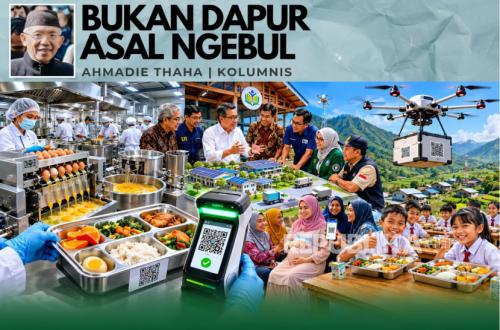
The Free Nutritious Meal (MBG) programme is often imagined merely as a matter of kitchen logistics. Perhaps this is why Prabowo Subianto recently appointed a woman to lead the MBG division. In a kitchen, there is rice, vegetables, and side dishes, and then it is finished. However, in practice, the task of feeding millions of Indonesian children is not as simple as cooking instant noodles while waiting for an advertisement to end.
It is therefore interesting that in Purwakarta, an idea has emerged to develop the Nutrition Fulfillment Service Unit (SPPG) based on the ‘Kampung Ilmu’ (Science Village) concept in Cisarua Village. This is not merely a communal kitchen, but a social laboratory that brings together academics from the University of Indonesia, Bandung Institute of Technology, and IPB University, alongside the government and local villagers.
Under the coordination of Professor Imam Prasodjo, individuals who daily grapple with theory, data, technology, and community empowerment are being brought to the field to witness reality. This is good news, as too many public programmes in this country are born in air-conditioned rooms and then sent to villages like expedition packages, only to encounter numerous problems upon arrival.
Cisarua Science Village is known as a community movement born from concerns regarding primary schools that were nearly collapsed. From a school lacking classrooms and teachers, residents built a learning ecosystem through mutual cooperation (gotong royong). In other words, before the state arrived with programmes, the community had already proven that change could begin with their own hands.
This is where the intelligence of such an approach lies. Academics enter a space that already possesses social capital. Sociologists study community dynamics, technologists devise distribution solutions, and agricultural experts calculate the sustainability of food supplies. Meanwhile, the government provides policy and programme support. Everyone sits at the same table, rather than shouting from their respective podiums.
The technology envisioned in the Science Village does not remain abstract; it extends into the kitchen itself. Imagine an SPPG kitchen operating as a hybrid between a modern food factory and a data laboratory. Eggs are no longer cracked one by one, causing wrist strain for staff.
Automatic egg-cracking machines can handle thousands of eggs in a short time while maintaining strict hygiene standards. Food washing machines, large-capacity steamers, refrigeration systems, and cooking temperature controllers work together to ensure consistent nutritional quality from the first plate to the last.
Furthermore, every MBG tray or plate is given a digital identity via a QR Code. As food leaves the kitchen, trays pass through a scanner that records the delivery destination, menu type, distribution time, and recipient name. Students, pregnant women, or other beneficiary groups are no longer just numbers in a monthly report.
They are recorded as individuals who have truly received the service. If the question arises, “Who received this food?”, “When was it sent?”, or “Has it arrived?”, the entire trail can be traced in seconds. Consequently, the kitchen does not only produce nutritious food but also generates data that makes the programme more transparent, accountable, and difficult to manipulate.
At that point, the MBG kitchen is no longer just a place for cooking. It transforms into an operations centre that integrates nutritional science, information technology, logistics management, and social service into a single ecosystem, working with almost no room for the chaos that has long been a chronic ailment of many public programmes.