
More Than 270 Dead, Nearly 1,400 Missing After Nepal Floods
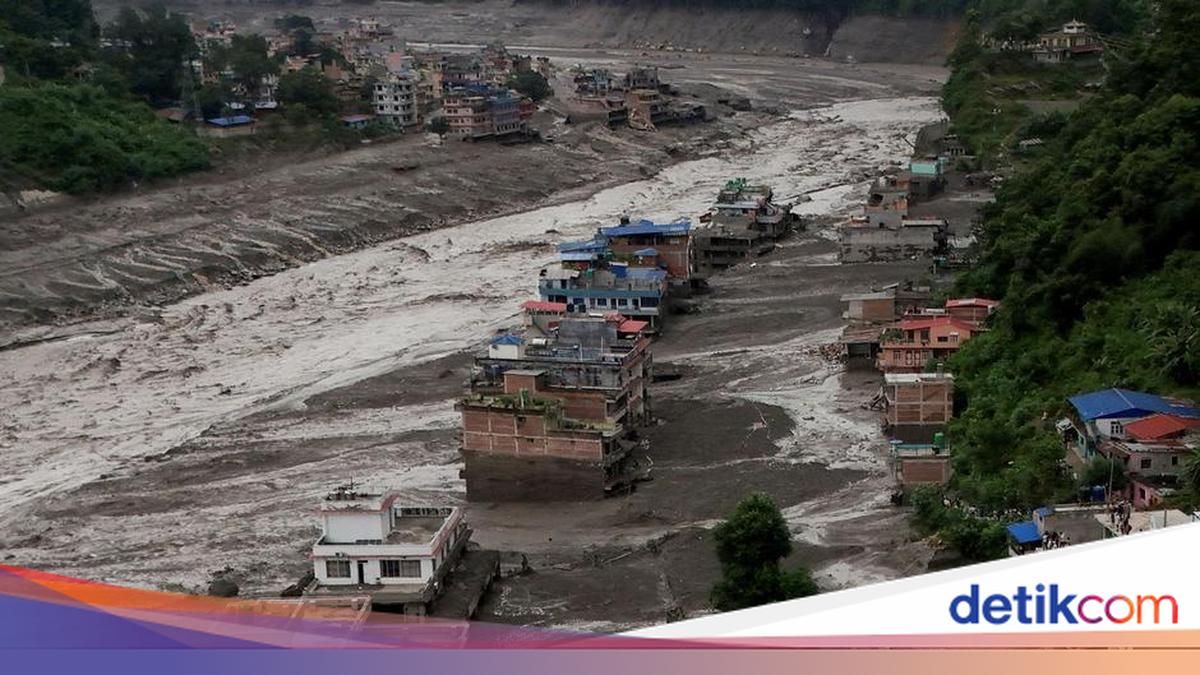
Flash floods caused by a glacial ice avalanche have struck the border region between Nepal and China. By Thursday afternoon (27/08), the disaster had killed at least 270 people, while the number of missing continued to rise.
Nepali authorities on Thursday (27/08/2026) said the number of missing in their country had surged to 826. The figure includes tourists, both Nepali and foreign nationals.
Overall, the total number of missing in Nepal and China has exceeded 1,300, according to the dpa news agency. In China alone, 558 people were reported missing.
According to experts, the disaster was triggered by an ice avalanche from a glacier in the Himalayan region that has been warming due to climate change.
Drone footage showed major roads destroyed and buildings buried under thick mud resembling wet cement. China’s state news agency Xinhua reported that the possibility of large-scale casualties remained.
The steep valleys in the area serve as economic lifelines and major transit routes, yet they are extremely prone to disasters.
Photographs from the scene showed mud covering buildings up to the second floor in Nuwakot District, Nepal, one of the worst-affected areas. Debris was caught in tree branches and power lines, vehicles were buried in earth, and survivors appeared covered in mud.
Residents had almost no time to save themselves.
“When I arrived at Dhunge market, within half an hour, the flood came and destroyed the entire market. At that time, people were preparing to go to the office,” a local resident, Shoyam Rajbhandari, told the AP news agency. “How many people are missing or dead, we do not know,” he said.
Missing while on pilgrimage to sacred sites
The deadly event coincided with the local Janai Purnima festival on Friday. Although the monsoon season is considered less than ideal for outdoor activities, this period is actually the peak climbing season towards Kailash via the route in Rasuwa District.
On Wednesday (26/08), officials in Nepal said 403 people, including 341 foreigners, were reported missing.
Sunil Sharma, a spokesperson for the local tourism agency, detailed that 133 of them were Indian nationals undertaking a pilgrimage to Mount Kailash in Tibet, a sacred site for Hindus.
In addition, 47 US citizens, 34 Australians, 33 Britons, and 24 Canadians were also reported missing. The US State Department confirmed it was monitoring its affected citizens.
Meanwhile, Sharma also said at least 62 missing Nepalis were trekking in the Gosaikunda Lake area of Rasuwa District. The district, which directly borders Gyirong, Tibet, was among the hardest hit by the disaster.
Nepal Police spokesperson Abi Narayan Kafle told the AP news agency that at least 28 police personnel were also reported missing.
The government warned residents in several districts to stay away from the banks of the Trishuli, Bhotekoshi, and Narayani rivers. The strong currents swept away at least 19 bridges and nearly 40 kilometres of roads. According to local officials, the Bhotekoshi River began overflowing around 9.00 am on Wednesday (26/08), then destroyed several villages and hydropower projects.
“We have requested assistance from both India and China for rescue operations,” said government spokesperson Sasmit Pokharel.
The US Geological Survey (USGS) initially reported a magnitude 4.4 earthquake early on Wednesday (26/08), about 66 kilometres north of Kathmandu. However, the USGS later revised its analysis. The detected seismic activity was actually a massive glacial avalanche, equivalent to a magnitude 5.2 tremor that released tonnes of material downstream and flattened settlements.
This conclusion was based on data from the nearest seismic stations and satellite imagery, which confirmed that no purely tectonic activity had occurred.
International responses
The South Korean government reported that nine of its citizens working on a hydropower construction project in Nepal were on the missing list.
Malaysia’s Ministry of Foreign Affairs announced it had lost contact with 11 of its nationals believed to be in Rasuwa District. Meanwhile, the Russian Embassy in Nepal said four of its citizens were missing in the disaster zone.
Indian Prime Minister Narendra Modi has spoken with Nepali Prime Minister Balendra Shah to offer direct assistance. “India is ready to provide all possible humanitarian assistance to Nepal. Our teams are coordinating closely in rescue and relief efforts,” Modi wrote on social media.
The United Nations has also begun mobilising aid. “In an effort to meet what will clearly be enormous humanitarian needs,” stressed UN spokesperson Stephane Dujarric.
In a joint statement, Australia, the United Kingdom, the European Union, Finland, France, Norway, and Switzerland expressed their solidarity. “We encourage all parties in the affected areas to follow the instructions of local authorities and official safety warnings, given the still-evolving situation.”
Not the first glacier-related disaster
Climate experts at the International Centre for Integrated Mountain Development (ICIMOD) based in Kathmandu confirmed that snow and ice avalanches from glaciers were most likely the primary trigger of the flash floods.
“Hydrological observations indicate an extraordinary speed and magnitude of the flood wave,” the experts wrote in their official statement. The water level at one point on the Trishuli River was reported to have surged by up to nine metres in just half an hour.
According to ICIMOD, the Lhende Khola River, a tributary of the Bhotekoshi, bore the brunt of the flooding.
“Lhende Khola has been hit by floods twice in the last 14 months. This time…”
Source: jawawa.id (https://jawawa.id/newsitem/more-than-270-dead-nearly-1-400-missing-after-nepal-floods-1787831629)
Originally published by detikcom (https://news.detik.com/dw/d-8637067/lebih-dari-270-orang-tewas-hampir-1-400-hilang-usai-banjir-nepal), translated from Indonesian