
Moral Politics
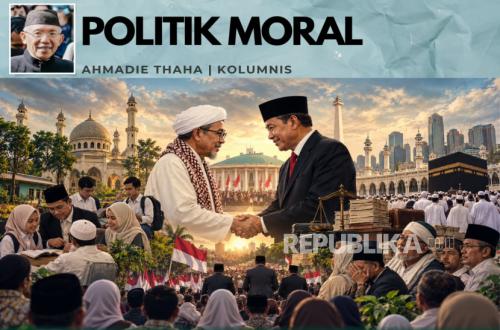
Religion never enters politics alone. What enters is humans carrying the name of religion, religious authority, organisations, or religious values. And because religion exists throughout time, while power is required, the two are never truly inseparable.
Therefore, when discussing the relationship between religion and politics, attention should not be directed solely towards doctrines or institutions. We also need to look at who the actors are, what interests they bring, and how they utilise the authority they possess.
This idea was a significant part of the inaugural lecture by Professor Idris Thaha at the UIN Syarif Hidaylarullah campus in Jakarta. He views religion not merely as a set of values, but also as an actor and an arena of power.
Values such as justice, honesty, trustworthiness, solidarity, brotherhood, public welfare, and responsibility do not function on their own. Values require actors to interpret them and institutions to bring them into the public sphere.
Consequently, a religious actor essentially carries a name much larger than themselves. A leader of a religious organisation carries the name of their organisation. A politician carries the name of their party. A cleric carries scholarly authority.
Similarly, a religious cadre carries the history of a community that may be far older than themselves. When they succeed, the name they carry gains honour. When they encounter problems, that name can also be dragged down.
This is where the issue of the ‘rogue individual’ (oknum) becomes interesting. When someone succeeds, their success is easily cited as a collective achievement. But when they encounter trouble, the phrase ‘it is just a rogue individual’ quickly emerges.
That statement may indeed be true. One person’s mistake does not automatically become the mistake of the organisation. However, reputation does not function like administration. The public does not always separate an actor from the institution they represent with such a clean line.
Therefore, an organisation cannot simply claim that the perpetrator is a rogue individual. It must also ask whether its system is strong enough to prevent, supervise, and resolve the behaviour of actors who carry its name.
This issue becomes sensitive. For instance, when such realities touch upon the dynamics of large religious organisations like Nahdlatul Ulama, which recently held its 35th Muktamar in Jombang. Various issues emerged leading up to and following the Muktamar.
Among these were unpleasant rumours regarding alleged money politics and fund flows linked to the contestation. Videos regarding this are scattered across social media. Some of these allegations have been denied by NU, while others have called for clarification and ‘tabayyun’ (verification).
Therefore, these issues must remain placed as allegations or claims that have not been legally proven, rather than as facts that have reached a final verdict. However, there is a lesson greater than the truth or falsehood of a rumour.
Rumours can often damage reputations before the truth has been fully investigated, as mentioned in one of the verses of the Al-Qur’an. Therefore, moral politics must not operate like social media.
Moral and ethical politics does not treat allegations as a verdict. It demands investigation, or ‘tabayyun’. If true, there must be the courage to rectify the situation. If false, there must be the courage to explain and restore one’s good name.