
Moon's Surface Seen Pockmarked After Collision with Elon Musk's 4-Tonne Rocket
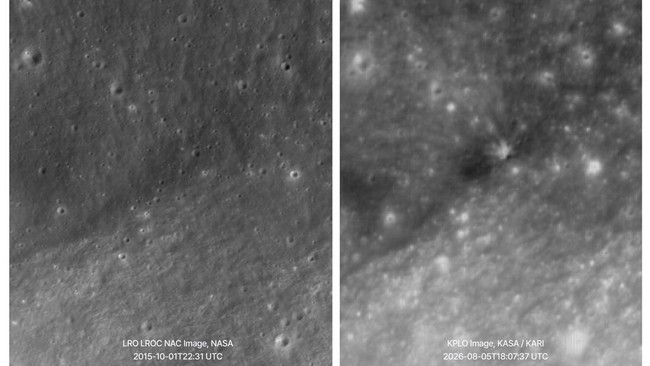
Visual evidence of a spent SpaceX rocket stage striking the Moon has finally been captured. South Korea’s Danuri lunar orbiter recorded the newly formed surface changes resulting from the impact.
The object was the upper stage of a Falcon 9 booster, weighing approximately four tonnes. After running out of fuel while delivering a lunar lander, it had been drifting uncontrollably since its launch in January 2025. Due to gravitational forces and solar activity, it eventually crashed into the Moon’s western limb near the Einstein crater on Wednesday, August 5, 2026, at 1:34 p.m. Western Indonesian Time, travelling at nearly 8,700 kilometres per hour.
According to an official report from the Korea Aerospace Research Institute (KARI) and Space.com, Danuri began monitoring the location roughly 30 minutes before the impact occurred. The orbiter passed over the site seven more times after the event, completing a total of eight imaging sessions by Thursday morning.
A comparison of images reveals a dark smudge spreading from the point of impact, contrasting with the smooth lunar surface seen in earlier recordings. The newly formed crater is estimated to be between 20 and 27 metres wide.
“Danuri successfully recorded conditions before and after the event, allowing us to analyse changes caused purely by the rocket impact and obtain highly valuable research data,” KARI stated in an official social media post.
This data will be combined with observations from NASA’s Lunar Reconnaissance Orbiter to further study how human-made object collisions affect the lunar surface. In addition to the visual evidence, a giant telescope in Chile detected traces of sodium and lithium gas ejected into space for ten minutes following the impact.
This is the second time space debris has unintentionally struck the Moon, following a similar incident involving a Chinese rocket remnant in 2022. The findings serve as a stark reminder of the need for better management of space hardware as human activity beyond Earth becomes increasingly congested.
Source: jawawa.id (https://jawawa.id/newsitem/moons-surface-seen-pockmarked-after-collision-with-elon-musks-4-tonne-rocket-1786103567)
Originally published by CNBC Indonesia (https://www.cnbcindonesia.com/tech/20260807132841-37-757418/penampakan-bulan-ditabrak-roket-4-ton-elon-musk-sampai-bolong-bolong), translated from Indonesian