
Monitoring TNI Law Lawsuit at Constitutional Court, UI Student Body Rejects Resurgence of Military State
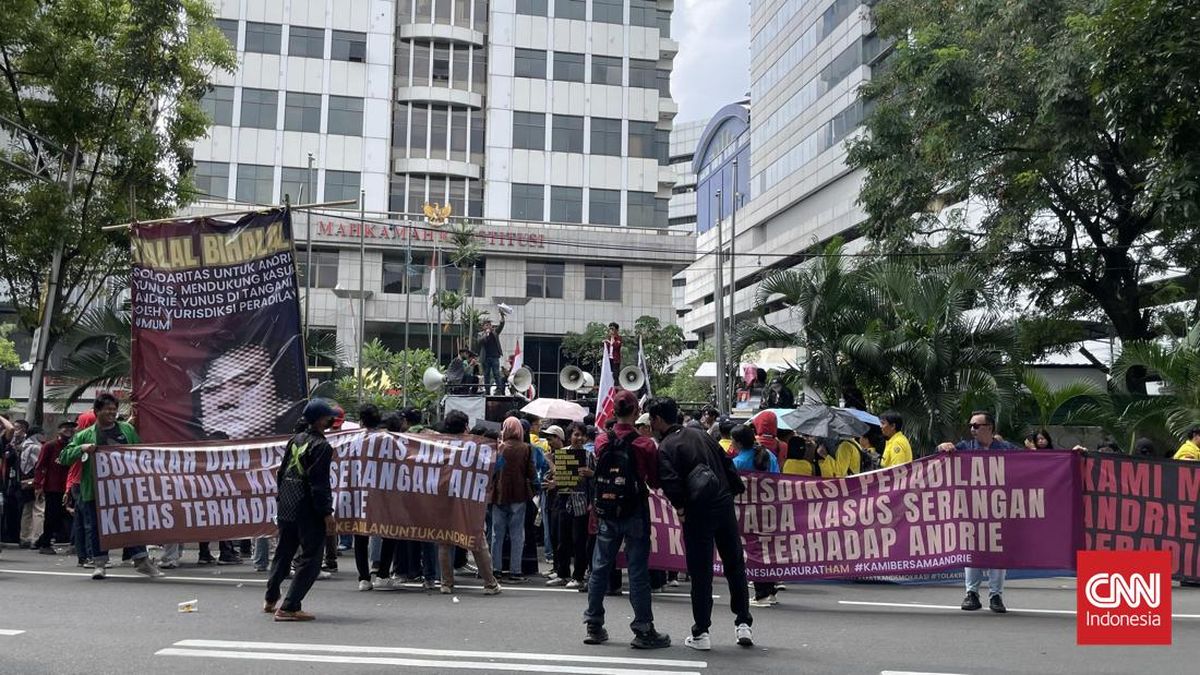
The Executive Board of Students at Universitas Indonesia (BEM UI), together with a coalition of civil society groups, held a solidarity action at the Constitutional Court (MK) to monitor the material examination of Law No. 3 of 2025 on the TNI.
BEM UI Chair Yatalatof Imawan stated that the MK must boldly take a stance without fear of shadows of power intervention in handling the TNI Law lawsuit.
“We are monitoring and also want to send a message to the MK itself that the MK should not fear any pressure. Especially here, we are faced with a state heading towards authoritarianism,” said Yatalatof at the MK area in Central Jakarta on Wednesday (8/4).
BEM UI held this action also as a form of solidarity for Wakil Koordinator KontraS Andrie Yunus, a victim of acid splashing terror who is currently fighting for justice through a judicial review related to Article 47 of the TNI Law.
According to Yatalatof, if the lawsuit is granted, it will become a key to breaking the chain of impunity, so that problematic apparatus can no longer hide behind the closed military justice system.
“Because if the MK grants the judicial review filed by Andrie Yunus, among others, then every criminalisation carried out by the TNI against civilians will be tried in general courts, not in the highly closed and non-transparent military courts,” he said.
Yatalatof emphasised the students’ commitment to multiplying mass strength to prevent Indonesia from returning to being an authoritarian military state.
“Therefore, we will carry out a larger movement to hold back so that this country does not become a military state, an authoritarian state, which does not protect its own people,” he said.
Concerns over the strengthening of state repression were also voiced by a representative of the Indonesian Political Prisoners Union, Khariq Anhar, who joined in solidarity.
Khariq said that civil freedom spaces are increasingly narrowing, evidenced by the proliferation of physical intimidation to digital terror against activists.
“This insecurity we also feel when even in private WhatsApp group discussions with our friends, they can be doxxed. Information is leaked just like that so we feel there is no security at all,” he said.
“Even for making a post, for example, an invitation to a discussion, I always get phoned by intelligence,” Khariq added.