
Momentum to Repair a Shaken Stock Market
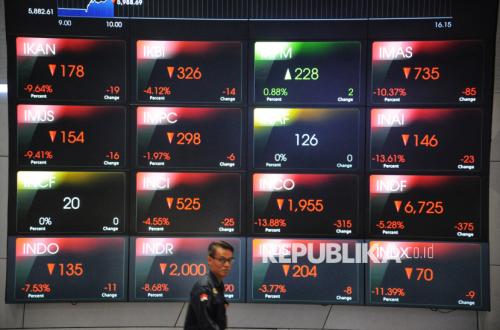
Although it has not yet been formally announced, Morgan Stanley Capital International’s (MSCI) plan to change the classification of Indonesia’s stock market has already caused considerable turmoil. It is easy to see why investors were startled. Despite claims that Indonesia’s economic growth can be maintained above 5 per cent and the government’s insistence that the national economy is in good shape, a warning has suddenly emerged that is forcing economic actors to think twice before investing in Indonesia.
Indonesia will inevitably face pressure on the rupiah if MSCI reclassifies the domestic stock market from Emerging Market to Standalone Market. Such a change would trigger substantial capital outflows and increase pressure on the national economy. As of 19 October 2026, foreign fund outflows were reported to have reached Rp3.3 trillion, and could continue to rise.
If there is no significant improvement and MSCI does downgrade Indonesia to Standalone Market, the risks will extend beyond portfolio adjustments by foreign investors to the possibility of a broader withdrawal of funds from Indonesia’s financial markets. As widely reported, MSCI’s warning immediately sparked widespread panic on the Indonesia Stock Exchange (IDX). The Jakarta Composite Index (JCI) plunged 11.57 per cent to 5,185.11 in a single trading day — its steepest daily fall since the financial crisis of January 1998. At the same time, the external pressure spread to the foreign-exchange sector, pushing the rupiah back beyond Rp18,000 to the US dollar.
The MSCI report
Although painful, MSCI’s assessment must be accepted as a serious warning. Its comments amount to an open critique of the governance framework of our capital market. This is a moment of truth, forcing regulators, issuers and the government to conduct a thorough examination of structural problems that have long been concealed in our capital market.
Signs that something was wrong with our capital market have been discussed for years. Over the past several years, global fund managers have repeatedly voiced deep concerns about the quality of price discovery and market accessibility in Indonesia. According to MSCI’s official report, three key issues underpin its concerns.
The first is a lack of transparency in ownership structures. Indonesian issuers are seen as frequently concealing the identities of their ultimate beneficial owners. Reported public shareholdings (free float) often do not reflect the reality on the ground, as shares are controlled by parties affiliated with the controlling shareholders. Actual ownership is deliberately hidden to obscure collusion in share-price manipulation. Typically, a share price is driven up through purchases by subsidiaries or other parties within the same network. Once it is considered to have reached its peak, the shares are sold to buyers deceived by the manipulation.
The second issue is market dysfunction and fictitious share trading. Experience on the ground has repeatedly shown that coordinated trading or price manipulation — popularly known in Indonesia as “saham gorengan” — is considered seriously alarming. Share-price movements no longer reflect issuers’ operational fundamentals, but instead result from artificial liquidity engineering. In other words, shares are often manipulated, causing price rises that do not correspond with the productivity of the businesses behind them.
The third concern is the impact of weak law enforcement. The exchange and regulators are considered insufficiently aggressive and inconsistent in taking firm action against market manipulators. The absence of penalties that act as a deterrent leaves foreign investors feeling that their investment protections are at risk, making concerns about regulators’ performance understandable. Previous improvement measures and the suspension of certain transactions have apparently failed to deliver adequate and consistent progress. International observers see a wide gap between regulations on paper and their enforcement in practice. This has helped trigger capital flight.
A moment of opportunity
Following MSCI’s warning, many risks need to be anticipated. If Indonesia’s status is downgraded to Standalone Market, the consequences would go beyond its removal from the major regional and global MSCI indices used as benchmarks by investment managers worldwide. The knock-on effects would also spread to the real economy through several channels.
Alongside the risk of capital outflows from passive index funds, an MSCI reclassification would likely weaken the rupiah, prompting imported inflation, higher yields on government bonds (SBN) and a rise in Indonesia’s risk premium. Fiscal space would almost certainly narrow as government borrowing costs increased, ultimately disrupting funding for development.
Fortunately, no final decision on Indonesia’s reclassification has been made. MSCI is still conducting a public consultation and awaiting feedback and evidence of substantive reform until 30 April 2027, before announcing its final decision on 30 June 2027. Less than a year remains. This is a crucial opportunity that must be used to carry out radical reform.
Although painful, MSCI’s assessment is not the end of the road. We must acknowledge that our stock exchange has appeared too focused on quantity — the number of new listings, daily trading frequency or records set by headline indices. We have forgotten that trust and integrity are the foundations of any financial market.
To begin rebuilding market confidence, the Financial Services Authority (OJK) and the IDX should require all issuers, particularly those included in the MSCI Indonesia Index, to declare their ultimate beneficial owners as a matter of law. Publicly held shares found to be controlled by concealed affiliated parties should be excluded from free-float calculations to ensure the data are accurate.
The relevant authorities should also demonstrate their resolve by bringing perpetrators of artificial share-price manipulation before the courts for financial crimes. Global investor confidence is not built on lenient rules, but on firm enforcement that protects their capital.
The MSCI test is an ideal opportunity to clean up the capital-market mafia and build a healthy, transparent and fair investment ecosystem for domestic and global investors.
Source: jawawa.id (https://jawawa.id/newsitem/momentum-to-repair-a-shaken-stock-market-1792385469)
Originally published by Republika (https://opini.republika.co.id/berita/tn4ya4393/momentum-memperbaiki-pasar-saham-yang-terguncang), translated from Indonesian