
'Molinas' marks new chapter in Indonesia's EV industrialization
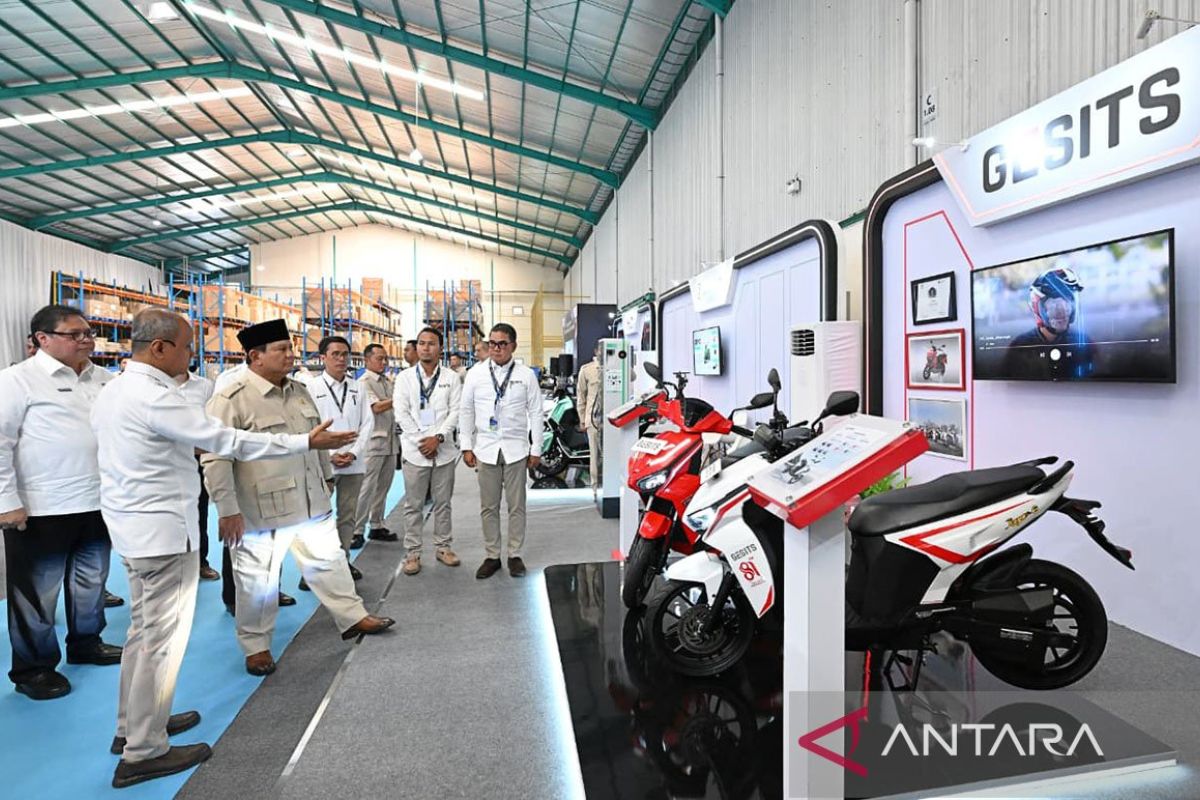
..the Molinas framework lays the groundwork for Indonesia’s transformation from primarily a consumer market into an integrated global hub..Jakarta (ANTARA) - For decades, the familiar roar of internal combustion engines has defined daily transportation across Indonesia.
With annual motorcycle sales consistently hovering between 6 million and 7 million units, two-wheelers serve as the undisputed backbone of personal mobility throughout the archipelago.
Yet, despite this massive domestic market, electric motorcycles have historically struggled to secure a meaningful foothold, recording a modest 60,000 to 70,000 units sold annually—a mere 1 percent of overall national sales.
This pronounced disparity between conventional and electric two-wheeler adoption presented both a policy challenge and an unprecedented economic opportunity.
Recognizing that the vast gap opened a strategic gateway to pioneer domestic electric vehicle (EV) manufacturing, the Indonesian government launched the National Electric Motorcycle (Motor Listrik Nasional or Molinas) initiative to build a comprehensive, end-to-end industrial ecosystem.
Officially introduced on August 13, 2026, at PT Ilectra Motor Group’s (ALVA) production facility in Cikarang, West Java, Molinas signals a fundamental transition in national economic strategy.
Rather than relying on imported completely built-up units or basic assembly operations, the government’s roadmap targets comprehensive domestic capacity spanning component manufacturing, battery technology, charging networks, commercial financing, distribution and after-sales support.
Indonesia’s foray into two-wheeler electrification rests on a solid manufacturing foundation.
Industry Ministry data shows the nation already hosts 69 battery-based electric vehicle manufacturers specializing in two- and three-wheeled models—boasting a combined annual capacity of 2.511 million units and over Rp1.2 trillion (approximately US$74.5 million) in capital investment.
To translate this capacity into mass-market adoption, the government is actively expanding domestic manufacturer involvement, with at least 10 local companies already meeting strict Domestic Component Level (TKDN) requirements to participate directly in the development of Molinas.
At the enterprise level, state planners are encouraging companies like the corporate group overseeing, ALVA—which currently produces roughly 20,000 units annually—to scale output tenfold to 200,000 units per year.
This expansion forms a vital stepping stone toward achieving a broader target of 2 million national electric motorcycles.
Transitioning from small-scale manufacturing to mass production brings several key economic advantages.
First, component suppliers get the chance to serve a steady, high-volume domestic market, giving them the stability needed to grow their operations.
Second, producing goods on a larger scale lowers per-unit manufacturing costs, allowing equipment makers to pass savings directly to everyday buyers through lower retail prices.
Finally, this growth helps smaller local businesses connect with larger supply networks, enabling micro, small, and medium enterprises (MSMEs) to join the broader automotive chain as supporting suppliers.
Related news: Indonesia sets four criteria for national electric motorcycles
Extending downstream value
As the world’s largest nickel producer, Indonesia plays an indispensable role in global battery supply chains, but policy leaders emphasize that mineral processing and raw material extraction represent only the initial links of a much longer value chain.
The Molinas ecosystem seeks to retain maximum value domestically by linking nickel refining directly with battery cell fabrication, localized component production, vehicle assembly and downstream retail networks.
By extending the domestic value chain, Indonesia aims to cultivate a self-sustaining industrial landscape where local enterprises grow in lockstep with consumer demand.
To orchestrate this multifaceted push, the administration of President Prabowo Subianto has adopted a collaborative approach termed the “Indonesia Incorporated” model.
Under this framework, state defense contractor PT Len Industri has been appointed as lead integrator—tasked with harmonizing efforts across state-owned enterprises, private manufacturers, academic institutions, research bodies, financial institutions and MSMEs.
As electric vehicles possess a very different supply chains and demand patterns compared to conventional internal combustion engine vehicles, synchronized development across all sectors is imperative.
While manufacturers require stable battery and parts supply chains, end consumers demand accessible vehicle financing, reliable battery-swapping networks and nationwide maintenance infrastructure.
Related news: Prabowo calls Molinas an example of “Indonesia Incorporated”
Boosting market demand
To stimulate consumer demand and overcome the initial affordability gap, the government and financial institutions are rolling out targeted incentives.
Through the government’s investment management agency, Danantara, the State-Owned Banks Association (Himbara) is preparing specialized financing packages featuring lower interest rates, extended repayment terms and reduced or waived down payments.
Furthermore, authorities are also exploring structured trade-in schemes that would allow consumers to exchange existing gasoline motorcycles for new electric models.
Beyond consumer adoption, two-wheeler electrification could strengthen national energy security by reducing reliance on imported refined petroleum products and shifting energy consumption toward domestically generated electricity.
Projections indicate that expanding the electric motorcycle fleet to 11 million units by 2037 could generate Rp82.2 trillion (US$5.1 billion) in government fuel subsidy savings between 2027 and 2037.
The program is also projected to generate Rp150 trillion (US$9.3 billion) in direct economic val