
Mobile Phone Sales Becoming Increasingly Difficult, ITC Traders Report Widespread Stock Shortages
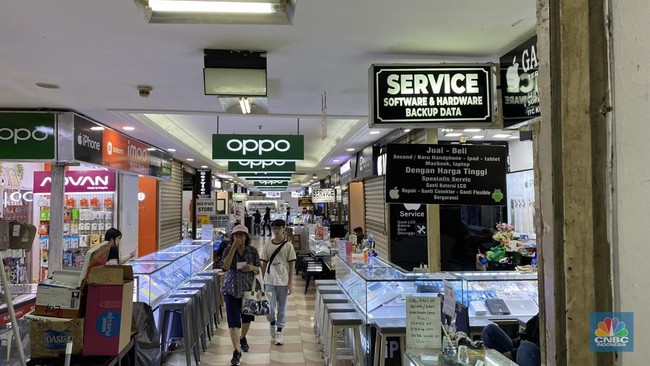
Mobile phone traders are complaining about the increasing difficulty of obtaining product stock for sale. In recent months, supplies have been inconsistent, with certain colour variants frequently out of stock due to limited distribution from central hubs.
“The stock is becoming increasingly scarce. It is not always available, and even colours are sometimes incomplete from the central suppliers,” said a shop employee at ITC Kuningan, South Jakarta, to CNBC Indonesia on Tuesday (2/6/2026).
He explained that while most mobile phones are assembled in Batam, key components and spare parts still rely on supplies from China. Currently, memory chip components are experiencing a global shortage, which is triggering price increases for electronic goods, including mobile phones.
This phenomenon occurs amidst ongoing pressure on the global smartphone industry. Chinese smartphone giants have been the most affected by the global memory chip crisis, according to Q1 202_6 shipment reports from research firms IDC and Counterpoint.
According to IDC data, Xiaomi’s shipments experienced a 19.1% year-on-year decline. Xiaomi shipped 33.8 million units in the first three months of 2026, capturing a 21.1% market share. While Xiaomi maintains its third-place position, it recorded the sharpest decline among the ‘Top 5’. IDC reports that this was due to Xiaomi’s strategic decision to reduce shipments of older models to avoid massive price hikes.
Projections continue to decline. Counterpoint Research projects that global smartphone shipments will fall by 13.9% to 1.08 billion units, following the worsening global memory chip shortage. According to reports from The Straits Times released on 1 June 2026, this projection is worse than the February 2026 forecast, which predicted a 12.4% decline.
Counterpoint noted that chip supplies are under increasing pressure due to the impact of the Iran war, which has exacerbated global supply chains. The greatest pressure is felt in the low-end smartphone segment, as chip manufacturers are now allocating more production capacity to chips used in the development of Artificial Intelligence (AI), making the production of budget devices increasingly uneconomical. Counterpoint chief analyst Wang Yang stated that manufacturers focusing on the low-price segment are expected to face greater pressure. For instance, Xiaomi is projected to record a 28% decline in shipments throughout the year.