
Mobile Phone Prices Triple as Traders at ITC Struggle
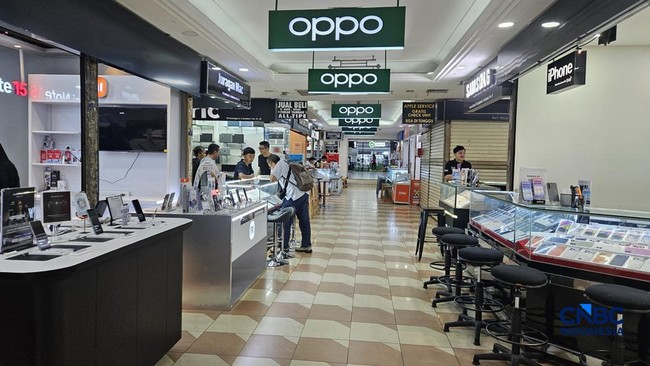
The weakening exchange rate of the rupiah against the US dollar is beginning to impact the prices of various electronic products. Numerous traders at ITC Kuningan have complained that the prices of smartphones and memory cards have been steadily climbing over recent months.
According to traders, these price increases are likely to continue in the near future, driven by US dollar fluctuations and rising component costs, particularly for chips. The global chip shortage, which began in late 2025, is attributed to a surge in demand for Artificial Intelligence (AI) chips, causing manufacturers to prioritise AI production over conventional chips used in consumer electronics such as mobile phones, laptops, gaming consoles, and household appliances.
A shop employee at ITC Kuningan stated that the upward price trend has been noticeable since March and April 2026, affecting almost all categories of electronic devices. “In the future, prices will rise again as they follow our dollar. It could happen every two weeks due to the dollar and AI chipsets,” the employee told CNBC Indonesia on Tuesday (2/6/2026).
The price hikes are not limited to mobile phones but extend to tablets, laptops, smartwatches, and even memory cards. In a worst-case scenario, some products could see prices jump several times over. “All phones, electronics, even memory cards, could increase up to three times. Something that used to be Rp100,000 could now be Rp300,000,” they added.
For mid-range products, such as the Redmi series, increases typically range between Rp100,000 and Rp200,000. However, for flagship models, the jump can be much larger, with Xiaomi flagship series seeing increases of up to Rp500,000 per unit. Another trader noted that the price hikes affect both new and second-hand devices. For second-hand iPhones, prices have risen by approximately Rp200,000 to Rp300,000, while new products have seen increases of around Rp400,000 to Rp500,000.
This trend is directly impacting sales activity, as consumers are increasingly hesitant to spend due to the volatile pricing. The global memory chip shortage is said to hit the Asia-Pacific market hardest, as this region is dominated by budget-friendly smartphones that operate on thin margins, leaving little room to absorb soaring component costs.
Research firm Counterpoint has slashed its global smartphone shipment growth projection for 2022 to minus 2.1%, with Chinese manufacturers such as Honor, Oppo, and vivo facing the sharpest revisions. Memory chip prices are expected to potentially rise by 40% throughout Q2-2026, which could add 8% to 15% to production costs. According to Counterpoint senior analyst Yang Wang, if manufacturers cannot pass these costs to consumers, they may begin to reduce their product portfolios, particularly in the low-end segment.
Overall, global smartphone shipments fell by 6% year-on-year according to Counterpoint, while IDC reported a 4.1% decline. IDC noted that the global shipment of 289.7 million units in Q1 2026 ended a ten-quarter growth trend that had persisted since mid-2023. Despite these challenges, Samsung remains the global leader with a 21.7% market share, followed closely by Apple with 21.1%.