
Mobile Compost Carts Drive South Jakarta Towards Zero Waste
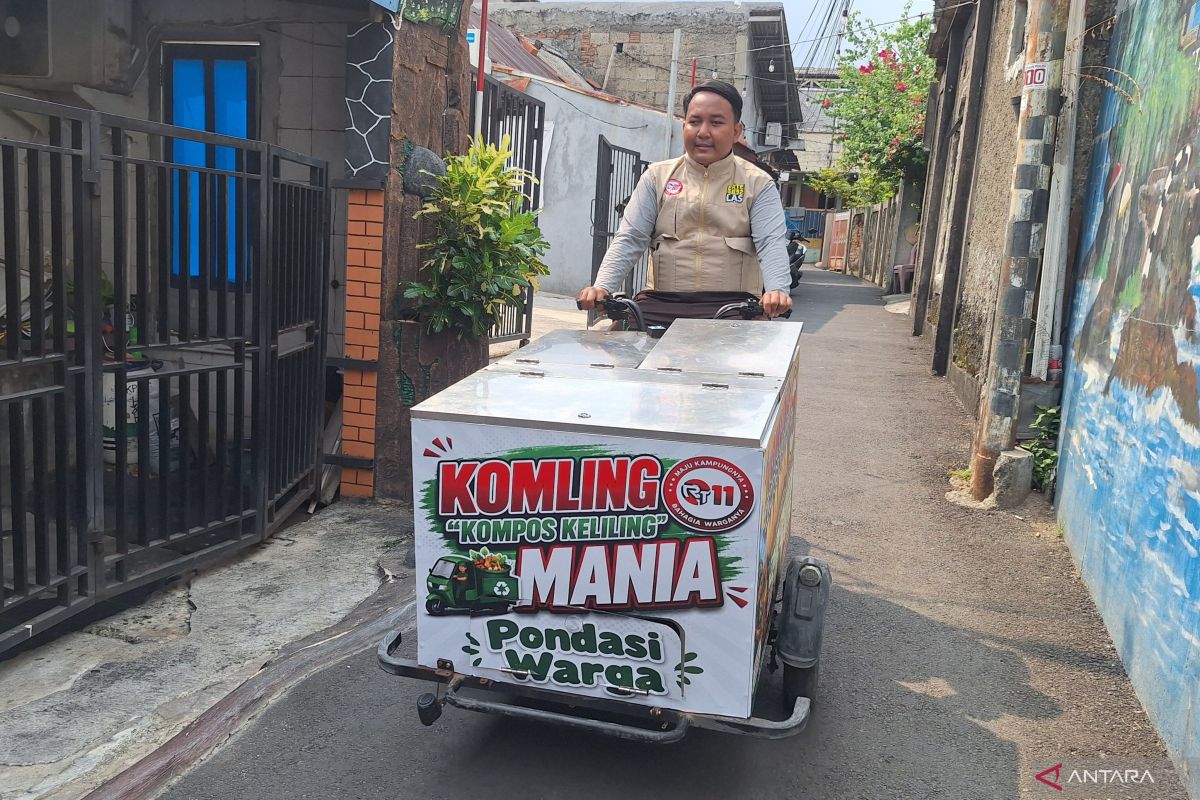
Jakarta (ANTARA) - The waste issue in Jakarta is becoming increasingly urgent. Ahead of the policy to cease waste shipments to the Bantargebang landfill starting 1 August 2026, residents in various areas are brainstorming ways to ensure household waste remains controlled and does not accumulate in the environment.
In South Jakarta, several community units (RW) have chosen not to remain idle in addressing the waste problem. Various innovations have emerged, ranging from mobile composting carts to ‘bottle houses’ as efforts to reduce waste volume directly from the source.
Imam Basori, the head of RT 11/RW 07 in Cilandak Barat, stated that these innovations stem from the desire to resolve waste issues at their origin, namely households.
The innovation is designed to tackle the waste problem at the upstream level. Therefore, a proactive ‘pick-up’ approach is being implemented for households. If this can be resolved from the upstream to the downstream, then waste will not accumulate.
Reduction at the household level will decrease the volume of waste that ends up in the final disposal site.
Through the ‘mobile composting’ programme, officers circulate daily to collect organic waste, such as household kitchen waste, from residents’ homes.
Under this system, household organic waste is processed using small-capacity composting machines capable of converting kitchen waste into compost in approximately six hours.
After being studied and monitored, the household kitchen waste is transformed into compost within six hours. Once mixed with soil, the result can be reused by the community.
If waste volumes increase, the neighbourhood committee (RT) will utilise larger capacity machines to ensure the processing remains rapid. A larger machine is currently in the production stage.
It is hoped that the resulting compost will be used for planting greenery within the community. Furthermore, the committee plans to organise a vegetable planting competition between houses to further encourage residents to utilise the compost.
In addition to processing organic waste, RT 11 has also developed a plastic bottle pressing machine named ‘smart geprek’. The machine was self-designed using actuators commonly used in seating.
Pressed plastic bottles hold higher economic value because they are more compact, making storage and transport easier.
It is hoped that through such management, the ‘zero waste’ target in their environment can be realised, while simultaneously changing the public’s perception of waste.
Moreover, the committee is maintaining communication with scrap collectors and waste banks in the surrounding area so that the results of waste sorting can provide economic benefits to the community.
In this way, residents will be increasingly motivated to sort waste if they know that waste possesses economic value.
By recognising the economic value of waste, the community can be educated that waste can serve as an additional source of income. With the incentive of economic value, the community can be mobilised.
Currently, the ‘mobile composting’ cart has a capacity of approximately 2.5 cubic metres, with a production cost of around Rp5 million. Meanwhile, the composting machine uses approximately 500 watts of electricity, while the supporting generator requires approximately 800 watts.