
MLFF Could Be the Solution to Toll Gate Congestion During Eid Exodus and Return Flows
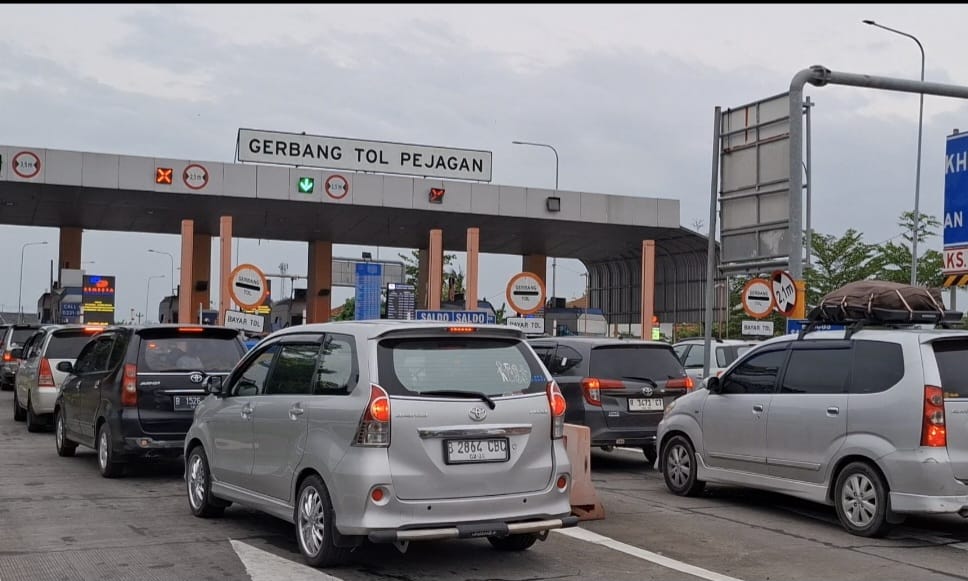
Insufficient e-toll balances among holidaymakers during the 2026 Eid exodus and return flows often cause severe congestion at toll gates, stretching for dozens of kilometres. The Multi Lane Free Flow (MLFF) technology is seen as a potential solution to this issue.
Transportation observer from the Road Transport Safety Polytechnic (PKTJ) Tegal, Anton Budiharjo, stated that Multi Lane Free Flow (MLFF) technology could significantly address congestion resulting from queues for e-money top-ups at toll gates during the 2026 Eid exodus and return periods. MLFF, or the stop-free and contactless toll technology, can eliminate transactions at toll gates or entry points.
“In the current conventional card-based system using e-toll, vehicles must stop to tap in for transactions. Thus, each vehicle requires about 4-5 seconds of service time, which increases dramatically if there is insufficient balance,” said Anton on Saturday (28/3).
Anton explained that the problem of insufficient e-money balances often prompts intervention from toll road officers to assist with top-ups. Consequently, the variability in service time becomes the main cause of long queues forming.
“MLFF technology changes this tap-in mechanism by implementing a contactless and stop-free payment system. Vehicles can thus proceed freely (free flow) without barriers like those in the e-money tap-in payment method,” Anton stated.
Anton added that MLFF transactions are also conducted automatically via technologies such as Global Navigation Satellite System (GNSS), Radio Frequency Identification (RFID), or Automatic Number Plate Recognition (ANPR), connected to the backend system. This eliminates the need for card tapping once MLFF is implemented.
“It truly removes queues at toll plazas and improves traffic flow, especially during high-volume exodus and return periods. The impact is that service time per vehicle approaches zero, with no barriers or tap-in processes. Overall, MLFF can eliminate the root of the problem by transforming transactions into a smoother (free flow) system,” Anton clarified.
THOUSANDS OF VEHICLES
Previously, Jasa Marga President Director Rivan A. Purwantono stated that based on evaluations from H-10 to H+1 of the 1447H/2026 Eid al-Fitr holiday period, or 11-22 March 2026, there were 21,000 vehicles with insufficient e-toll balances at the Kalikangkung Toll Gate on the Batang-Semarang Toll Road, which conducted top-ups there. This number represents 4.9% of the total 442,000 vehicles transacting at the Kalikangkung GT during the same period.
“Insufficient e-toll balances, which lead to high top-up activity at toll gates, will cause significant delays and result in queues at the toll gates,” said Rivan.
Rivan added that similar conditions could recur during the return flow, particularly at the Cikampek Utama GT. Therefore, Jasa Marga urges road users to anticipate the return journey by ensuring sufficient e-toll balances before entering the toll road. “This is to avoid vehicle queues and maintain smooth traffic flow,” Rivan explained.
MLFF PROJECT
Minister of Public Works, Dody Hanggodo, stated that the MLFF project is fundamentally proceeding, despite previously facing several issues that needed resolution with various stakeholders.
“MLFF is still in process. There were some technical and non-technical problems, but they have all been sorted out. However, as it involves many parties, it naturally takes time to tidy up,” said Dody during a media gathering for 2026 Eid exodus preparations at the Ministry of Public Works pendopo in Jakarta on Friday (6/2).
According to him, resolving these challenges involves not only the Ministry of Public Works but also various other stakeholders engaged in developing the barrier-free toll payment system. “Therefore, the refinement process requires cross-institutional coordination,” Dody explained.
INSUFFICIENT BALANCES
Previously, Jasa Marga President Director Rivan A. Purwantono said that based on evaluations from H-10 to H+1 of the 1447H/2026 Eid al-Fitr holiday period, or 11-22 March 2026, there were 21,000 vehicles with insufficient e-toll balances at the Kalikangkung Toll Gate on the Batang-Semarang Toll Road and conducted top-ups at that toll gate. This number represents 4.9% of the total 442,000 vehicles transacting at the Kalikangkung GT during the same period.
“Insufficient e-toll balances, which lead to high top-up activity at toll gates, will cause significant delays and result in queues at the toll gates,” said Rivan.
According to Rivan, similar conditions could recur during the return flow, particularly at the Cikampek Utama GT. “Therefore, Jasa Marga urges road users to anticipate the return journey by ensuring sufficient e-toll balances before entering the toll road to avoid vehicle queues and maintain smooth traffic flow,” Rivan advised.