
Mladic's Funeral Becomes Political Test Ahead of Serbian Elections
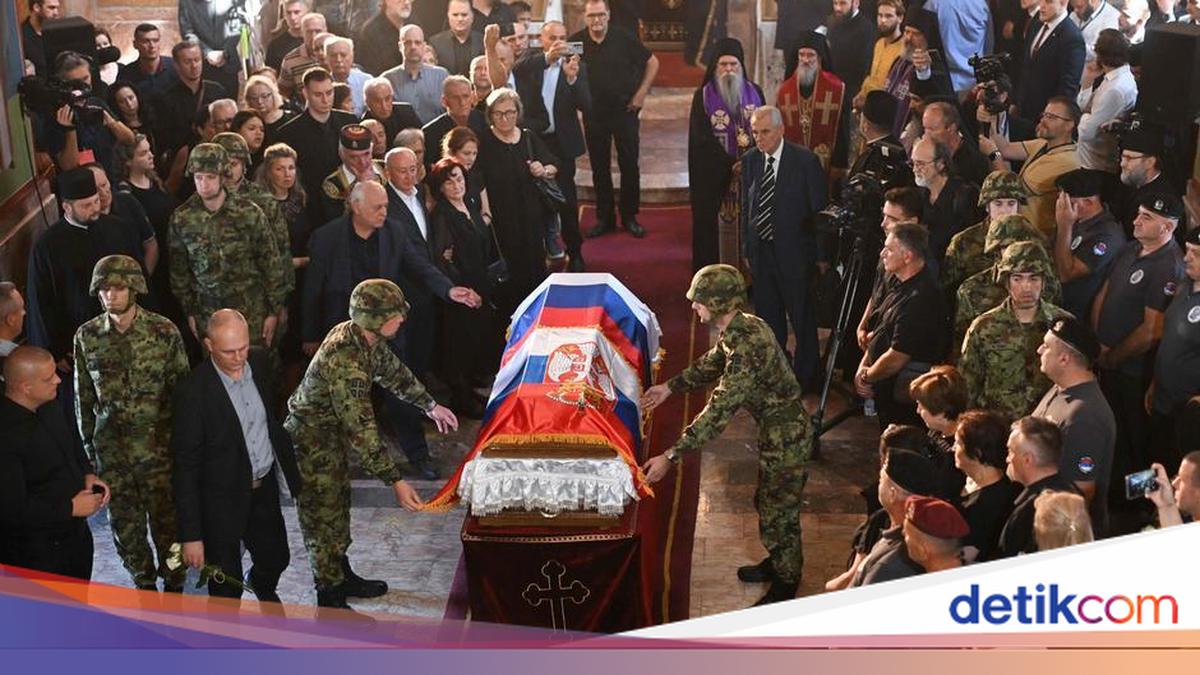
Thousands of people crowded the streets of Belgrade, Serbia, on Monday (07/09) to attend the funeral ceremony and burial procession of the former commander of the Bosnian Serb army, Ratko Mladic.
Earlier on the same day, Patriarch Porfirije, the highest leader of the Serbian Orthodox Church, led the funeral service for the former general. Mladic died while serving a life sentence in The Hague for genocide in Srebrenica and various other war crimes during the bloody conflict that accompanied the breakup of Yugoslavia in the 1990s.
In accordance with his wishes, Mladic was buried in the Topcider Cemetery, alongside his daughter who died by suicide in 1994.
Informer TV, a television station known for being highly supportive of the local government, broadcast live the event which they described as a “magnificent farewell”. The broadcast did not mention the approximately 8,000 Bosnian Muslim civilians and prisoners of war massacred by Bosnian Serb forces under Mladic’s command during the Srebrenica genocide in July 1995.
Serbian President does not attend funeral
Serbian President Aleksandar Vucic did not attend the funeral as he had to welcome a state visit from the President of Uzbekistan, which had been scheduled previously. Observers assess that Vucic is attempting to take a middle position regarding the controversy surrounding Mladic’s burial.
Mladic was not buried with state honours, but with military honours. Vucic emphasised that the state only respected the family’s wishes and ensured the funeral took place with dignity. “Should we forbid people from attending a funeral, forbid the funeral itself, and create dog graves?” he said when responding to criticism arriving from the European Union.
The term “dog graves” in Serbia refers to unmarked graves for those deemed “enemies of the people” who were executed by Yugoslav partisans during and shortly after the Second World War.
Vucic also condemned the decision by EU Enlargement Commissioner Marta Kos to cancel her visit to Belgrade. He described Kos’s reaction to the Mladic funeral controversy as “stupid”. Vucic responded to other criticisms regarding the glorification of Mladic with a similar tone.
An EU spokesperson said in a statement that “glorifying war criminals, denying genocide, and distorting history contradicts Europe’s fundamental values. Such things have no place in the European Union nor in EU candidate member states.”
Mladic’s funeral as a political test for the Serbian President
For Vucic, who has long sought to maintain a balance in Serbia’s relations with the European Union and Russia, the situation is politically quite complex. He is expected to announce parliamentary elections as early as this week, with voting likely to be held on 25 October.
For the first time in recent years, there is a real possibility that the ruling bloc could be defeated by the student movement, which has led anti-government demonstrations in Serbia for almost the past two years. Although currently serving as president, Vucic is expected to be nominated by the Serbian Progressive Party as the prime ministerial candidate in the upcoming election.
Bosnia and Herzegovina will also hold elections
According to Dejan Bursac, a political scientist from the Institute for Philosophy and Social Theory in Belgrade, Vucic appears increasingly worried about the upcoming elections. “Vucic is utilising every available opportunity,” Bursac told DW. “One of those opportunities is the Mladic funeral and the nationalist sentiment it can evoke, allowing Vucic to present himself as a patriot while portraying his political opponents as traitors.”
Bursac said many Serbians still harbour deep resentment regarding the outcome of the Yugoslav wars and believe that crimes committed against the Serbian ethnic group during the war have largely gone unpunished. “That sentiment is now being deliberately heated and exploited for political interests,” said Bursac.
Tanja Topic, a political analyst from Banja Luka in Republika Srpska, a region of Bosnia and Herzegovina where Srebrenica is located and the majority of the population is ethnic Serb, sees similar dynamics. “Politics here is very much based on emotion,” she told DW. “This issue is being used to mobilise citizens. They forget the difficulties of daily life because patriotic sentiment dominates.”
Bosnia and Herzegovina will hold elections before Serbia, on 4 October.
Student movement focus differs
In Serbia, the student movement, consisting of various protest groups and campus organisations, has chosen not to mention Mladic, his funeral, or war crimes extensively on social media. Analysts note that both Vucic’s party and the list of candidates supported by the student movement, which is expected to include professors, activists, and prominent public figures, are both attempting to create political platforms capable of appealing to various groups of voters.
In Serbia, this situation means that both President Aleksandar Vucic’s camp and the group supported by the student movement are equally unwilling to lose the support of nationalist voters. “Particularly because the election results will likely be determined by a very thin margin of votes,” said Dejan Bursac.
According to him, students realise that for many citizens, campaigning on the rule of law, democracy, and resistance to systemic corruption is sufficient. The protest movement began with student blockades of campuses following the collapse of a newly renovated canopy at a railway station in Novi Sad in November 2024, which killed 16 people. Although local prosecutors have opened several investigations, including those related to alleged corruption in construction contracts, no trials have been conducted to date.
Source: jawawa.id (https://jawawa.id/newsitem/mladics-funeral-becomes-political-test-ahead-of-serbian-elections-1788872583)
Originally published by detikcom (https://news.detik.com/dw/d-8654314/pemakaman-mladic-jadi-ujian-politik-jelang-pemilu-serbia), translated from Indonesian