
Mixed Asian Currencies Greet New Fed Face, Rupiah Moves Differently from Won and Others
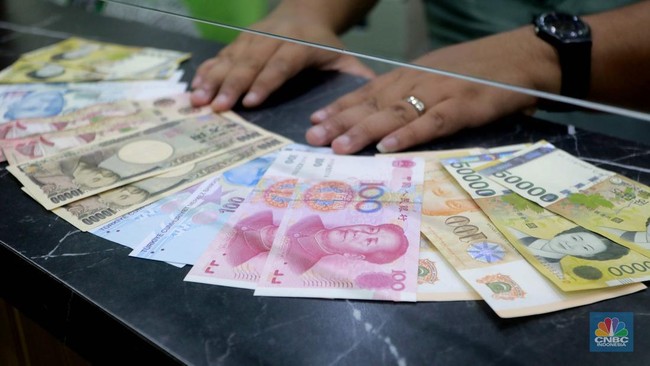
Asian currencies moved variably in Wednesday morning trading (22/4/2026), as market participants responded to the confirmation hearing of US Federal Reserve (The Fed) chair nominee Kevin Warsh.
According to Refinitiv data as of 09:15 WIB, out of eleven Asian currencies, five strengthened, five weakened, and one remained stagnant against the US dollar.
The largest gain was led by the South Korean won, which rose 0.36% to KRW 1,477.95 per US dollar.
The Vietnamese dong followed, strengthening 0.11% to VND 26,295 per US dollar. The Taiwanese dollar rose 0.10% to TWD 31.452 per US dollar, followed by the Singapore dollar up 0.09% to SGD 1.27 per US dollar. The Japanese yen strengthened 0.08% to JPY 159.24 per US dollar.
Meanwhile, the Indian rupee remained stagnant at INR 93.48 per US dollar.
On the other hand, the rupiah remained in the red after weakening 0.15% to Rp17,165 per US dollar. Although the rupiah opened with a slight gain of 0.06% at Rp17,130 per US dollar.
Market participants are also awaiting the outcome of the Bank Indonesia Board of Governors meeting this afternoon, particularly the BI Rate interest rate decision.
The Philippine peso faced the deepest pressure, falling 0.23% to PHP 60.08 per US dollar. This was followed by the neighbouring country’s currency, the Malaysian ringgit, which weakened 0.13% to MYR 3.95 per US dollar.
Meanwhile, the Thai baht fell 0.03% to THB 32.19 per US dollar, and the Chinese yuan weakened 0.02% to CNY 6.82 per US dollar.
The movement of Asian currencies this morning occurred as the US dollar index remained the main benchmark for market participants.
Although at the same time the DXY was seen weakening slightly by 0.05% to 98.342, the market continued to respond to the dollar’s strengthening at the previous trading close on Tuesday (21/4/2026), when the DXY rose around 0.30% following Kevin Warsh’s confirmation hearing in the Senate.
In his testimony, Warsh called for major reforms at the US central bank. He urged comprehensive changes in how The Fed controls inflation, while also assessing that The Fed’s communication methods need to be overhauled so that its officials do not provide too many forward policy guidance hints.
Markets interpret this message as a signal that if Warsh leads, The Fed’s approach could become more stringent and cautious, particularly regarding directing market expectations.
This tone is important for markets because it directly relates to the direction of interest rates. When a Fed leadership candidate emphasises inflation control and reducing the habit of giving early policy signals, market participants tend to assess that there will be no aggressive room for rate cuts.
In such situations, the US dollar usually gains easier support because sustained high interest rates make dollar assets more attractive.
In addition to the Warsh factor, the dollar was also supported by developments in the US-Israel war with Iran, which made markets doubt the ceasefire prospects again.
Concerns arose because Iran is said not to have decided whether to attend peace negotiations, after US forces boarded an Iranian oil tanker with only one day left in the ceasefire period. This situation has markets preparing for longer disruptions in the Strait of Hormuz, thus turning back to the dollar as a safe-haven asset.