
Mismanagement of Indonesia's Railway Safety
This article is a column; the entire content and opinions represent the personal views of the author and do not reflect the editorial stance.
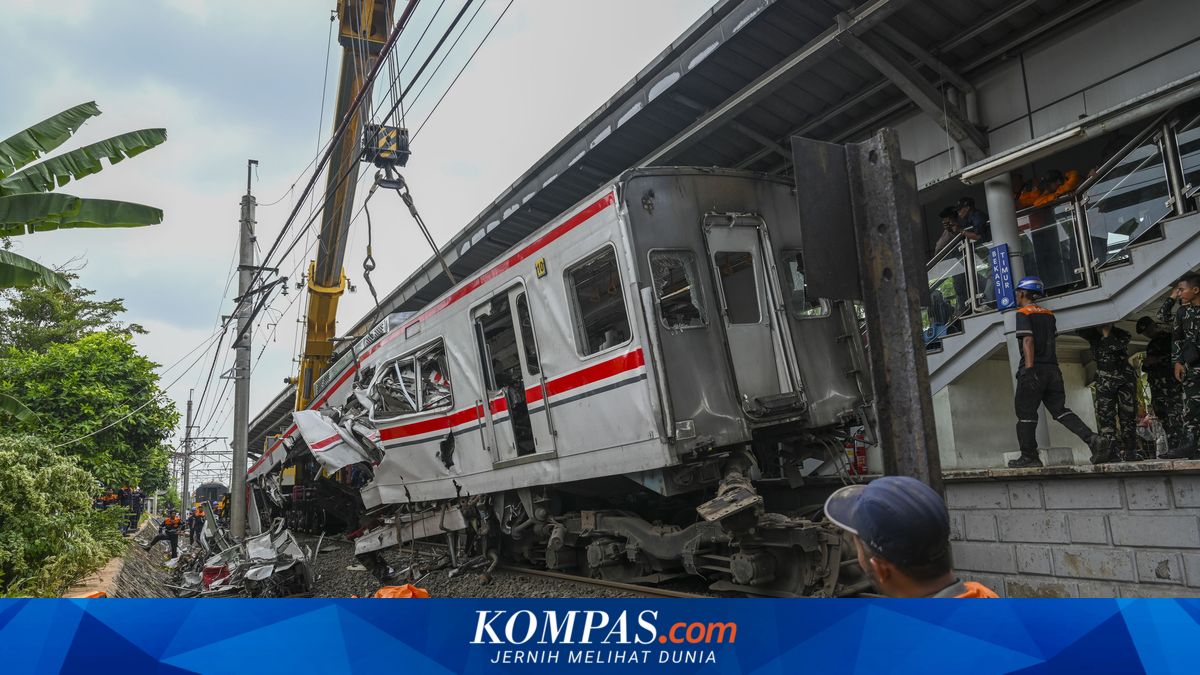
On Monday evening, 27 April 2026, at 20:52 WIB, at the platform of Bekasi Timur Station, the KA Argo Bromo Anggrek train collided with a stationary KRL Commuter Line train.
There is a journey home that will never arrive. There are families waiting with dinner menus that will never be touched.
With condolences to the victims and without diminishing empathy for them, as a regular user of KRL transport services, I feel the need to discuss this tragedy down to its root causes.
Rail accidents in Indonesia usually end with expressions of condolence. The news fades. We may even forget.
Yet, behind every accident, there are those who left in the morning without knowing it was their last.
Looking back, from 2007 to 2023, KNKT recorded 103 rail accidents. Derailments dominated at 62.14 percent. Collisions between trains accounted for 22.33 percent.
Collisions like the one in Bekasi are indeed in the rare category. Their consequences are far heavier than ordinary derailments.
What is even more glaring is the point of vulnerability. Nearly 70 percent of rail incidents in Indonesia originate from at-grade level crossings.
From hundreds of cases already analysed, 97 percent of them were caused by vehicles forcing through when signals or gates were active.
The pattern in Bekasi follows a classic sequence. The disruption begins at the level crossing. Then it spreads to the chain of signals and communication between trains.
The problem does not stop at the crossings. Indonesia uses Computer Based Interlocking (CBI). This system is computer-based and, in principle, quite advanced in preventing two trains from being in the same block.
Most routes also use automatic block signalling. Sensors on the tracks detect the presence of a train and change signal aspects according to the condition of the block ahead.
The critical issue to investigate is Automatic Train Protection (ATP). Without ATP, a red signal only serves as an advisory. The execution relies solely on the driver’s level.
At the speeds of long-distance trains, braking distance can reach 800 metres to one kilometre. A one-second difference between warning and response has, physically, already taken the decision away from humans.
Other countries have moved further. Japan has the Advanced Train Administration and Communications System (ATACS). This wireless communication-based system tracks train positions in real-time without track sensors (moving block system).
Whoosh in Indonesia uses the European Train Control System (ETCS Level 2).
The most congested conventional lines, including Jakarta-Bekasi-Cikarang, still rely on the older fixed block architecture.