
Misbakhun Provides Evidence Danantara Bonds Are Not Money Laundering Instruments
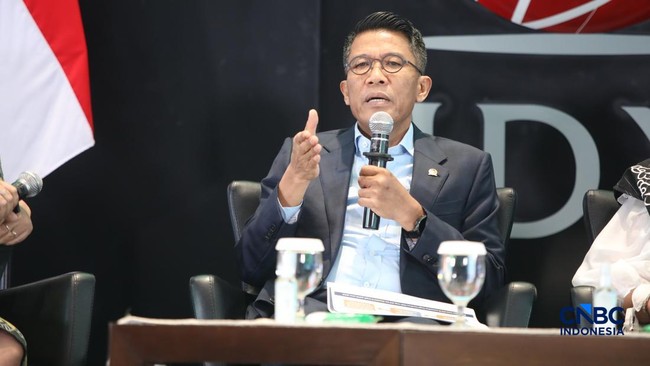
Jakarta, CNBC Indonesia — Mukhamad Misbakhun, Chair of the DPR’s Commission XI, has firmly denied claims that debt instruments of BPI Danantara, such as the Merah Putih Bond and Patriot Bond, could be used as money laundering vehicles through Article 50A of the Law on the Development and Strengthening of the Financial Sector (P2SK Law).
He said that if the drafting of the P2SK Law had accommodated money laundering through Danantara debt instruments, then purchases of such debt would have to be made in cash. In fact, he noted, debt transactions are carried out through primary dealers, which means they are certainly not cash transactions.
“They claim it is the biggest money laundering venue? No one invests carrying cash; they would certainly go through an investment manager,” said Misbakhun at the CNBC Indonesia Investment Forum 2026 in Jakarta on Wednesday (15/7/2026).
Misbakhun’s statement echoes an earlier assertion by the Financial Transaction Reports and Analysis Centre (PPATK). PPATK confirmed that the provisions of Article 50A of the P2SK Law cannot automatically be construed as increasing the risk of money laundering in Indonesia.
“PPATK takes the view that the issuance of Article 50A of the P2SK Law cannot automatically be interpreted as an increase in the risk of money laundering in Indonesia,” said PPATK Head Ivan Yustiavandana to CNBC Indonesia on Friday (3/7/2026).
According to Ivan, PPATK does not interpret Article 50A as weakening the enforcement capability of Indonesia’s anti-money laundering regime, let alone raising the risk of money laundering in the country.
“This is explicitly regulated in Article 50A paragraph (3) of the P2SK Law, which mandates that the implementation of Article 50A must be carried out in accordance with principles of good governance, adequate risk control, and managed in line with professional, accountable principles and sound business judgement — all of which are consistent with Indonesia’s AML/CFT provisions as well as FATF standards,” he said.
Furthermore, Ivan stressed that the provisions set out in Article 50A do not legalise or remove the criminal status of funds derived from criminal acts. The origin of such funds remains tainted as proceeds of crime if proven to be so.
“Article 50A only provides legal protection within a certain scope and at certain stages; it does not legitimise the proceeds of crime,” said Ivan.
He emphasised that Article 50A does not remove the obligation of Reporting Parties to apply the Know Your Customer Principle (PMPJ) or to submit Suspicious Financial Transaction Reports to PPATK.
“PPATK continues to carry out all of its financial intelligence functions in accordance with the Money Laundering Law. PPATK can still obtain data, conduct analysis, prepare analytical results, and convey them to law enforcement authorities,” he affirmed.
Source: jawawa.id (https://jawawa.id/newsitem/misbakhun-provides-evidence-danantara-bonds-are-not-money-laundering-instruments-1784109254)
Originally published by CNBC Indonesia (https://www.cnbcindonesia.com/market/20260715162628-17-751086/misbakhun-kasih-bukti-surat-utang-danantara-bukan-tempat-cuci-uang), translated from Indonesian