
Miracle as Two Workers Rescued After Nepal Devastated by Massive Floods
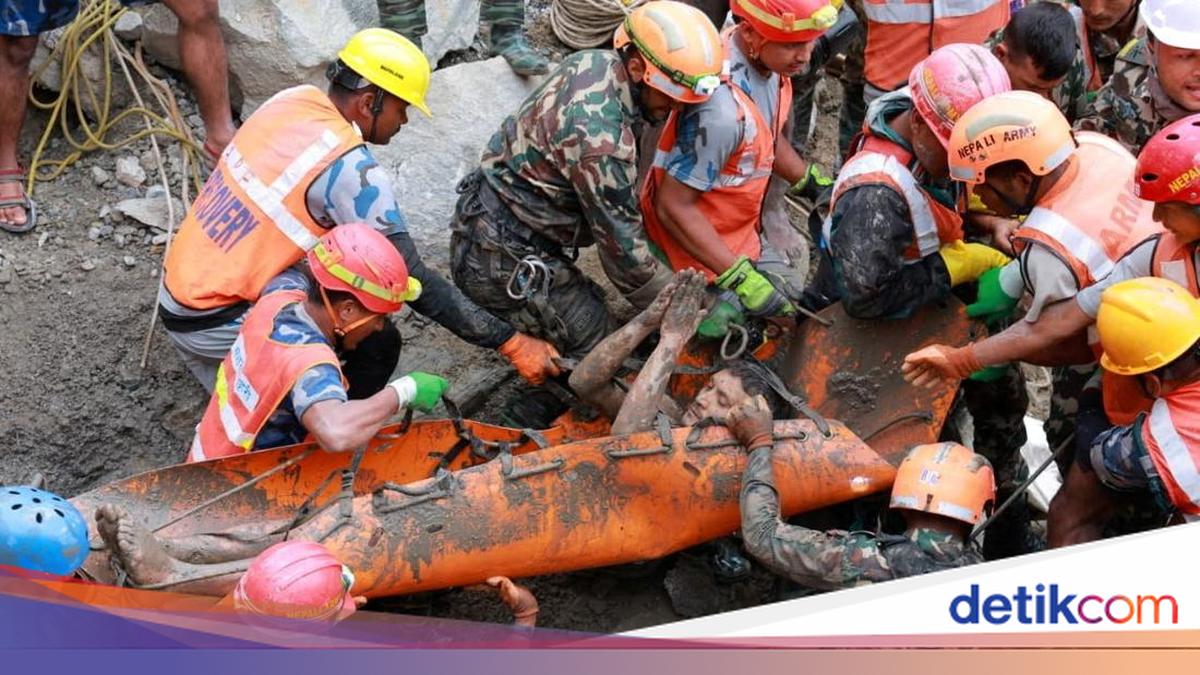
A miracle has unfolded as two individuals have survived after devastating flash floods struck Nepal. The two individuals were trapped for several days before being successfully rescued.
According to reports from Reuters, the two survivors are workers at a hydroelectric power plant (PLTA) on the Trishuli River in Nepal. They were trapped for nine days within a tunnel connected to the facility.
The two individuals were extracted from the Upper Trishuli 34 power plant tunnel on Friday (4/9) local time. The office of Nepal’s Minister of Energy, Biraj Bhakta Shrestha, identified the survivors as Sanjay Sah, a mechanical foreman, and Kabir Maharjan, a mechanical supervisor.
Video and photos released by Nepalese authorities show the moment Maharjan was pulled from a hole in the ground, met by cheers from onlookers, before being placed on a stretcher. Another worker, Sah, was carried by an official to a rescue tent with his face covered in mud.
In one released video, military medical teams can be seen examining Sah in an emergency tent built near the tunnel. They applied an oxygen-like mask to his mouth and checked his vital signs. A local military official stated, “His name is Sanjay Sah and he works in the mechanical control room. His vital parameters appear normal.”
While Sah’s injuries were reported as non-critical, a staff member for Nepal’s Minister of Energy informed Reuters that Maharjan was unable to move his arms or legs. Both were subsequently airlifted by helicopter to a hospital in Kathmandu.
The rescue operation utilised a WhatsApp group of experts to guide rescuers during the Search and Rescue (SAR) efforts at the hydroelectric project site. This method proved highly effective alongside helicopters and heavy machinery in the rapid effort to locate the survivors.
A tunnel development expert involved in the rescue explained to the BBC how they reached the survivors. Arnold Dix provided advice to Nepalese hydroelectric authorities on how to penetrate the tunnels, which had been blocked by mud and debris following last week’s flash floods.
“It was like layer upon layer of miracles,” said Dix, referring to the numerous challenges faced. The first obstacle was locating the power plant station amidst terrain that had been rendered almost unrecognizable by the floodwaters.
“I have never known a rescue operation where we had to search for a tunnel entrance that was previously on a hillside but was now underground. You can imagine the scale of the landslide, which completely buried the entrance,” said Dix, who is the President of the International Tunnelling and Underground Space Association.
Using engineering techniques, old topographic maps, post-disaster satellite imagery, helicopter video footage, and surface landmarks such as utility poles, Dix and his team estimated the entrance position and began digging. Although they found the entrance, the next challenge was locating the survivors.
“We knew they were ahead, but we did not know exactly where. So we had to start digging in the right direction and listen to see if we could hear anyone,” he said. The SAR team had to penetrate tunnels completely blocked by mud and rocks, some larger than cars. They even had to use explosives to clear a path, a high-risk move that threatened both the survivors and the rescuers.
Ice, rock, and mud landslides swept through the valley in the Nepal region bordering Tibet, China, last Wednesday (26/8). Officials believe a glacier collapse upstream on the Trishuli River on 26 August trapped at least 900 people within tunnels associated with six hydroelectric projects along the river.
At least 1,252 people have died in the Nepal region as houses, roads, and schools in various towns and villages near the Tibetan border were hit by the massive flash floods. More than 4,200 others remain missing, and thousands have been forced to evacuate. Chinese authorities have recorded at least 21 deaths in Tibet, with 541 others reported missing.