
Ministry Strengthens Industry Partnerships to Boost Vocational School Human Resources
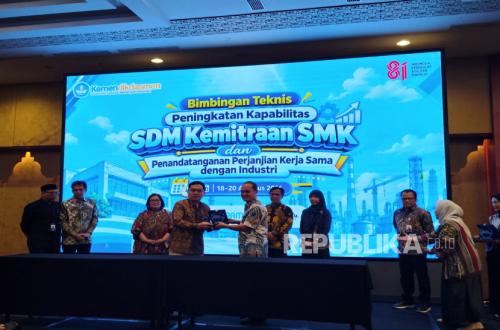
Improving the quality of human resources at vocational secondary schools (SMK) is a key factor in creating vocational education that is relevant to the needs of the world of work, business and industry. In an era of educational transformation and rapid technological development, SMKs are required to produce graduates who are competent, adaptive and competitive according to labour market needs.
One strategy to achieve this goal is strengthening partnerships between SMKs and industry, universities, regional governments and other stakeholders. The Ministry of Primary and Secondary Education therefore held an activity on improving partnership human resource capabilities and the signing of cooperation agreements between SMKs and industry in Yogyakarta on Wednesday.
Director General of Secondary Education and Special Education, Tatang Muttaqin, said that industry brings new technology and market insights that are increasingly needed by SMK graduates. Without industry involvement, what is done at school, even with the hardest effort, may not match or may even lag behind what exists in industry and business.
Tatang said that amid economic conditions in recent years, the unemployment rate for SMK graduates has continued to decline. When he first joined the Directorate General of Vocational Education two years ago, the figure had fallen by four percent from around 12 percent to around 9 percent. The challenge now is to reduce the unemployment rate further to below 5 percent.
He noted that in Europe the unemployment rate is always around 3 percent, which is considered good because eliminating it entirely is impossible. He therefore stressed the importance of schools collaborating with industry. However, there are challenges because the climate in Indonesia differs from European countries such as Switzerland and Germany, where industry and vocational schools are equally numerous.
In Indonesia, vocational schools are growing exponentially while industry is relatively stagnant. In this position, the bargaining power of SMK students to obtain internships in industry is not easy. Industry will choose SMKs with a good track record, creating a significant gap between internship demand and industry availability. Through the current cooperation, he hopes that more internship students will be absorbed, including those from SMKs in rural areas.
Another challenge, according to Tatang, is digitalisation, which is accelerating the obsolescence of school curricula. He sees the need to strengthen the soft skills of SMK students. Besides hard skills, soft skills are key. The ministry wants to emphasise improving learning quality that is not only more relevant but also flexible enough to ensure SMK students are adaptable and responsive to change.
The relationship between SMKs and industry must not stop at cooperation agreements but must continue in daily practice, because industry moves very quickly. Teachers must be able to keep pace with these rapid movements.
Division Head of PT Astra Daihatsu Motor, Ferry Nugroho, welcomed the cooperation agreement. He said existing cooperation has been quite good, and his institution often provides coaching to students and teachers to bring an industrial atmosphere to schools. Students thus feel familiar with the industrial environment. The programme brings industrial culture, habits and practices to schools and introduces them to students early.
Ferry said the partnership programme is highly beneficial for both parties. When internship offers were opened generally, the chance of SMK students passing selection could be 1 in 100. After the company intensively coached SMKs, introduced curricula suited to needs, and familiarised students with the company’s work culture, the chance became nearly 1 in 1, meaning the probability of passing is almost 100 percent.
A similar experience occurred in the hospitality sector. Cluster General Manager of Grand Mercure & Ibis Yogyakarta Adisucipto, Pupung Sutisna, said training programmes have become an entry point for students to develop skills before truly entering the workforce. The hotel is very open to receiving and giving opportunities to SMK students, especially for training at the hotel. This is a very good opportunity for students to gain experience and get to know the world of work directly.
Pupung said some trainees he had coached were later hired as employees. Training programmes can last from six months to one year, a period used to equip students and assess their readiness before entering the workforce. He believes opportunities for SMK students to obtain training and work experience are increasingly open, and cooperation between schools and industry needs to be continuously strengthened. The hotel synergises strongly with tourism and hospitality schools to continue coaching them.
Source: jawawa.id (https://jawawa.id/newsitem/ministry-strengthens-industry-partnerships-to-boost-vocational-school-human-resources-1787136863)
Originally published by Republika (https://rejogja.republika.co.id/berita/tk0gm4291/tingkatkan-sdm-pada-smk-kemendikdasmen-kuatkan-kemitraan-dengan-dunia-industri), translated from Indonesian