
Ministry pushes science to preserve local traditions
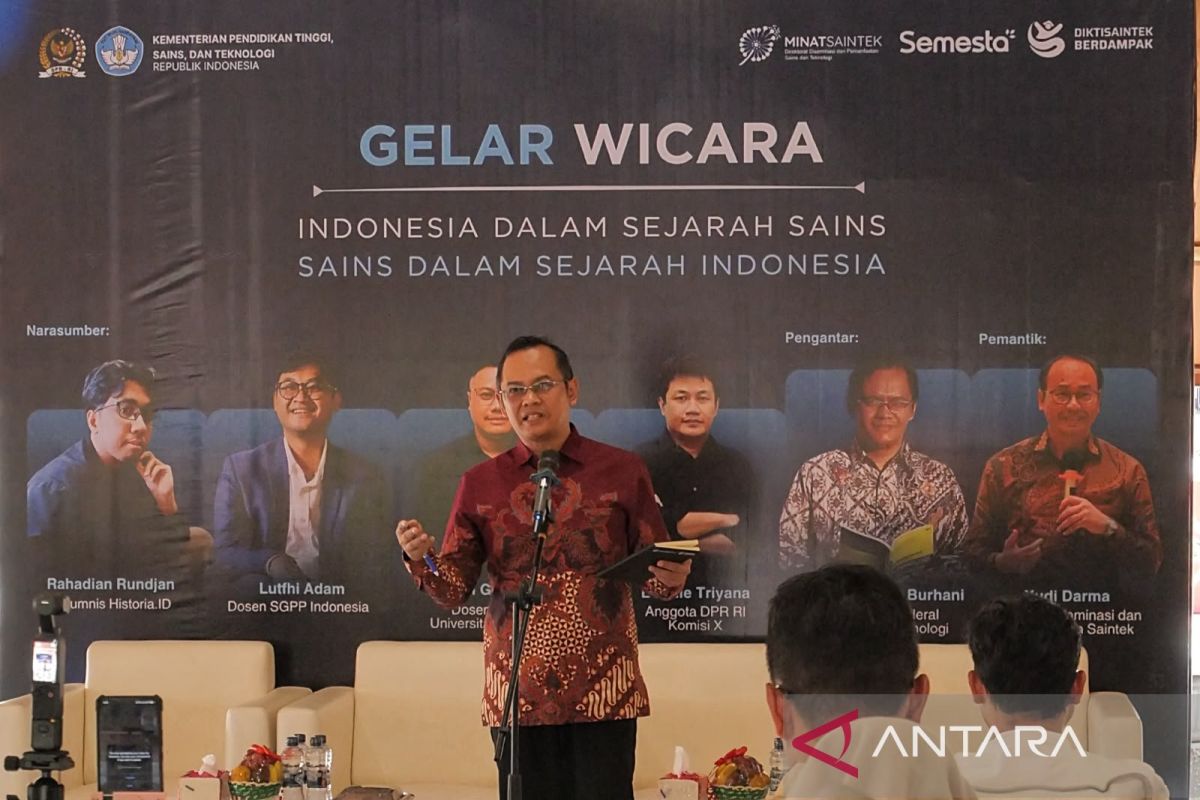
The Ministry of Higher Education, Science, and Technology (Kemdiktisaintek) is encouraging the strengthening and implementation of a scientific culture within society to support the preservation of history, culture, and local traditions across the country. Director General of Science and Technology at Kemdiktisaintek, Ahmad Najib Burhani, stated in Jakarta on Monday that history shows science is not something foreign to Indonesia. “Knowledge traditions have developed in Nusantara society through empirical experience in shipping, agriculture, medicine, astronomy, maritime technology, and environmental management. Science is part of the long journey of Nusantara civilisation that needs to be continuously developed to answer future challenges,” he said.
Najib added that revisiting history is important for building a scientific culture and national self-confidence. He noted that the knowledge that has grown must be continuously nurtured and re-examined, while also being brought together with contemporary scientific developments. “Science must not only grow in laboratories or on campuses, but must be present in everyday life, become the basis for decision-making, and encourage the birth of innovations that benefit society,” he stated.
Director of Dissemination and Utilisation of Science and Technology (Minat Saintek) at Kemdiktisaintek, Yudi Darma, explained that the challenge of strengthening scientific culture is not only related to the level of public trust in science, but also to public involvement in scientific activities and conversations. He revealed that the 2025 National Survey on Perception and Interest in Science and Technology, conducted with the Indonesian Survey Institute (LSI) involving 1,203 respondents, showed that 87.9 per cent of the public trust science and 81.1 per cent trust scientists and researchers. However, these figures have not been matched by public participation in science and technology. “As many as 88.2 per cent of the public are not involved in science and technology activities, 74.1 per cent admit they have never discussed science and technology, and 87.3 per cent rarely, or it could be said never, read scientific journals or books in the past year,” he explained.
Yudi said this condition shows that public trust in science has grown, but more spaces are still needed so that the public can discuss, interact with the scientific process, and understand how knowledge is formed and tested. Therefore, science dissemination needs to move beyond merely conveying research results. Public spaces, museums, history, and community experiences can serve as entry points to bring scientific thinking closer to the public.
Similarly, Member of Commission X of the Indonesian House of Representatives (DPR RI), Bonnie Triyana, stressed the importance of viewing the history of science more openly towards the diversity of knowledge sources. “Local knowledge does not need to be pitted against modern science, but needs to be elevated, critically examined, and elaborated upon in the development of science,” said Bonnie. Bonnie then raised the idea of the pluriversality of knowledge, namely the recognition that knowledge can grow from diverse experiences, cultures, and community contexts. He explained that this approach does not mean rejecting scientific rationality, but rather prevents science from adopting a single perspective that could ignore knowledge that has long lived within society. “Within this framework, traditional knowledge can become an important source for further research. Science can play a role in testing, validating, explaining, and developing local knowledge so that it can be understood more widely and provide benefits to society,” concluded Bonnie Triyana.