
Ministry of Villages and Disadvantaged Regions Collaborates with Barisan 8 Center to Develop 5,000 Export Villages
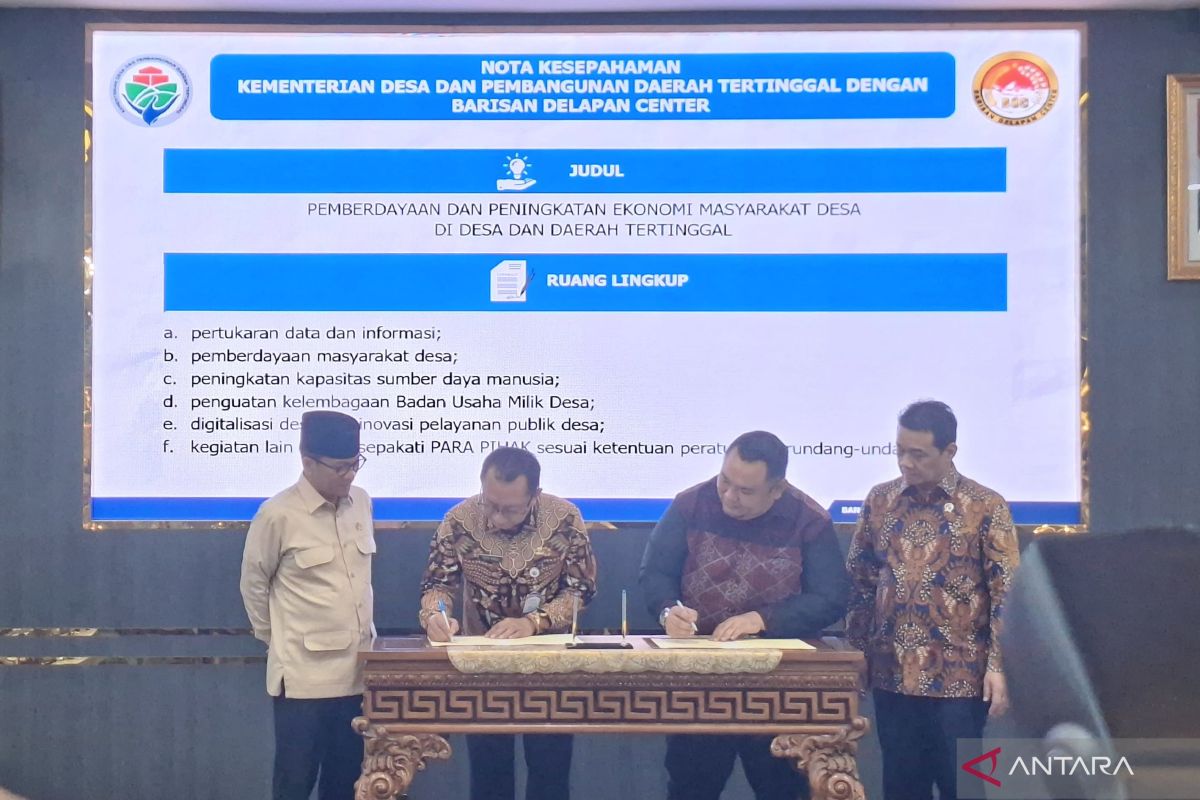
Jakarta (ANTARA) - The Ministry of Villages and Disadvantaged Regions (Kemendes PDT) is collaborating with several organisations, including Barisan 8 Center, in a cross-sectoral partnership to accelerate village development, targeting the establishment of 5,000 export villages throughout Indonesia.
The Minister of Villages and Disadvantaged Regions (Mendes PDT), Yandri Susanto, stated that this collaboration is part of the central government’s strategy that places villages as subjects, not merely objects of development.
“We are a support team, not Superman. The government cannot work alone in building villages; all elements must be actively involved and have sponsored villages according to the potential of their respective regions,” Yandri said after the signing of a memorandum of understanding (MoU) and cooperation agreement at the Kemendes PDT office in Kalibata, Jakarta, on Tuesday.
Yandri explained that the development of export villages is one of the 12 priority actions for village development. Currently, several flagship commodities, such as coffee, vanilla, candlenuts, and palm sugar, have successfully penetrated international markets.
Through this partnership, Kemendes PDT aims to accelerate the transformation of villages to become more independent and competitive, while also resolving fundamental issues such as access to clean water, electricity, and signal-free areas.
“If there is empowerment, there must be accompaniment. We want to build the perception that villages are centres of economic growth. If villages advance, Indonesia will advance,” he emphasised.
Meanwhile, the General Chairman of Barisan 8 Center, Andrio Caesario, expressed his readiness to partner with the government in strengthening global market access for village products.
The primary focus of the organisation is to ensure that village natural resource outputs provide direct economic added value to farmers.
“We help find export markets and ensure supportive regulations, so that village products have global competitiveness. For the initial stage, West Java is one of the pilots with a focus on Arabica coffee commodities,” said Andrio.
In addition to market access, the organisation is also preparing technological support in the form of a village potential mapping application based on geotagging. This system contains data on land area to commodity quality in depth.
He hopes that this collaboration can strengthen the rural economic ecosystem in line with President Prabowo Subianto’s directives to equalise welfare and eradicate poverty from the lowest levels.