
Ministry of UMKM, ITBAD Jakarta and UM Maluku Promote Inclusive Micro-Enterprise Empowerment Based on Al-Ma'un Theology with a Women's Perspective
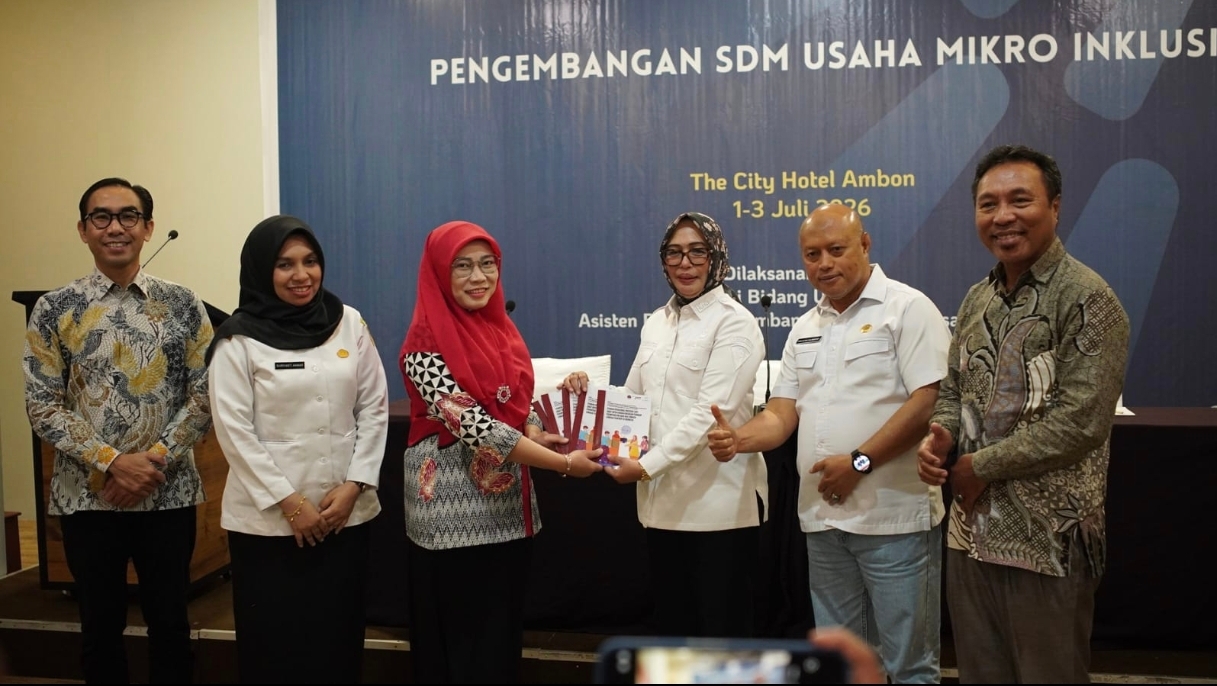
The development of micro-enterprises requires more than just access to capital. Strengthening human resource capacity, providing sustainable mentorship, and supporting vulnerable groups, especially female heads of households, are crucial foundations for building an inclusive economy.
This message was emphasised during the Inclusive Micro-Enterprise Human Resource Development event held by the Ministry of UMKM in collaboration with the Ahmad Dahlan Institute of Technology and Business (ITB) Jakarta and the University of Muhammadiyah Maluku at The City Hotel Ambon from 1 to 3 July 2026.
In the first session, the Head of the Centre for Islamic, Women and Development Studies (PSIPP) at ITB Ahmad Dahlan Jakarta, Yulianti Muthmainnah, presented an economic empowerment model based on Al-Ma’un Theology with a Women’s Perspective (TABP) using 30 indicators. The majority of poor families meeting these 30 indicators are women who are victims of domestic violence, poor widows, and those with more than two children.
“The core spirit of TABP teaches that worship of God must be accompanied by a willingness to share with others. Without social concern, worship loses its meaning. Therefore, community empowerment is part of the implementation of Islamic values,” she told dozens of women MSME actors.
She explained that through TABP, students do not just learn theory in the classroom but are required to conduct direct observations in the community, create village maps, and identify poor families using the 30 indicators together with residents. Students then interview potential beneficiaries identified from the village map, raise donations, and distribute them in the form of business tools, not cash.
“This model is designed so that assistance does not stop at a charitable approach, but truly encourages the economic independence of the beneficiaries,” she said.
Yulianti revealed that since its launch in 2017, the TABP programme has targeted women who are the backbone of their families, a group often overlooked by government and social institution programmes. “The reality of women as family breadwinners is undeniable. They work as domestic helpers and survive in difficult economic conditions. Yet this group receives the least assistance,” she explained.
From this mentoring, PSIPP found that the poverty experienced by female heads of families is multidimensional. The issues are not just a lack of business capital, but also involve power relations in the social environment, debt traps, and various cultural barriers that make it difficult for them to escape the cycle of poverty.
TABP is a form of Al-Islam and Kemuhammadiyahan (AIK) education in Muhammadiyah-Aisyiyah Higher Education Institutions aimed at integrating gender issues into the curriculum to eliminate six forms of violence. Through TABP, the programme contributes to helping victims of domestic violence become economically empowered.
“Therefore, economic empowerment must be seen as a sustainable process. It is not enough to just provide assistance; we must also mentor them so that their businesses truly grow,” she said.
Furthermore, according to Yulianti, the implementation of TABP has had a significant impact not only on the beneficiary communities but also on the students. “This programme fosters social empathy and an entrepreneurial spirit among students. Even after the course ends, many students continue the businesses they started during the programme,” said the AIK lecturer.
The concept of women’s economic empowerment based on TABP presented by the Head of PSIPP was one of the main topics of the event. The session was attended directly by the Deputy Mayor of Ambon, the Rector of the University of Muhammadiyah Maluku, the Head of the Maluku Province Cooperatives and SMEs Office, the board of the University of Muhammadiyah Maluku, and the Muhammadiyah Regional Leadership of Maluku.
Deputy Mayor of Ambon, Ely Toisutta, assessed that the theme is highly relevant to the economic development challenges in Maluku. “The main issues we face today are market access, technology utilisation, and sustainable business development. Most of our MSMEs are also managed by resilient women who are the driving force of the family and regional economy,” he said while officially opening the Inclusive Micro-Enterprise Human Resource Development event. He expressed hope that the training would serve as a learning space for business actors to improve their business quality and expand access to various development opportunities.
Rector of the University of Muhammadiyah Maluku, Faris Al Fadhat, stated that capacity building for business actors is a long-term investment no less important than capital support. “Capital is important to start a business, but it is equally important for business actors to continuously develop their capacity so their businesses can survive and grow. Universities have a responsibility to provide community mentoring as part of the Caturdharma of higher education,” he said. He added that the University of Muhammadiyah Maluku is committed to being a collaborative space that brings real benefits to the people of Maluku through various community service programmes.
Meanwhile, the Head of the Maluku Province Cooperatives and SMEs Office, Suriyanti Anwar, encouraged all participants to use the training as an opportunity to improve their competence. “Do not see this activity as a mere ceremony. Make this a moment to learn and increase your knowledge so that your businesses can develop better. We are also continuously assisting MSME actors with business legality arrangements and hope this service can reach all districts in Maluku,” she said.
Source: jawawa.id (https://jawawa.id/newsitem/ministry-of-umkm-itbad-jakarta-and-um-maluku-promote-inclusive-micro-enterprise-empowerment-based-on-al-maun-1783043426)
Originally published by Media Indonesia (https://mediaindonesia.com/ekonomi/906988/kementerian-umkm-itbad-jakarta-dan-um-maluku-dorong-pemberdayaan-usaha-mikro-inklusif-berbasis-teologi-al-maun-berperspektif-per), translated from Indonesian