
Ministry of Transportation Urges Travellers to Schedule Trips and Halt Illegal Balloons
The Ministry of Transportation is reminding the public to anticipate a potential surge in return traffic expected to increase after the Lebaran Ketupat celebrations on 28 March 2026. The peak of Lebaran return traffic is projected to occur on 24, 28, and 29 March 2026. This tradition could drive further movement of the population, who will return to their hometowns in a short time ahead of the end of the holiday period on Monday (30 March 2026).
Head of the Bureau of Communication and Information at the Ministry of Transportation, Ernita Titis Dewi, emphasised that the weekend period, particularly Saturday (28 March 2026) and Sunday (29 March 2026), has the potential to become a concentration point for return traffic. Titis stated that public movement tends to cluster in a relatively short time.
“This needs to be anticipated because it has the potential to cause density on main road routes, both toll and arterial, as well as at transport nodes,” said Titis in a written statement in Jakarta on Friday (27 March 2026).
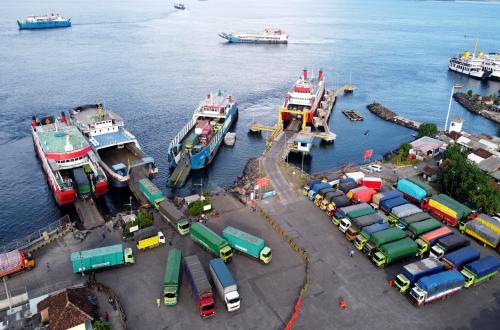
She explained that, besides land roads, crossing nodes are crucial points that require special attention. Crossing routes such as Bakauheni and Ketapang are expected to experience a significant increase in vehicle and passenger volume if not balanced with good travel time scheduling by the public.
Titis conveyed that optimisation of buffer zones and delaying systems will be implemented to disperse queues of vehicles heading to the Ketapang Port area. Similarly, scheduling for two-axle goods vehicles not subject to restrictions needs to be monitored to ensure smooth operations.
“Buffer zones for four-wheeled vehicles and buses are allocated at Gran Watudodol and Bulusan Parking Pocket. Meanwhile, for goods vehicles, buffer zones are at Sri Tanjung and PT Pusri and Pelindo Parking Pockets,” Titis added.
Titis outlined another strategy involving ferry operations. Under normal conditions, 28 ferries operate. However, during dense conditions, 30 ferries will operate, and during very dense conditions, there will be 32 ferries operating.
As another anticipatory measure, the Ministry of Transportation, together with the police, local governments, and transport operators, has prepared various control scenarios, including field-based traffic arrangements, optimisation of crossing transport capacity, and strengthening operational services at ports and main distribution routes.
“Intensive monitoring is also conducted to ensure that safety and smoothness of travel remain maintained, including aspects of transport facility seaworthiness and personnel readiness in the field,” said Titis.
Nevertheless, Titis added, the ministry stresses that the effectiveness of these efforts greatly depends on public participation in managing travel times. “We urge the public not to travel simultaneously during peak times. Scheduling departures, maintaining physical condition, and ensuring vehicles are roadworthy are important factors in supporting smooth return traffic,” Titis continued.