
Ministry of Transport: Mass transit key to tackling congestion and high costs
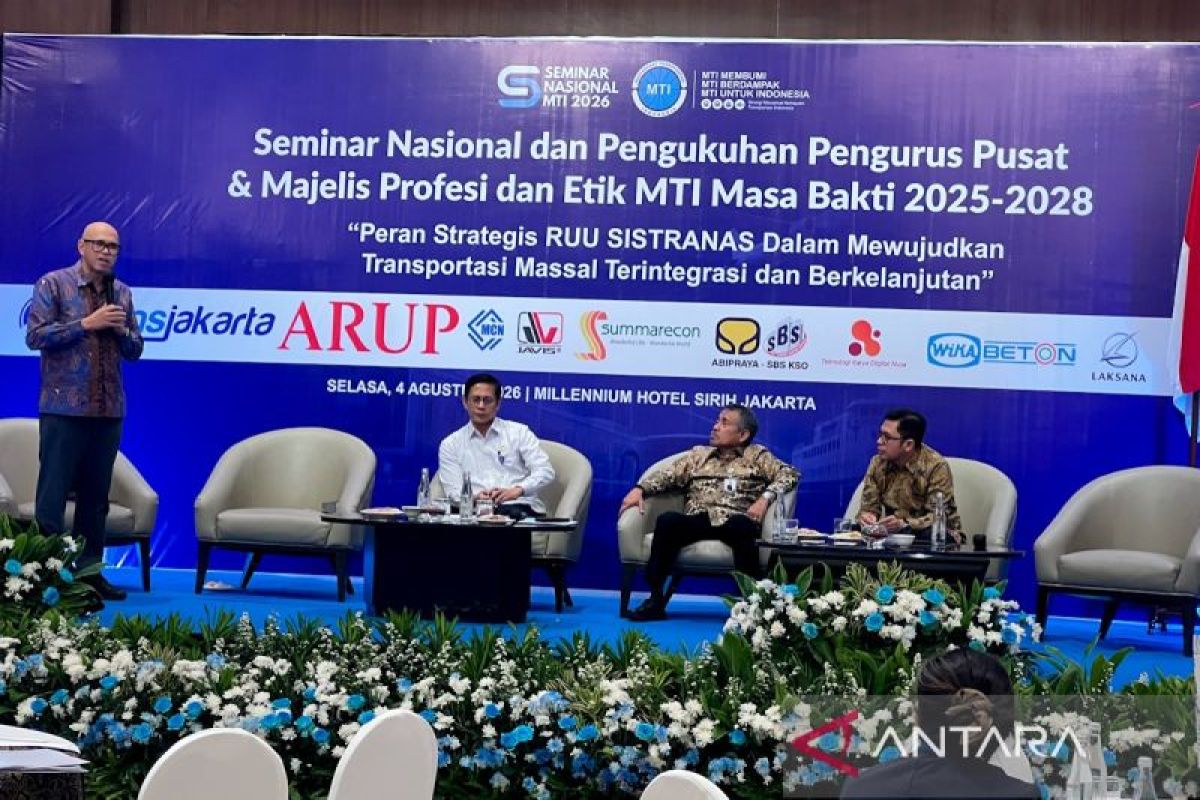
Integrated and sustainable mass transit is the answer to the problems of congestion, expensive transport costs and the public’s heavy dependence on private vehicles.
Jakarta (ANTARA) — The Ministry of Transport (Kemenhub) has stated that integrated and sustainable mass transit is the solution to congestion, high travel costs and the public’s dependence on private vehicles in urban areas.
“Integrated and sustainable mass transit has arrived as the answer to the problems of congestion, the high cost of transport and the public’s heavy dependence on private vehicles,” said Muiz Thohir, Director of Road Transport at the Directorate General of Land Transport, Ministry of Transport, in Jakarta on Tuesday.
Muiz emphasised the point whilst speaking at the Indonesian Transport Society (MTI) National Seminar titled “The Strategic Role of the National Transport System Bill in Realising Integrated and Sustainable Mass Transit”, held in Jakarta.
The Ministry affirmed that urban mobility is a basic need underpinning the vision of Golden Indonesia 2045.
“Although the foundations have been laid by the central government, the ultimate determinant of success lies in the political will and fiscal commitment of the regions,” said Muiz.
According to the ministry’s latest data, he noted, there are 172.9 million motor vehicles, growing at 4.5 per cent per year, burdening road infrastructure. Losses from traffic congestion nationally are estimated at Rp77 trillion per year.
Muiz said the urban transport sector carries a heavy burden, with transport costs reaching 16 to 24 per cent of total household income according to 2023 data from Statistics Indonesia (BPS), far exceeding the SDG 11.2 standard of 5 per cent.
Moreover, the transport sector absorbs the bulk of energy subsidies — up to Rp300 trillion per year — amid the reality that 58 per cent of the population works in the informal sector earning below the provincial minimum wage (UMP).
He stressed that affordable mass transit is key to supporting the 8 per cent economic growth target, as it broadens people’s access to jobs, education and public services, thereby boosting productivity and equitable national development.
“As a concrete step, the government has rolled out the Indonesia Mass Transit Project (MASTRAN Project), which prioritises development in 20 urban areas over the medium term,” he said.
Currently, the Mebidang area (Medan, Binjai, Deli Serdang) and the BBMA/Bandung Basin Metropolitan Area (Bandung City, Cimahi City, Bandung Regency, West Bandung Regency and Sumedang Regency) are serving as pilot projects with financing support from the World Bank and AFD.
“In the Mebidang area, the project covers 21 km of dedicated lanes, 31 on-corridor stops and 681 off-corridor stops, 12 routes and 273 buses, with a projected 154,851 passengers per day at the start of operations in 2027, integrated with 109 ATCS intersections,” he added.
He further noted that in the BBMA area (Bandung), the project covers 21 km of dedicated lanes, 34 on-corridor stops and 719 off-corridor stops, 18 routes and 478 buses, with a projected 204,736 passengers per day, integrated with 65 ATCS intersections.
The project’s key success indicators (PDO) include the establishment of a management institution, improved access to employment, reduced travel times, increased daily ridership, user satisfaction and greater employment of women.
“The MASTRAN Project is currently in the construction phase and the preparation of BRT management institutions in BBMA and Mebidang. The BRT management institutions are targeted to be established by November 2026, and construction work is targeted for completion in March 2027,” said Muiz.
He explained that an evaluation of the project’s implementation would subsequently form an important foundation in drafting the National Transport System Bill (RUU Sistranas).
The challenges on the ground, he said, reveal limited central and regional fiscal capacity, the fact that urban mass transit services are not yet a priority, and obstacles in agreeing on the division of public service obligations (PSO) between regional governments in agglomeration areas.
In addition, transport operators’ institutions in the regions have not all been established, and synchronisation of central and regional regulations remains suboptimal.
“Therefore, the RUU Sistranas is greatly needed to provide a legal umbrella for the regulation of creative funding, the regulation of mandatory spending (earmarking) for the provision of urban mass transit, and the regulation of a standard and firm institutional form for urban mass transit,” he said.
Source: jawawa.id (https://jawawa.id/newsitem/ministry-of-transport-mass-transit-key-to-tackling-congestion-and-high-costs-1785858870)
Originally published by Antara (Indonesian) (https://www.antaranews.com/berita/5680048/kemenhub-transportasi-massal-kunci-atasi-kemacetan-dan-biaya-tinggi), translated from Indonesian