
Ministry of Social Affairs Maps Social Welfare Conditions Through 2026 IKESOS Technical Guidance
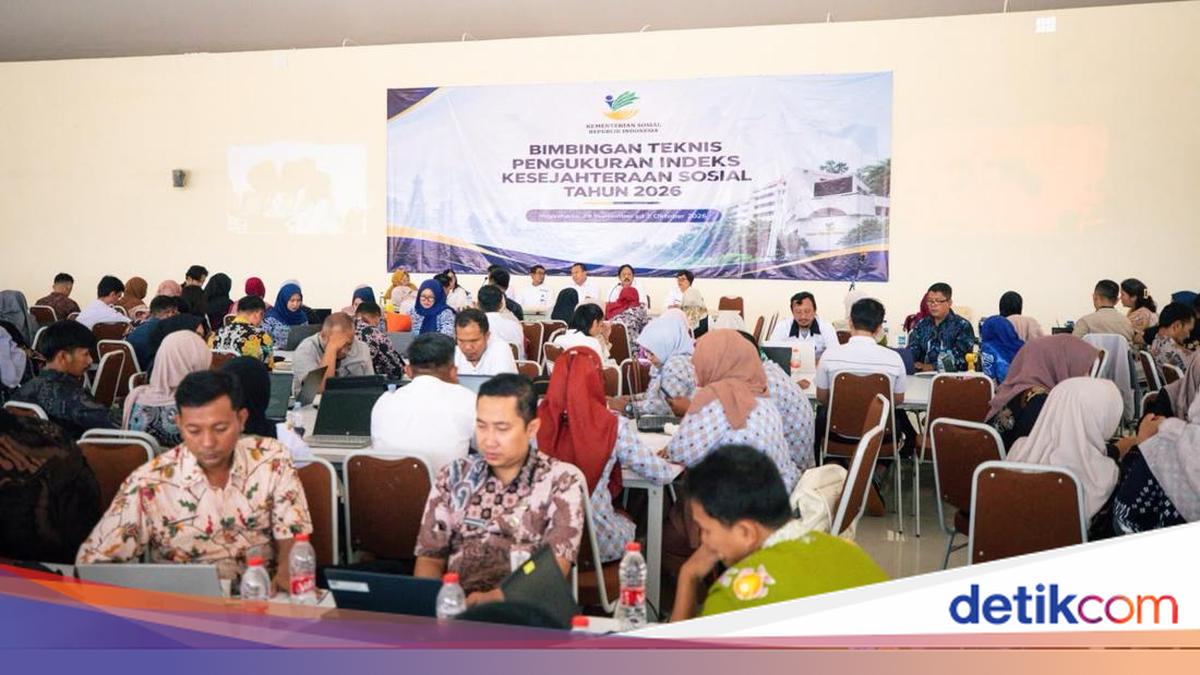
The Ministry of Social Affairs is optimising the 2026 Social Welfare Index (IKESOS) measurement at both central and regional levels through technical guidance (Bimtek).
Taking place via a hybrid format from 29 September to 2 October 2026, the activity is designed to obtain a more objective and measurable overview of social welfare conditions. “IKESOS is not merely a task imposed by the central government, but a collective necessity to map social welfare conditions,” stated Suharma, Director of the Bandung Polytechnic of Social Welfare, in a written statement on Thursday (1/10/2026).
Suharma noted that the technical guidance is intended to provide a comprehensive picture of public welfare. The measurement encompasses three dimensions: Basic Needs, Social Role, and Economic Empowerment.
The technical guidance sessions are being held in three locations representing the western, central, and eastern regions of Indonesia: Medan, Kulon Progo, and Jayapura. Specifically in Kulon Progo, the event was held at the Integrated People’s School Hall 1, attended by 495 participants from 20 provinces and 125 regencies/cities.
Participants include managers and verifiers from the central level as well as regional officials handling social affairs and data management. They are learning to understand IKESOS measurements through the Basic Needs dimension, which includes food and nutritional security, health, social security, housing, education, safety, and physical mobility.
Additionally, the Social Role dimension covers participation, social cohesion, and inclusive institutions, while the Economic Empowerment dimension includes utility, economic resilience, and economic participation.
“Does an economically wealthy region automatically possess a high Social Welfare Index? Not necessarily. The economic aspect might be high and basic needs met, but the social role could be low,” Superma remarked.
Based on the 2025 measurements, the national IKESOS score was recorded at 50.56, placing it in the ‘Advanced’ category. For 2026, the national target for IKESOS has been set at 62.09, with a medium-term target of 69.80 by 2029.
The Head of the DIY Social Affairs Office, Suyarno, explained that the IKESOS measurement is a multi-sectoral and multi-data task that requires collaboration and high-quality data. “We hope that through this technical guidance, the Social Welfare Index in each province and regency/city can truly reflect the real conditions of their respective regions. This is a shared challenge, particularly in building collaboration, data interoperability, and maintaining data accuracy and quality,” said Suyarno.
The results of the IKESOS measurement can serve as a reference for local governments in drafting planning documents. At the central level, the results can be used for social mapping and identifying welfare aspects or indicators that need strengthening in specific regions.
The Head of the Kulon Progo Regency Social Affairs, Empowerment, and Child Protection Office, Ernawati Sukeksi, assessed that the IKESOS measurement helps synchronise perspectives on community welfare, as social conditions cannot always be viewed through a single indicator.
“Behind those figures lie various social issues, such as children needing access to education, the elderly requiring equipment and health insurance, and various other social problems,” said Ernawati.
In addition to receiving briefings on policies, concepts, dimensions, and IKESOS measurement mechanisms, participants also participated in demonstrations and practical use of the IKESOS application. The practice utilised training data according to individual roles, ranging from data entry and uploading supporting evidence at the regency/city level, to verification and data transmission at the provincial level, and finally verification, validation, processing, and data calculation at the central level.
Following the technical guidance, the 2026 IKESOS measurement process will proceed through stages of data collection and entry, verification of supporting evidence, processing, submission of preliminary results, an appeal period, final verification, and the official ratification of final results on 4 December 2026.
The IKESOS measurement results will subsequently be used to assess social welfare conditions in each region. This data will also serve as a primary resource for the government in formulating social planning, policies, and programmes.