
Ministry of Social Affairs Guides Regional Operators on PBI-JK Health Insurance Reactivation
Jakarta (ANTARA) - The Ministry of Social Affairs has provided technical guidance on the reactivation of subsidised Health Insurance Premium Assistance (PBI-JK) membership to data operators at social services offices across Indonesia, in order to ensure healthcare services reach their intended recipients.
The socialisation event was held online under the theme “Challenges and Policies of PBI-JK: Efforts to Provide Targeted Health Insurance” and was attended by heads of social services offices and data operators from across the country on Wednesday. The session discussed developments in membership data and the mechanism for submitting reactivation requests for residents whose coverage had been deactivated.
Head of the Ministry of Social Affairs’ Data and Information Centre (Pusdatin), Joko Widiarto, confirmed that the reactivation process is being carried out selectively based on the latest data.
The Ministry confirmed that of the 11 million PBI participants deactivated in February 2026, 106,153 participants had been automatically reactivated and 44,500 through the regular mechanism. Of this latter figure, 42,367 were restored as active PBI-JK participants, whilst 2,133 shifted segment to become independent participants or regional PBI recipients.
He explained that under the village-level proposal mechanism, the mandatory document to be uploaded is a medical referral letter from a healthcare facility, whilst a Certificate of Financial Hardship (SKTM) from the village is optional.
The letter from the healthcare facility is required to confirm that the participant genuinely needs services, including for maternity care and other medical needs.
During the dialogue session, data operators from the South Konawe Regency Social Services Office reported cases of residents classified in decile 2 of the National Socio-Economic Single Data (DTSEN) with active PBI status, but recorded in the system as excluded because they were listed as family members of civil servants, military, or police personnel.
Meanwhile, representatives from the Hulu Sungai Utara Regency Social Services Office reported a significant decline in the number of recipients, as well as complications arising from domicile transfers that caused membership data to remain registered at previous addresses.
Joko reminded operators to ensure data entry reflects actual conditions on the ground. Input errors or the use of identities for other purposes can affect welfare rankings (decile) and impact the social assistance received.
He stressed that updates to the National Socio-Economic Integrated Data (DTSEN), sourced from the Socio-Economic Registry (Regsosek), the Acceleration of Extreme Poverty Elimination programme (PPKE), and the Ministry’s legacy databases, must be continuously refreshed to ensure accurate decile determinations.
He expressed hope that synergy with regional social services offices would continue to be strengthened so that communities in need of healthcare services can be served swiftly and accurately.
The Ministry of Social Affairs had previously deployed 30,000 Family Hope Programme (PKH) field officers to conduct ground-level verification of the 11 million BPJS PBI-JK segment participants who were deactivated.
The Ministry’s PKH officers are carrying out verification alongside Central Statistics Agency (BPS) personnel and statistical partners, with a target of completing the process within three months so that data updates can be synchronised in real time.
The Ministry affirmed that PBI-JK reactivation services operate 24 hours a day, seven days a week. Complete and compliant applications can be processed within one day, whilst requests with discrepancies in population data or unclear documentation will be rejected until rectified.
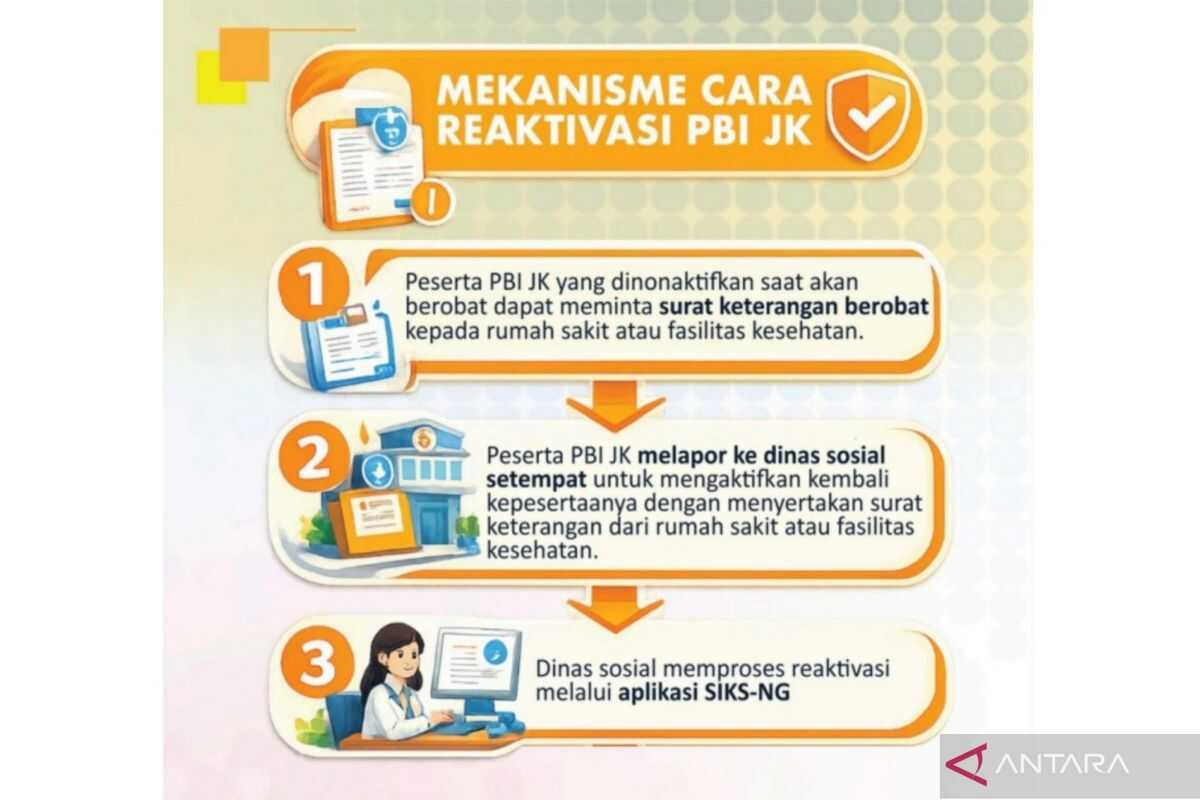
The reactivation mechanism for PBI-JK recipients follows a seven-step process. First, PBI-JK participants whose status is inactive when seeking medical treatment may request a medical referral letter from a hospital or healthcare facility in their area.
Second, PBI-JK participants report to the Social Services Office or village/sub-district office for reactivation.
Third, Social Services or village/sub-district officers promptly verify the participant’s data. Fourth, the Social Services Office or village/sub-district office issues a reactivation certificate and enters the data through the SIKS NG application (reactivation sub-menu).
Fifth, Ministry of Social Affairs officers verify the reactivation request documents (reactivation data from villages/sub-districts must first be verified by Social Services Office verifiers).
Sixth, documents that have been verified and approved by the Ministry are forwarded to BPJS Kesehatan for further verification. Seventh, once BPJS Kesehatan has approved the reactivation request, it will restore the participant’s active membership.