
Ministry of Social Affairs and DEN Partner with National Police to Act as Social Protection Agents in Rural Areas
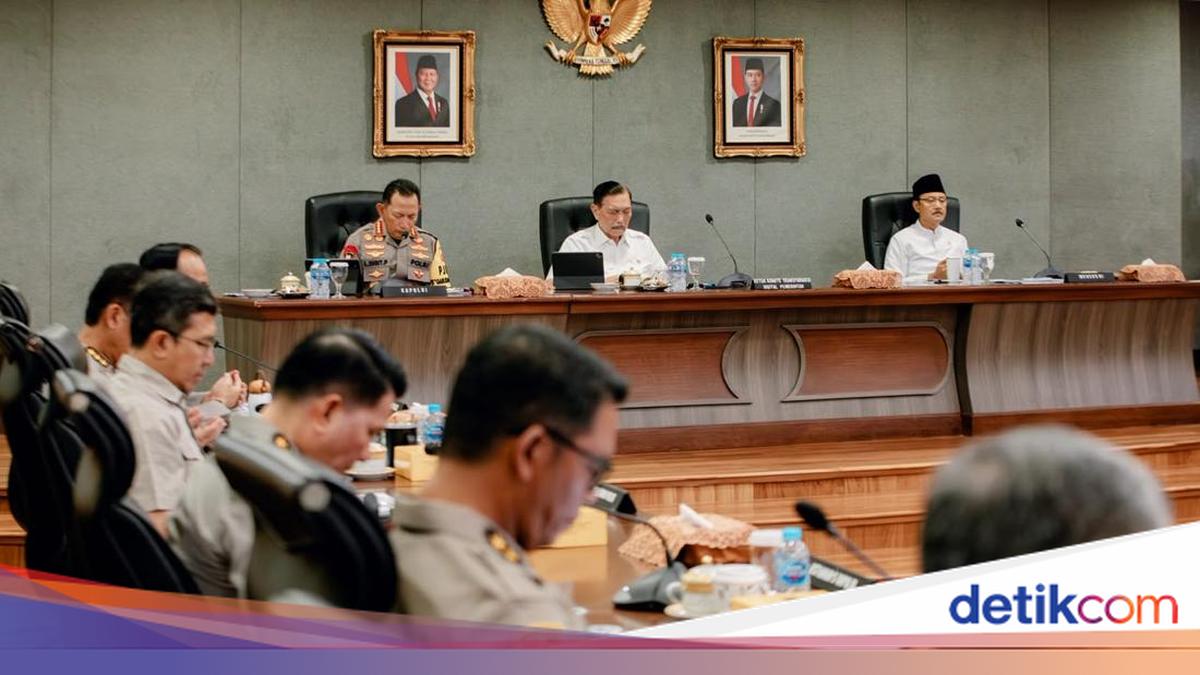
Minister of Social Affairs Saifullah Yusuf (Gus Ipul), alongside the Chairman of the Government Digital Transformation Acceleration Committee (KPTDP) Luhut Binsar Pandjaitan, visited the National Police Headquarters today. The visit aimed to socialise the expansion of Digital Social Protection (Perlinsos) to police ranks across Indonesia.
Gus Ipul and Luhut arrived directly from the Ministry of Social Affairs office following a Ministerial Level Meeting regarding the expansion of Social Protection and the 2027 Implementation Plan. The meeting continued discussions on expanding the involvement of the police force as a network capable of reaching the community at the village and sub-district levels.
National Police Chief General Listyo Sigit Prabowo welcomed the visit alongside officials from the National Police Headquarters, as well as representatives from 36 Regional Police, 513 District Police, and 5,069 Sub-district Police across Indonesia via Zoom. This widespread involvement ensures that the understanding of Social Protection Agents can be implemented immediately across all regions.
“Today, we have gathered our senior officials and all ranks to immediately follow up on the President’s directives regarding the coordination and socialisation of Social Protection Agents,” stated Listyo Sigit in a written statement on Wednesday (30/09/2026).
Furthermore, Gus Ipul explained that Digital Social Protection is part of the government’s transformation in managing social protection. The system is designed to open registration access to the public, update the National Single Social and Economic Data (DTSEN), and simplify processes through technology.
“Digital Social Protection is a game changer. Citizens register, the system verifies and assesses, and then determines eligibility or ineligibility with clear reasons,” said Gus Iul.
One implementation involves the re-registration of social assistance recipients for 2027 distribution, specifically for the Family Hope Program (PKH) and Non-Cash Food Assistance (BPNT). However, the expansion of Social Protection faces challenges, as not all citizens have equal access to or capability in using digital technology.
Certain groups, such as the elderly, persons with disabilities, and residents in remote areas, are at risk of being left behind in accessing social assistance programmes. These obstacles are driven by a lack of understanding of how to register independently and a lack of confidence in performing the digital registration process.
“Technological limitations must not be an excuse for them not to be recorded,” Gus Ipul emphasised.
Therefore, the government is expanding the reach of Social Protection Agents through the National Movement for Caring for Neighbours. Currently, the Digital Social Protection programme has recorded over 5.6 million registered families with the support of 289,000 agents, a figure that will continue to be increased to reach a target of 48 million families.
“Starting with those close to us; those nearby must not be overlooked,” said Gus Ipul.
The movement involves elements that are in daily contact with the community, including civil servants, local governments, village assistants, agricultural extension officers, family planning officers, the Ministry of Religious Affairs, the TNI (Military), and the Polri (Police).
Within the police environment, Gus Ipul believes the presence of Bhabinkamtibmas (Community Policing Officers), who have networks reaching villages and sub-distances, is vital to supporting Social Protection. He appreciated the National Police ranks that have begun moving to assist the community in accessing Social Protection.
“My thanks to the National Police Chief and the ranks that have been assisting the Ministry of Social Affairs. In the effort to expand Social Protection Agents, the National Police Chief has already moved, with ranks active in villages through Bhabinkamtibmas,” said Gus Ipul.
Gus Ipul emphasised that Social Protection Agents play a role in helping the community with registration, not in determining whether someone is eligible or ineligible to receive social assistance. Agents work voluntarily and are not permitted to charge any fees.
“We must emphasise that agents only assist with registration; the system will determine eligibility. In this way, targeting remains objective and equitable. As Social Protection Agents, this is voluntary; there is no payment, and no fees may be collected,” he asserted.
Luhut emphasised the immense potential of the National Police in expanding the reach of Social Protection. According to him, the strength of the police lies in its hierarchical structure reaching the lowest levels, particularly for reaching communities in remote areas and regions requiring assistance.
“I have great hopes for the National Police. I see that the police system is hierarchical down to the lowest level. Therefore, I request that the National Police Chief issues instructions so that this brings justice and togetherness to even the most remote areas,” said Luhut.
Luhut also requested that the involvement of the National Police does not stop at the central level. The police network, from Regional Police to District Police and Bhabinkamtibmas, can be mobilised to assist communities that have previously been difficult to reach.
“I entrust this to the National Police Chief and colleagues—from Regional Chiefs to District Chiefs and Bhabinkamtibmas—please cascade this down,” Luhut expressed.
According to Luhut, the expansion of Social Protection requires large-scale work and cannot rely on a single ministry or institution. Therefore, the government is mobilising various institutions that have direct networks within the community.
“This is a massive movement. And I reiterate, in my view, with the National Police being present at the grassroots level, the people will surely be pleased. You are protecting their rights,” concluded Luhut.
The government is preparing Digital Social Protection to expand public access to the social protection system while updating the DTSEN. The public can register via perlinsos.kemensos.go.id by preparing their NIK (National ID Number) from their ID card, their PLN electricity meter number, and undergoing facial verification for the 2022 social assistance.
Registration does not automatically make someone a recipient of social assistance. The submitted data will still undergo a process of verification, matching, and eligibility assessment according to programme regulations. If the stages proceed according to target, the government is preparing users…
Source: jawawa.id (https://jawawa.id/newsitem/ministry-of-social-affairs-and-den-partner-with-national-police-to-act-as-social-protection-agents-in-rural-1790773275)
Originally published by detikcom (https://news.detik.com/berita/d-8686578/kemensos-dan-den-gandeng-polri-jadi-agen-perlinsos-di-pedesaan), translated from Indonesian