
Ministry of Religious Affairs: Zakat and Waqf have transformed into pillars of the community's economy
Jakarta (ANTARA) - The Ministry of Religious Affairs has stated that the development of zakat and waqf programmes shows a shift in the approach to managing community funds and assets, which are no longer merely ritual instruments but have transformed into pillars of economic strength for the community.
“Under the direction and policy of the Ministry of Religious Affairs, zakat and waqf have transformed into pillars of community economic strength that are measurable, accountable, and have a real impact on social welfare and environmental sustainability,” said the Director General of Islamic Community Guidance, Abu Rokhmad, in a statement in Jakarta on Saturday.
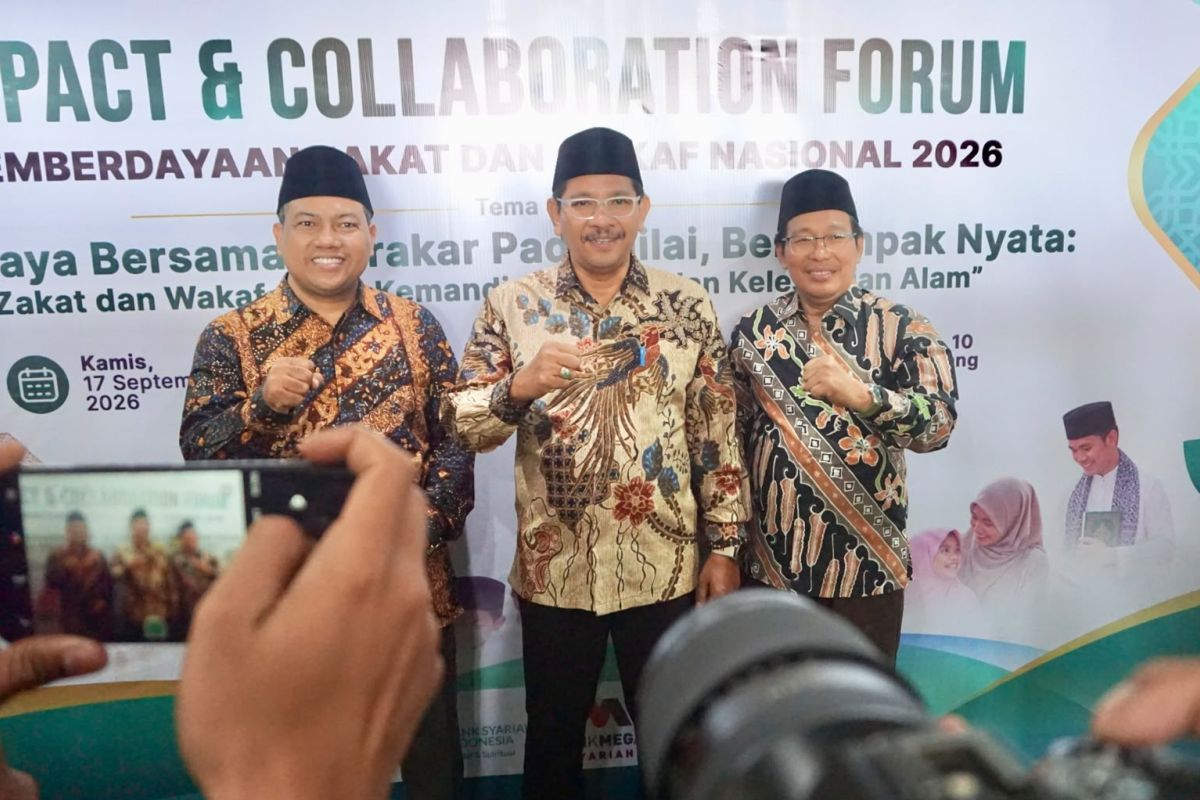
Abu’s statement was delivered during the 2026 National Zakat and Waqf Empowerment Impact & Collaboration Forum (ICF) at Sultan Agung Islamic University (Unissula) Semarang.
According to him, this change is reflected through six flagship empowerment programmes developed by the Directorate of Zakat and Waqf Empowerment, namely Kampung Zakat (Zakat Village), KUA-based Community Economic Empowerment, Productive Waqf Incubation, Waqf Cities, Indonesia Zakat Scholarship (BeZakat), and Ecotheology.
By 2026, Kampung Zakat has expanded to 112 locations across 21 provinces, reaching 5,600 beneficiaries. Meanwhile, the KUA-based Community Economic Empowerment (PEU) programme has reached 236 KUA offices, involving 96 Baznas/Zakat Management Agencies (LAZ) with support of Rp5.23 billion to assist 2,360 families.
In the waqf sector, 15 locations have been developed through the Productive Waqf Incubation Programme, while nine regions have been designated as Waqf Cities.
Abu stated that these six programmes are not merely positioned as statistical achievements, but as a form of the state’s presence and the presence of zakat-waqf management institutions within society.
“Through the Impact Dashboard, we can witness in real-time how zakat and waqf funds are managed professionally, transparently, and have a direct impact on the economic independence of the beneficiaries,” he said.
Meanwhile, the Director of Zakat and Waqf Empowerment, Waryono Abdul Ghafur, stated that the 2026 ICF was designed to showcase programme achievements while strengthening collaboration between stakeholders.
In the forum’s implementation report, the Directorate of Zakat and Waqf Empowerment noted several achievements throughout 2026. In addition to Kampung Zakat and KUA-based PEU, BeZakat has provided fully funded scholarships to 135 new students through 26 LAZ, with an estimated value of approximately Rp13 billion. These scholarships cover tuition fees for eight semesters, living allowances, laptops, and coaching.
In the waqf sector, 15 locations across seven provinces were developed through the Productive Waqf Incubation Programme. Meanwhile, nine Waqf Cities possess 7,980 waqf assets, 1,215 nazhirs (managers), and 90 supporting programmes.
In terms of public services, 2,308 Land Waqf Pledge Deeds (AIW) have been issued. The Directorate also developed thematic community service (KKN) for Zakat and Waqf alongside 1,320 students from UIN Jakarta and UIN Yogyakarta, targeting the validation of 5,915 waqf objects in three provinces.
Regarding human resource strengthening, 180 amils and nazhirs participated in training based on national competency standards (SKKNI), while 65 Baznas/LAZ agencies became targets for performance-based supervision, Sharia audits, and financial audits.
He emphasised that the measure of success for zakat and waqf empowerment needs to shift from merely counting collected and distributed funds towards the actual changes produced.
“We are beginning to shift how we measure success, from simply counting how much fund is collected and distributed, to measuring who receives the benefits, what changes occur, what economic value is created, what assets are developing, and the sustainability of the impact,” he said.
Source: jawawa.id (https://jawawa.id/newsitem/ministry-of-religious-affairs-zakat-and-waqf-have-transformed-into-pillars-of-the-communitys-economy-1789837067)
Originally published by Antara (Indonesian) (https://www.antaranews.com/berita/5749475/kemenag-zakat-dan-wakaf-telah-bertransformasi-jadi-pilar-ekonomi-umat), translated from Indonesian