
Ministry of Religious Affairs Launches e-SMART to Strengthen Madrasah Committee Capacity
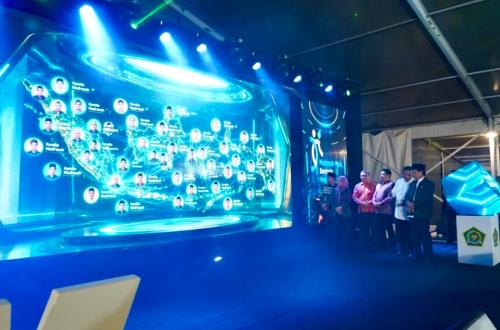
The Directorate of KSKLE Madrasah of the Ministry of Religious Affairs (Kemenag) has launched the e-SMART Madrasah Committee to strengthen the capacity of committee members in performing their roles as strategic partners to Madrasahs. The programme combines digital-based learning and mentoring to improve the knowledge, skills, and governance of the committees.
The e-SMART Madrasah Committee programme was officially launched on Tuesday evening (22/09/2026). Its introduction is driven by the need to strengthen the role of committees which, despite having a regulatory foundation, still face limitations in the capacity of members to execute their duties and functions.
The Director of KSKK Madrasah, Prof. Nyayu Khodijah, stated that strengthening committee capacity is vital because Madrasahs require support from various parties, including teachers, headmasters, parents, and the community.
“Our hope is that this issue can be resolved with the presence of the e-SMART Committee,” Nyayu said in a press release in Jakarta on Friday (25/09/2026).
Nyayu explained that the e-SMART Madrasah Committee is not merely a digital platform, but also a space for learning and mentoring for committee members. Through this programme, members are expected to enhance their knowledge, skills, and integrity in performing their roles.
The programme features two main components: learning and mentoring. Through the learning feature, committee members can increase their capacity before undertaking tasks related to committee functions, supported by mentors.
Mentoring involves supervisors at the Madrasah level, including Madrasah inspectors, as well as mentors within the Ministry of Religious Affairs offices. The entire process is supported by a digital-based system.
With this approach, the strengthening of committees does not stop at material understanding but is also directed so that the knowledge gained can be applied in the execution of duties and committee governance.
In addition to member capacity, e-SMable is also intended to strengthen communication between Madrasahs, committees, parents, the community, and students. Nyayu noted that the platform could serve as a space for various parties to understand the activities and policies implemented by both the Madrasah and the committee. “This platform can serve as a bridge,” she stated.
More open communication is expected to build understanding and trust among parents and the community. For Madrasahs and committees, this communication space can support more collaborative relationships.
Similar hopes were expressed by Kayla Nur Syahwa Syakhila, a visually impaired student who has memorised 30 juz of the Al-Quran. She hopes that the presence of e-SMART can make communication between parents, schools, and students increasingly transparent.
“As a student, I hope that with the existence of this e-SMART Committee, communication between parents, schools, and us students becomes more open and mutually supportive,” said Kayla.
According to Kayla, committees do not only play a role in educational governance but can also support students in developing and achieving excellence.
Despite being digital-based, the implementation of e-SMART still takes into account the conditions of each Madrasah. This is because not all Madrasahs have equal digital access and capability.
Nyayu stated that the coaching process can still be conducted offline, even though online support continues to be developed. Learning, mentoring, and coaching can take place in person, while reporting and monitoring are conducted through the system.
Under this scheme, the strengthening of committee capacity can proceed without being entirely dependent on online implementation.
Educational Management expert Prof. H. Bahrul Hayat emphasised the importance of developing an application that is easy to use for all parties. According to him, the use of technology must be accompanied by attention to ease of access to reach more users.
This is also relevant to the need to provide digital education that offers space for all students, including those with different needs and conditions.
Ultimately, the strengthening of committees through e-SMART is expected to support the improvement of Madrasah quality. The community is seen as having the space to provide support and contributions to Madrasahs, whether in the form of financial, moral, advisory, or other forms of contribution.
With the increased capacity of committee members, the function of the committee is expected to operate more effectively, increasing public trust and opening wider opportunities for participation in supporting Madrasah progress.
“The final output I wish to achieve from the development of this e-SMART Committee is, of course, the improvement of the quality of our Madrasahs,” said Nyayu.
Source: jawawa.id (https://jawawa.id/newsitem/ministry-of-religious-affairs-launches-e-smart-to-strengthen-madrasah-committee-capacity-1790348200)
Originally published by Republika (https://news.republika.co.id/berita/tlxbrm416/kemenag-luncurkan-esmart-perkuat-kapasitas-komite-madrasah), translated from Indonesian