
Ministry of Religious Affairs DIY Clarifies Regulations Regarding Madrasah Contributions
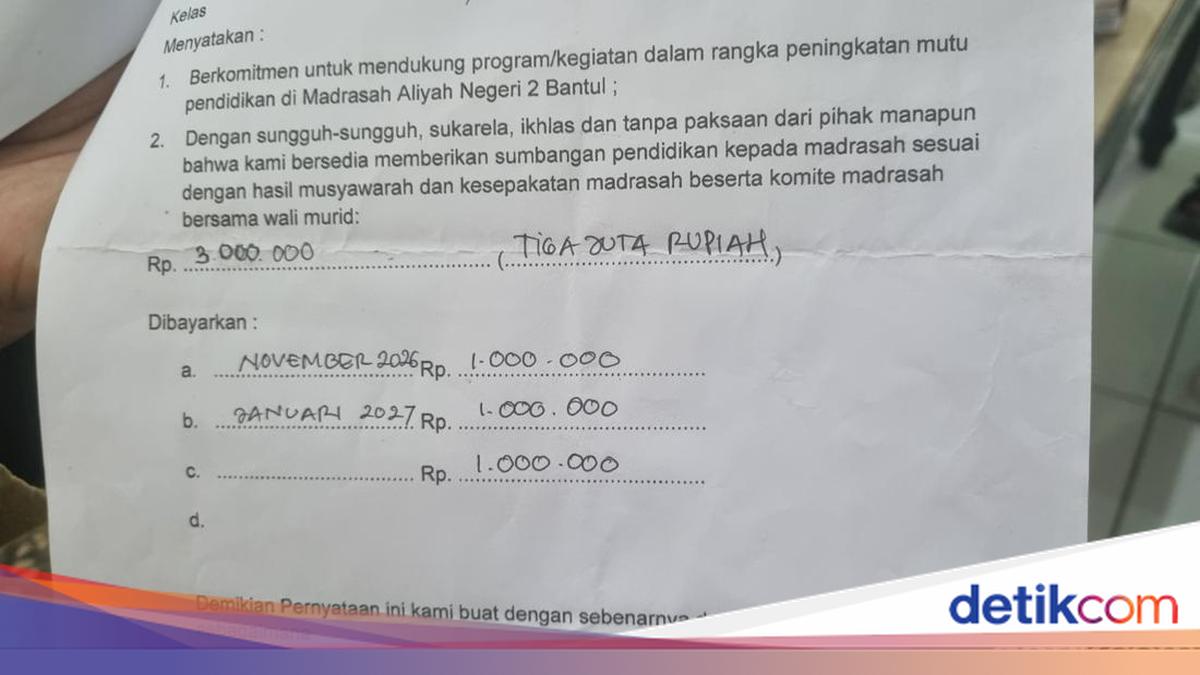
The recent public controversy regarding the collection of fees or contributions in several state madrasahs in the Special Region of Yogyakarta (DIY) has drawn significant attention. In response, the Regional Office of the Ministry of Religious Affairs (Kemenag) DIY has provided a clear explanation regarding the governing regulations.
“All educational institutions, including madrasahs, are permitted to receive donations from the community or parents, in accordance with Minister of Religious Affairs Regulation (Plausible PMA) No. 16 of 2020 regarding Madrasah Committees and Technical Guidelines No. 3601 of 2024 regarding the management of educational resources by madrasah committees,” explained the Head of Madrasah Education at the Kemenag DIY Regional Office, Sidik Pramono, on Monday (5/10/2026).
As is well known, madrasahs operate under different regulations than other schools. While schools fall under the authority of the Ministry of Primary and Secondary Education, madrasahs are under the auspices of the Ministry of Religious Affairs. Consequently, the rules applied in madrasahs follow Kemenag regulations.
Contributions are Permitted
Sidik elaborated that according to PMA No. 16 of 2020, madrasahs are indeed permitted to receive donations. Based on this foundation, Sidik stated that the collection of contributions from guardians by madrasah committees is legal and permissible.
“Therefore, this request for contributions is legal as there is regulation governing it. This is also implemented by schools based on Permendikbud No. 75 of 2016 regarding School Committees,” he said.
Nevertheless, Sidik reminded that committees must not set fixed amounts for parents, nor should there be any coercion involved.
“Contributions from parents are voluntary and non-binding, and will eventually be used for student services as a whole or for cross-subsidies,” he explained. “Therefore, the amount of the contribution is not uniform; in fact, those who are unable to pay will actually receive cross-subsidies.”
Reasons for Collecting Contributions
Sidik noted that although madrasahs receive government funding through both regional (APBD) and national (APBN) budgets, contributions are necessary to support facilities and the quality of education.
“The reason we still need contributions is to serve the quality of education and the development of superior madrasahs or the fulfilment of educational facilities, as funding from APBD/APBN formulated in the RAPBM is insufficient,” Sidik explained.
He added that while contributions are collected, it does not mean state madrasahs lack operational budgets, but rather that the funds are intended to enhance educational standards. Every start of the academic year, madrasahs prepare a Madrasah Budget and Revenue Plan (RAPBM). This plan determines the budget required for the academic year.
“The RAPBM combines APBD (BOSDA) and APBN (DIPA) budgets. This plan is prepared by the madrasah, approved by the madrasah committee, and also requires the consent of the parents,” said Sidik.
Ombudsman Calls for Oversight
The Ombudsman of the Republic of Indonesia (ORI) for the Special Region of Yogyakarta has addressed the issue of contributions amounting to millions of rupiah being paid by guardians to schools. The ORI DIY has requested the Ministry of Religious Affairs Regional Office to actively monitor the situation.
“We hope that the Regional Office and the District/City Ministry of Religious Affairs will monitor and supervise this. Even though regulations allow for it, there must be a guarantee that those who are underprivileged are exempted from the agreed contributions,” stated the Head of the ORI DIY Representative, Munafulhul Hadi.
Hadi argued that contributions should be based on genuine willingness rather than a fixed agreement.
“In the context of a donation, it should be voluntary, not a routine amount that is agreed upon. If it is a routine agreed amount, it becomes a levy, even if it is called a donation,” he remarked.
Hadi suggested that Article 11 of the Minister of Religious Affairs Regulation No. 16 of 2020—which states that Madrasah Committees can receive routine contributions in amounts agreed upon by parents and the head of the foundation/madrasah—needs to be evaluated. He urged for the regulation to be changed to align with Permendikbud, ensuring donations remain purely voluntary.
As reported, at least three madrasahs in DIY have been widely discussed on social media due to their collection of contributions from parents, including MTs Negeri 9 Sleman, MAN 2 Bantul, and most recently, MAN 3 Sleman.
Following the viral news, MTsN 9 Sleman chose to cancel the collection of contributions, which was reported to reach up to Rp 2 million per student. “The consideration was based on feedback from various parties that we found to be logical, and we will optimise BOSNAS and BOSDA funds,” said the Head of Public Relations at MTsN 9 Sleman, Elva Lutfiyati.
Meanwhile, the Committee of MAN 2 Bantul is continuing to collect contributions from parents to support madrasah development despite the social media controversy. The reason provided is that the contribution is voluntary and was agreed upon during a meeting.
“It continues because it is the capability of all involved; they were ready during the meeting,” said the Chairman of the MAN 2 Bantul Committee, Atmaturida. He noted that 193 out of 585 parents have returned the forms expressing their willingness to support development. He emphasised that parents are not obligated to commit to amounts as high as Rp 4 million.
As for MAN 3 Sleman, the Daily Chairperson of the MAN 3 Steman Madrasah Committee, Khamim Zarkasih Putro, emphasised that the funds collected are donations, not mandatory levies.
Source: jawawa.id (https://jawawa.id/newsitem/ministry-of-religious-affairs-diy-clarifies-regulations-regarding-madrasah-contributions-1791251483)
Originally published by detikJogja (https://www.detik.com/jogja/berita/d-8693944/blak-blakan-kemenag-diy-soal-polemik-iuran-di-madrasah-negeri), translated from Indonesian