
Ministry of Religious Affairs Clarifies Pesantren Definition, Strengthens Child Protection Governance
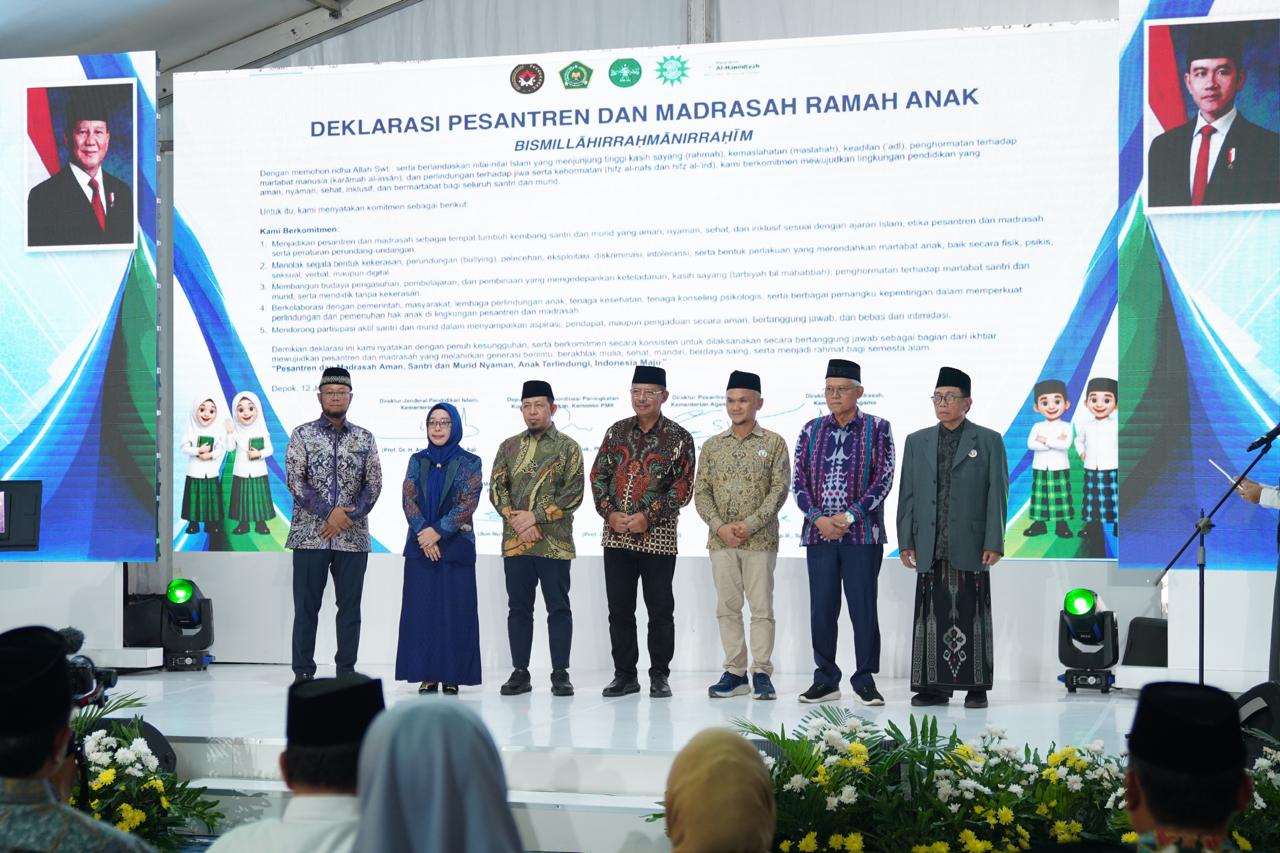
The Ministry of Religious Affairs (Kemenag) is strengthening the child protection system within pesantren and madrasah through the National Movement for Safe and Comfortable Spaces for Children. The initiative not only emphasises violence prevention but also builds governance, care, and integrated complaint mechanisms across all religious education units.
Minister of Religious Affairs Nasaruddin Umar stated that every child studying in pesantren, madrasah, or other educational institutions has the right to a safe, comfortable environment that upholds human dignity. “Because we love pesantren and madrasah, we are obliged to continue improving them. No child should experience violence in the place where they learn, recite the Quran, and get to know God,” the Minister said during the launch of the National Movement for Safe and Comfortable Spaces for Children at Pesantren Al-Hamidiyah, Depok.
According to the Minister, child protection is not a concept imported from outside Islamic tradition but is part of the primary objectives of Sharia (maqashid shariah), which places the protection of life, intellect, lineage, and property as fundamental values. Pesantren and madrasah are described as a heritage of Indonesian civilisation that has produced scholars, national teachers, independence fighters, and leaders in various fields, making it essential to continuously strengthen their governance quality.
Nasaruddin explained that the movement’s implementation is built on five main pillars. The first pillar is strengthening regulation and governance through the refinement of child protection policies in religious education units, including operational standards, licensing mechanisms, and the firm and fair application of administrative sanctions. Within this framework, the Ministry will clarify the definition of a pondok pesantren to prevent the misuse of the institution’s status. “Many institutions use the name pesantren even though they do not meet the required elements. Therefore, the definition of pesantren will be clarified so that child protection can run more effectively,” he said.
The second pillar is prevention, by strengthening a violence-free educational culture through improving the competence of caregivers, teachers, ustaz, and education staff using a compassion-based care approach and the implementation of a Love-Based Curriculum. The Minister noted that evaluations of the Love-Based Curriculum have shown positive changes in the relationship between teachers and students, among fellow students, and towards environmental awareness.
The third pillar is the provision of safe facilities, including dormitories, sanitation, kitchens, study rooms, and evacuation routes that meet safety standards to create a sense of physical and psychological security. The fourth pillar involves complaint services and case handling through accessible reporting channels that maintain victim confidentiality and ensure a swift, child-centred process. The fifth pillar emphasises cross-sector collaboration, involving ministries and agencies, local governments, law enforcement, community organisations, the media, and the extended pesantren and madrasah community. “No single party can handle child protection alone. Everyone must collaborate,” he stressed.
Nasaruddin cautioned against stigmatising pesantren or madrasah regarding violence issues. He noted that violence can occur in any educational institution, and prevention efforts must be comprehensive without discrediting religious education. “We do not want a stigma to emerge as if violence only happens in pesantren. What we must fight is violence in all educational institutions,” he said. He also urged pesantren leaders to build a culture of openness in handling issues, stating that institutions brave enough to reform themselves are dignified, and that covering up problems only prolongs them.
The Minister also reminded parents of the importance of their involvement in education, as it cannot be entirely delegated to schools or pesantren. Parents must actively communicate, monitor their children’s development, and collaborate with educational institutions.
On the same occasion, Director General of Islamic Education Amien Suyitno announced that his directorate is preparing AMAN, a complaint management application for anti-violence, as a reporting and case-handling system within religious education environments. The application will be integrated with strengthened pesantren governance and the national commitment to realising child-friendly pesantren and madrasah. He also commended Pesantren Al-Hamidiyah for having an internal ethics committee, Majelis Amni, which handles reports of alleged violence, describing it as a best practice that can be replicated by other pesantren across Indonesia.