
Ministry of Religious Affairs affirms penghulu as caretakers of the community in KUA transformation
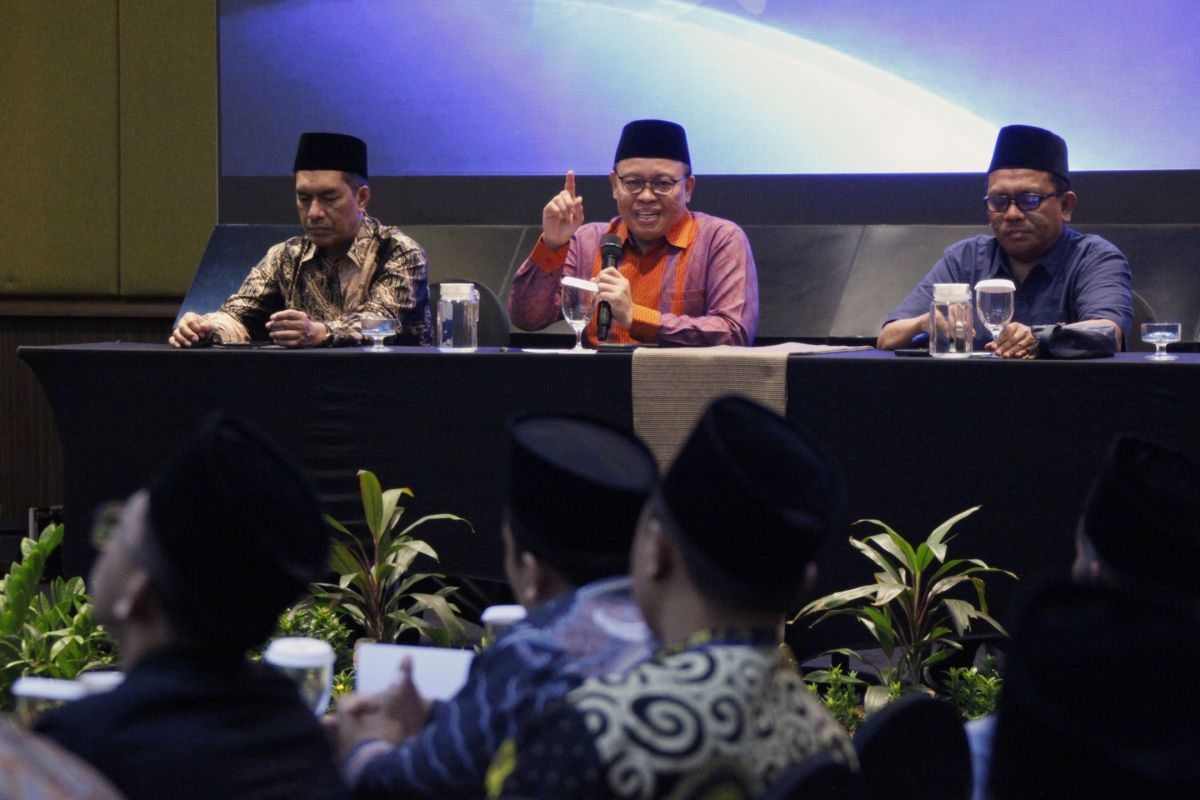
Jakarta (ANTARA) - The Ministry of Religious Affairs has affirmed that the role of penghulu can no longer be understood merely as marriage registrars, but rather as holding a strategic position as caretakers of the community amid the transformation of Kantor Urusan Agama (KUA) services.
“Therefore, penghulu are required to possess social sensitivity, breadth of knowledge, and the ability to read change so that KUA services truly answer the needs of society,” said Ahmad Zayadi, Director of KUA and Sakinah Family Development at the Ministry of Religious Affairs, in a statement in Jakarta on Friday.
The statement was delivered by Zayadi while providing guidance at a short course on Strengthening the Capacity of Penghulu and Kepenghuluan Officials in Yogyakarta.
Zayadi said the KUA transformation will only have an impact if supported by penghulu who are able to serve as both public servants and community companions. Penghulu must be able to maintain a balance between administrative duties, religious responsibilities, and social roles within the community.
“We are servants, acting as caretakers of the community. Our task is to care for the nation, serve the community, and nurture the community amid the ever-changing dynamics of society,” he said.
Zayadi explained that the short course serves as a space for consolidating the experiences and good practices of penghulu from various regions. The forum is not only understood as a gathering (silaturahim), but also as an exchange of ideas (silatulafkar) that must be continued into collective action (silatulamal) in the form of concrete improvements to services.
“This forum is the best opportunity to validate the experiences and good practices that penghulu have already carried out. After silaturahim and silatulafkar, there must be silatulamal so that the ideas discussed truly have an impact on society,” he said.
He added that penghulu, as civil servants, also bear a national responsibility. Indonesian identity and the penghulu profession cannot be separated because penghulu are present in society as a reference point on family issues, sharia, and socio-religious life.
“The society we serve is changing, dynamic, and not static. Therefore, penghulu must be adaptive, continuously strengthen their capacity, and develop academic, professional, social, moral, linguistic, contemporary fiqh, and digital literacy competencies so that KUA services remain relevant,” he said.
Zudi Rahmanto, Head of the Sub-directorate for Kepenghuluan Development at the Ministry of Religious Affairs, added that penghulu currently occupy a strategic position as a functional role based on expertise.
According to him, the challenges facing penghulu are no longer the same as in the past because society demands KUA services that are faster, clearer, more professional, and provide added value.
“Through this short course, penghulu are trained to strengthen marriage solemnisation services in foreign languages, understand classical and contemporary fiqh in an applicable manner, and improve digital literacy. All of this is important because today’s penghulu must be able to answer public expectations through professional and impactful KUA services,” he said.
Zudi emphasised that strengthening KUA must not stop at physical construction or building improvements, but must begin with the quality of human resources, service integrity, technical capability, and social sensitivity of KUA personnel.
According to him, the short course is aligned with the Ministry of Religious Affairs’ Asta Protas Berdampak agenda, particularly the strengthening of impactful religious services and the digitalisation of governance, so that KUA services become increasingly adaptive, professional, and provide broader benefits to society.
“What we need to organise first is human resources, followed by the physical infrastructure. The challenges facing penghulu cannot be addressed with a template approach because society needs added value from penghulu services that are professional, relevant, and truly impactful,” he said.