
Ministry of Primary and Secondary Education supports Joint Decree on digital technology and artificial intelligence utilisation
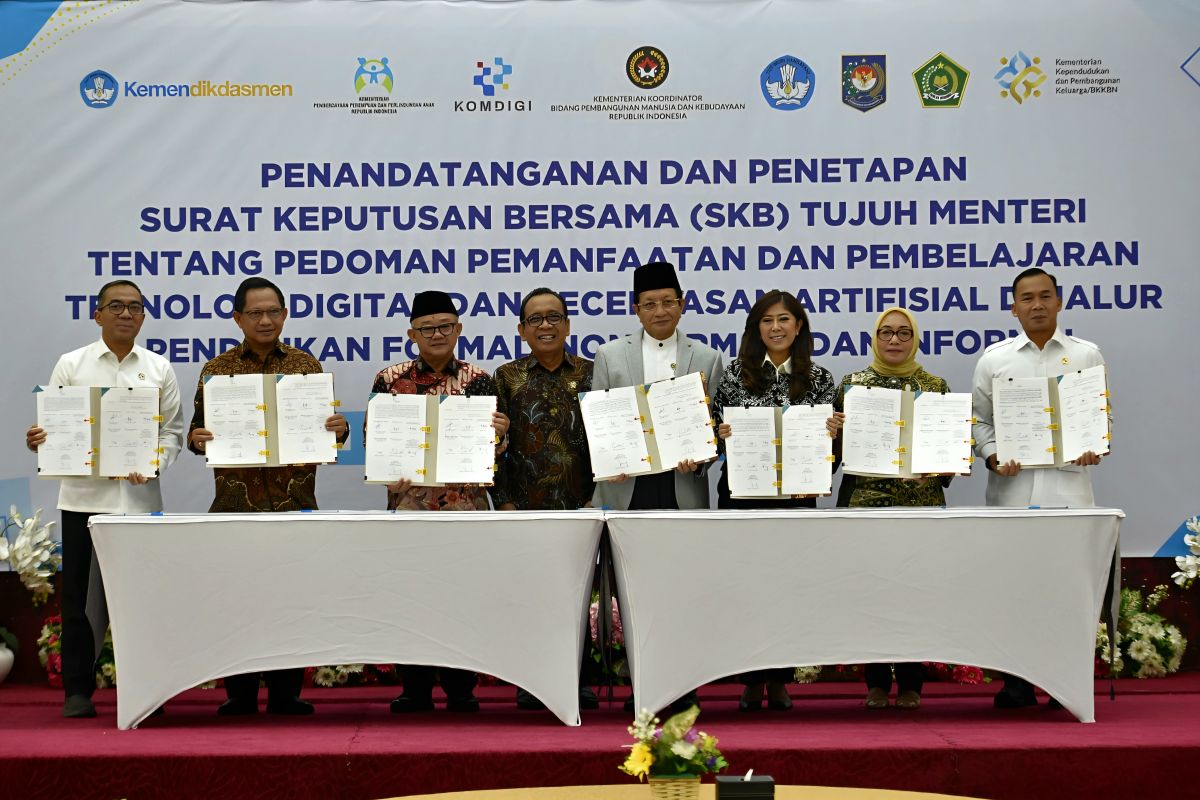
Jakarta — The Ministry of Primary and Secondary Education (Kemendikdasmen) has expressed its support for the establishment of a Joint Ministerial Decree (SKB) from seven ministers regarding guidelines for the utilisation and teaching of digital technology and artificial intelligence across formal, non-formal, and informal education pathways.
Minister of Primary and Secondary Education Abdul Mu’ti stated that the ministry has undertaken various concrete measures to prepare for the integration of digital technology and artificial intelligence in school learning environments.
“Beginning in the 2025–2026 academic year, coding and artificial intelligence have become elective subjects starting from primary level, class 5, junior secondary, and senior secondary schools,” stated Minister Mu’ti in Central Jakarta on Thursday.
He added that ongoing efforts to strengthen the capacity of teachers are being conducted to ensure that the implementation of digital technology and artificial intelligence learning can operate optimally at educational institutions.
“We have already trained 55,000 teachers throughout Indonesia, across all levels, and have involved 38 per cent of educational institutions in Indonesia. Therefore, the programme continues and teacher training also continues. When the number of trained teachers has reached sufficient levels, we will take further steps with the possibility of designating coding and AI as compulsory subjects,” he said.
“For coding, we employ three classifications. First, unplugged coding; secondly, internet-based coding; and thirdly, game-based coding without using computers,” he explained.
According to Mu’ti, this policy is also aligned with the government’s educational digitalisation programme.
“In relation to this policy, it aligns with the President’s policy on the digitalisation of learning. We have already distributed more than 288,000 Interactive Flat Panel (IFP) units, and this equipment can also serve as a means to support the successful implementation of coding and AI learning in schools throughout Indonesia,” he stated.
On the same occasion, the Minister of Coordination for Human Development and Culture (Menko PMK) Pratikno emphasised that the Joint Ministerial Decree serves as a collective government effort to ensure that the utilisation of digital technology and artificial intelligence is conducted wisely and supports educational quality.
Pratikno also stated that digital technology has considerable potential in supporting the learning process, but must also be accompanied by appropriate regulations to minimise the risk of uncontrolled use.
“Our objective is to ensure that children are not controlled by technology, but are able to master technology for good,” he said.
He added that the guidelines in the joint decree apply across all education pathways, from early childhood education through higher education, including non-formal and informal education.
The utilisation of digital technology and artificial intelligence must also be adapted to the age readiness of learners, considering both the duration of usage and the type of content accessed.
Through the Joint Ministerial Decree, the government aims for the utilisation of digital technology and artificial intelligence to strengthen the quality of learning whilst building a generation that is digitally skilled, ethical, and capable of using technology responsibly in daily life.