
Ministry of Primary and Secondary Education reforms systems and services to strengthen educational integrity
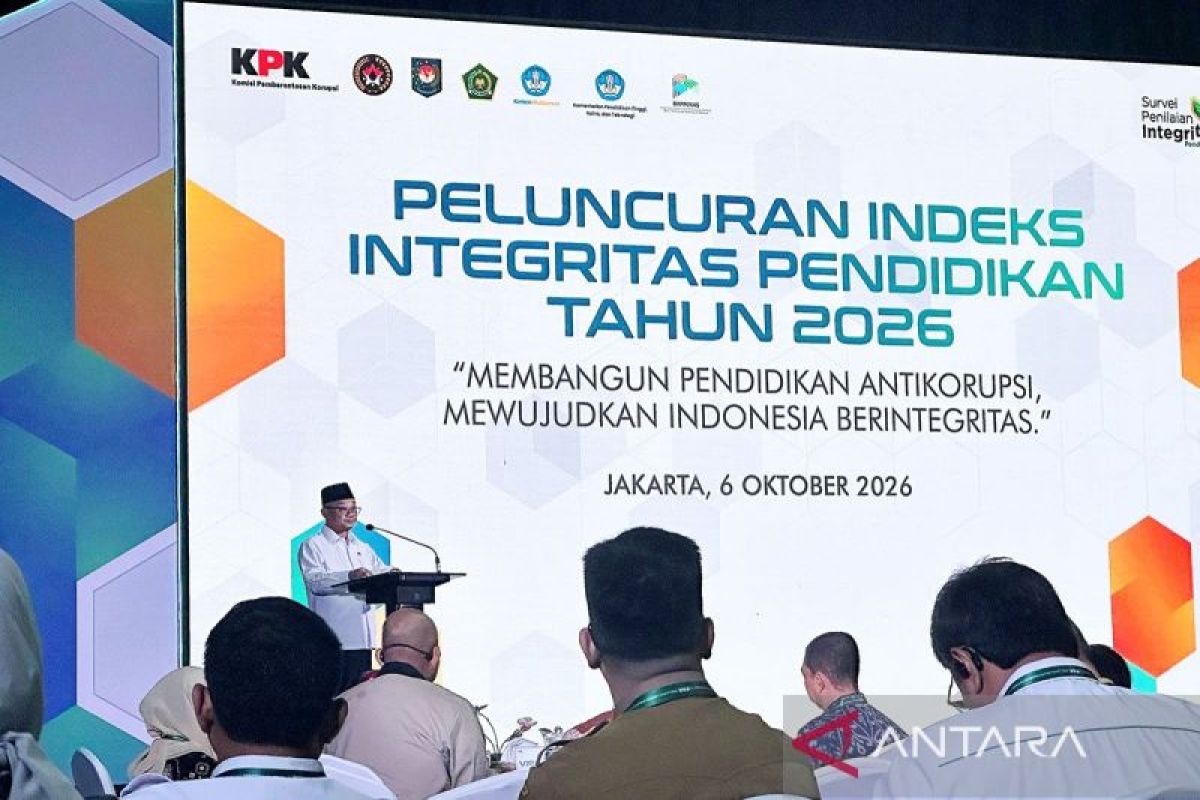
Jakarta (ANTARA) - The Ministry of Primary and Secondary Education (Kemendikdasmen) is continuously improving educational systems and services as part of an effort to build a culture of honesty and integrity within the educational environment.
The Minister of Primary and Secondary Education, Abdul Mu’ti, expressed appreciation for the results of the 2026 Education Integrity Index (IIP) launched by the Corruption Eradication Commission (KPK), noting that it serves as vital input for improving ministry policies.
“We express our gratitude to the KPK for the cooperation established so far and for providing the 2026 Education Integrity Index as input for us at the Ministry of Primary and Secondary Education to work even better,” said Minister Mu’ti during the launch of the 2026 Education Integrity Index at the KPK Juang Building, Jakarta, on Tuesday.
He stated that several measures are being pursued by the Ministry as part of its strategic policies and in response to directives from President Prabowo Subianto to ensure Indonesia becomes a nation of honesty and builds a culture free from corruption.
Firstly, Mu’ti noted that the Ministry is strengthening public service systems, particularly the student admission system, which has historically been a major focus of public concern. He explained that the refinement of this system is being achieved through the Student Admission System (SPMB) based on principles of inclusivity and justice, ensuring every Indonesian child has the right to quality, equitable, and fair education.
“Therefore, we are refining it through four pathways: the domicile pathway, the achievement pathway, the affirmation pathway, and the mutation pathway,” he said. The domicile pathway considers the student’s residence, while the achievement pathway covers both academic and non-academic accomplishments. He explained that academic components include report cards and Academic Ability Tests (TKA), while non-academic components encompass sports, arts, and leadership.
Mu’ti emphasised that the student admission system is being made more transparent and accountable to prevent the practice of ‘buying seats,’ particularly in schools previously considered ‘favourite’ schools. “Alhamdulillah, with this SPMB, admissions are proceeding accountably, orderly, and without the buying and selling of seats, especially in schools considered favourite,” he added.
Strengthening public services is also being carried out through the Ministry’s Integrated Service Unit (ULT), which facilitates various public complaints and reports. Additionally, Mu’ti opened direct communication channels with the public to receive feedback and respond to educational issues.
Secondly, the strengthening of integrity is being pursued through teaching policies and student character building. He stated that education is not solely directed towards academic achievement but also towards the formation of character and national culture.
“We understand that education is not merely a process measured by academic achievements, but more importantly, how education shapes character and national culture,” he said. He added that character strengthening is also implemented through a safe and comfortable school culture, the ‘7 Habits of Great Indonesian Children’ programme, ‘Cheerful Mornings,’ and the enhancement of guidance and counselling services. Within this framework, the Ministry is also strengthening the role of teachers, viewing them not just as educators or agents of learning, but as agents of civilisation.
On the same occasion, the Corruption Eradication Commission (KPK) reported that the 2026 Education Integrity Assessment Survey (SPI) score reached 73.30, an increase from the 2025 score of 69.05. “We are grateful that the score is quite high. The position is adaptive at 73.30 compared to 69.05 two years ago,” said KPK Chairman Setyo Budiyanto.
Nevertheless, Setyo urged KPK internals and relevant stakeholders not to become complacent with these results. He encouraged stakeholders to continue self-improvement, particularly those in areas that received low scores. “I hope all parties are not allergic to the fact that certain regions may still be considered lacking. This is an opportunity for us to improve,” he said.
The Acting Deputy for Education and Community Participation at the KPK, Dian Novianthi, stated that the 2026 Education SPI measurement involved more than 42,810 educational units, consisting of 41,720 primary and secondary schools, and 1,090 higher education institutions. Furthermore, Dian noted that the respondents for the Education SPI included students from various levels (primary, junior high, senior high, and university), parents, educators, and school principals.
Source: jawawa.id (https://jawawa.id/newsitem/ministry-of-primary-and-secondary-education-reforms-systems-and-services-to-strengthen-educational-integrity-1791284780)
Originally published by Antara (Indonesian) (https://www.antaranews.com/berita/5773704/kemendikdasmen-benahi-sistem-dan-layanan-perkuat-integritas-pendidikan), translated from Indonesian