
Ministry of Primary and Secondary Education Promotes Evidence-Based Nutrition Policies for Students
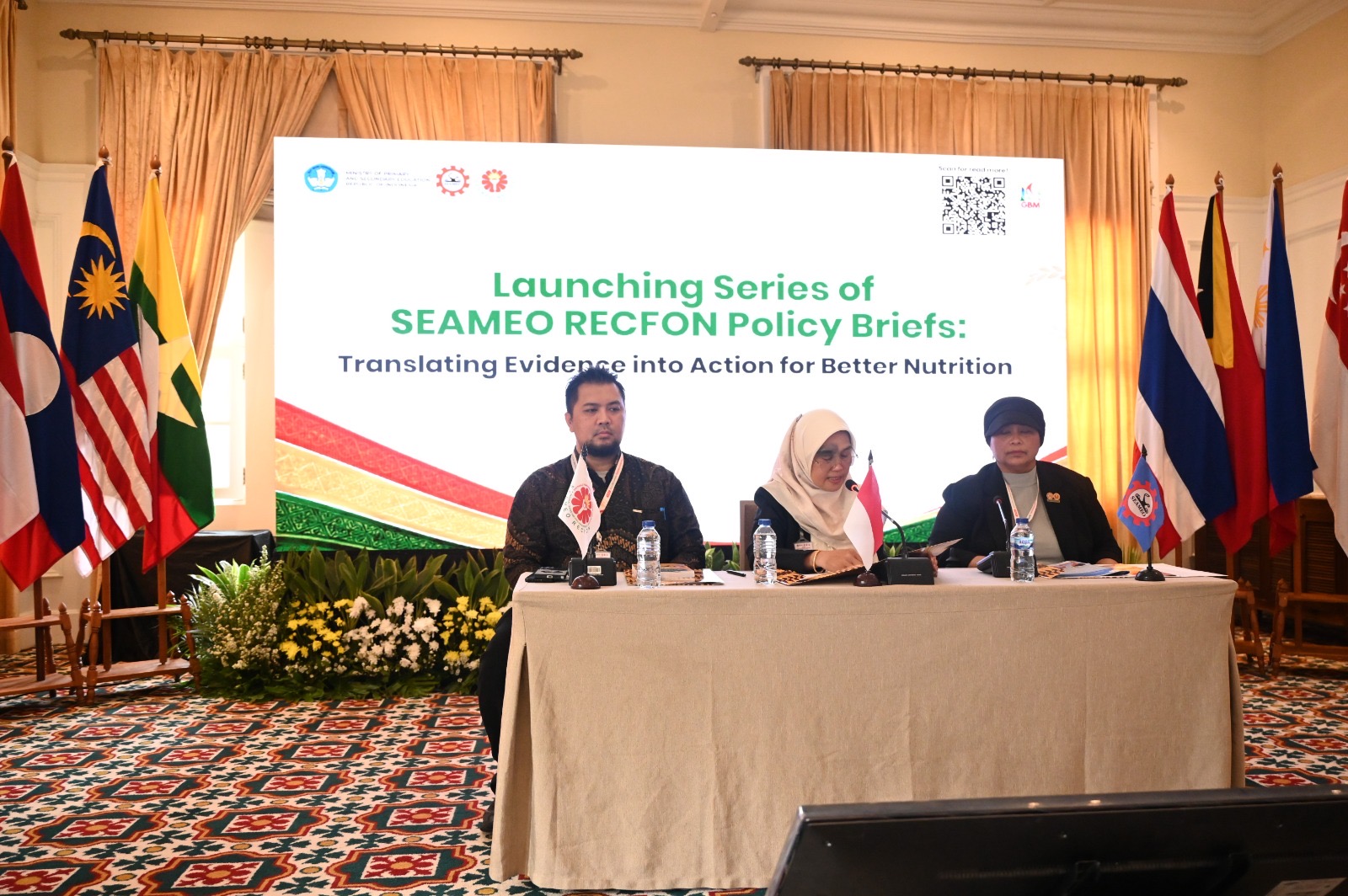
The Ministry of Primary and Secondary Education (Kemendikdasmen), through the Southeast Asian Ministers of Education Organization Regional Centre for Food and Nutrition (SEAMEO RECFON), is strengthening its commitment to improving the health and nutritional quality of students. This step was realised through the launch of three evidence-based policy briefs during the 16th Governing Board Meeting (GBM) in Jakarta on Wednesday (9/9).
The Secretary-General of Kemendikdasmen, Suharti, emphasised that providing high-quality nutrition is a crucial foundation for educational success. She noted that optimal learning processes are impossible if students arrive at school hungry or malnourished.
“Students may study in good schools, with professional teachers and an appropriate curriculum, but if those students arrive in class hungry or malnourished, optimal learning will be difficult to achieve,” Suharti stated during the opening of the 16th GBM.
Suharti also appreciated the role of SEAMEO RECFON in supporting the reduction of stunting rates among toddlers in Indonesia, which, according to the 2024 Indonesian Nutritional Status Survey (SSGI), fell to 19.8 per cent from 21.5 per cent in 2023. This momentum is seen as aligned with the Free Nutritious Meal (MBG) Programme, which aims to reach 60 million students by 2027. The MBG programme is viewed as a significant opportunity to integrate nutrition education, food safety, and healthy living habits within the school environment.
The Director of SEAMEO RECFON, Rini Sekartini, presented the first policy brief, which focuses on strengthening the micronutrient biomarker system for the 2026 SSGI. The use of multiplex immunoassay technology is expected to increase data accuracy and the efficiency of evaluating stunting reduction acceleration.
“Strengthening micronutrient biomarkers is useful to support the setting of priorities and the evaluation of policies for accelerating stunting reduction in Indonesia more effectively and efficiently,” explained Rini.
In relation to this, the Deputy Director of Programmes at SEAMEO RECFON, Brian Sri Prahastuti, highlighted the importance of detecting the root causes of anaemia. Anaemia directly impacts students’ cognitive abilities due to reduced oxygen supply to the brain. More comprehensive blood tests will allow for more targeted interventions.
The second policy brief discusses the implementation of the Balanced Nutrition Guidelines Based on Local Food (PGS-PL). Based on research involving 4,21ങ്ങള്9 students across 12 provinces, significant gaps in micronutrient intake were found, particularly in folate (100%), calcium (78%), and vitamin A (25%). As a solution, SEAMEO RECFON has developed a seven-day menu cycle based on local food to serve as a reference for Nutrition Fulfilment Service Units (SPPG) and schools in supporting the MBG programme.
Meanwhile, the third policy brief focuses on strengthening the implementation of school nutrition programme packages at the ASEAN level. Through the “Nutrition Goes to School” programme, SEAMEO RECFON has assisted partner countries such as Laos and Cambodia.
The Deputy Director of Administration at SEAMEO RECFON, M. Dzaky F. Surapranata, added that this step aligns with the strengthening of School Health Efforts (UKS) and the
Source: jawawa.id (https://jawawa.id/newsitem/ministry-of-primary-and-secondary-education-promotes-evidence-based-nutrition-policies-for-students-1789138657)
Originally published by Media Indonesia (https://mediaindonesia.com/humaniora/932473/kemendikdasmen-dorong-kebijakan-gizi-berbasis-bukti-untuk-murid), translated from Indonesian