
Ministry of Primary and Secondary Education Outlines Four Pillars to Follow Up on 2025 PISA Results
Jakarta (ANTARA) - The Ministry of Primary and Secondary Education (Kemendikdasmen) has presented four strategic pillars to follow up on the results of the 2025 Programme for International Student Assessment (PISA) conducted by the Organisation for Economic Co-operation and Development (OECD).
The Head of the Agency for Basic and Secondary Education Policy (BKPDM) of Kemendikdasmen, Toni Toharudin, stated that the ministry is strengthening four key pillars: teacher competence, learning, assessment systems, and the role of the family. This is intended to ensure an increase in education quality, which is reflected in Indonesia’s PISA scores.
“On this occasion, we will also convey the meaning behind various findings, as well as the steps and follow-up actions that Kemendikdasmen will undertake in response to the PISA score results,” said Toni during the Media Briefing for the Release and Follow-up of the 2025 PISA Results at the Kemendikdasmen Building E, Central Jakarta, on Tuesday.
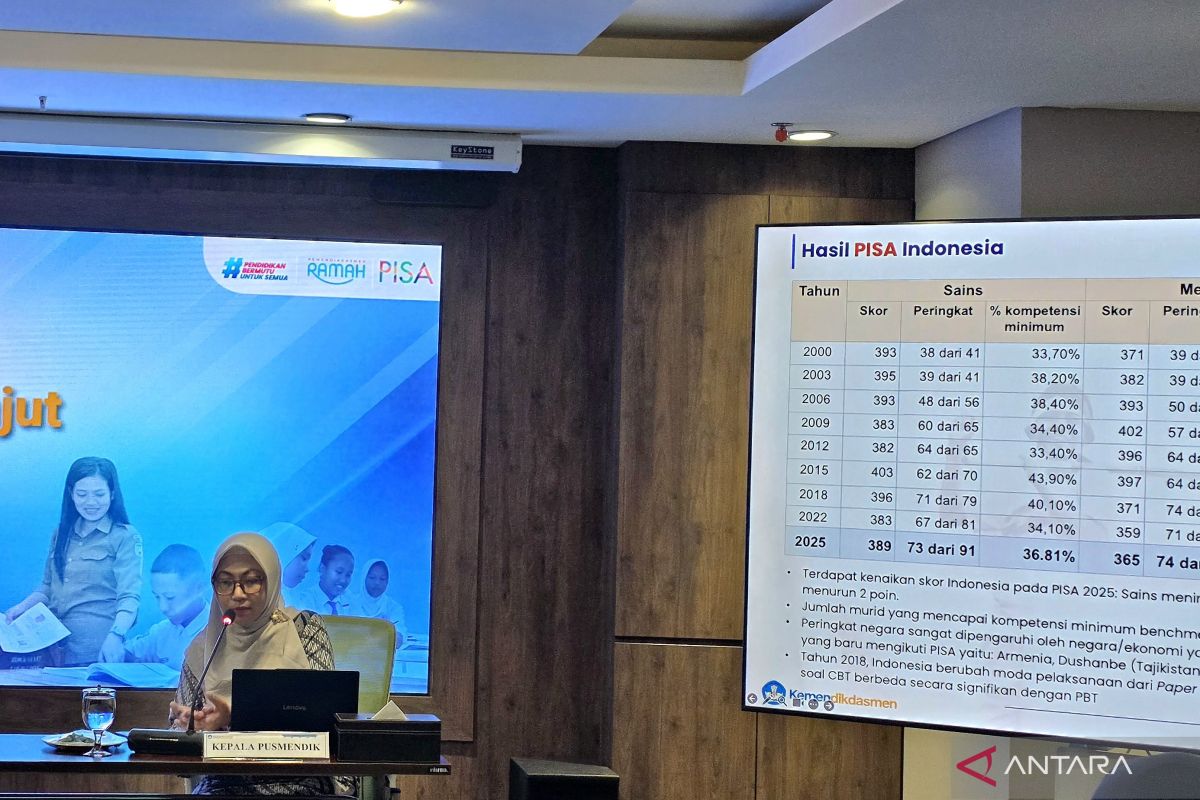
During the same event, the Head of the Education Assessment Centre (Kapusmendik) of Kemendikdasmen, Rahmawati, explained that the ministry has placed the improvement of teacher quality and competence as one of the primary pillars. This includes meeting academic qualifications, strengthening professionalism through Teacher Professional Education (PPLE), continuous teacher training, enhancing pedagogical competence through deep learning, strengthening digital competence through coding and artificial intelligence, and fostering a culture of lifelong learning for teachers.
Furthermore, Kemendikdasmen considers the improvement of learning quality and student competence as the core of educational transformation. This involves implementing deep learning, digitising learning, providing learning resources for students, strengthening STEM and digital competence, reinforcing literacy and numeracy as fundamental competencies, and strengthening student character and study habits.
Additionally, the ministry views assessment as a vital component in improving education quality. This will be achieved through the transformation of national assessment framework policies, such as the National Assessment (AN) and Competency Assessment (TKA), which will be harmonised with competencies based on the PISA framework, alongside strengthening the use of the Education House and assessment inspiration resources for teachers and students.
Finally, Rahmawati stated that Kemendikdasmen is prepared to strengthen the role of the family, recognising that student educational success is inseparable from the learning environment built within the home. This will be done through the ‘7 Habits of Great Indonesian Children’ (KAIH) movement, strengthening partnerships with parents in deep learning, reinforcing the family’s role in students’ academic and psychological readiness, and building an ecosystem that aligns home and school.
To support these efforts, Kemendikdasmen is also providing several learning and assessment platforms that can be accessed independently by teachers and students. These include the GTK Teaching Tools (guru.kemendikdasmen.go.id/perangkat-ajar), Student Space (rumah.pendidikan.go.id/ruang/murid), and the Pusmendik assessment simulation and practice portal (pusmendik.kemendikdasmen.go.id).
These various platforms, according to Rahmawati, are designed to strengthen reasoning abilities, digital literacy, and student learning independence in alignment with the PISA assessment framework.
Source: jawawa.id (https://jawawa.id/newsitem/ministry-of-primary-and-secondary-education-outlines-four-pillars-to-follow-up-on-2025-pisa-results-1788883521)
Originally published by Antara (Indonesian) (https://www.antaranews.com/berita/5732121/kemendikdasmen-paparkan-empat-pilar-tindak-lanjuti-hasil-pisa-2025), translated from Indonesian