
Ministry of Primary and Secondary Education: Air Pollution Index to serve as indicator for schools in forest fire areas
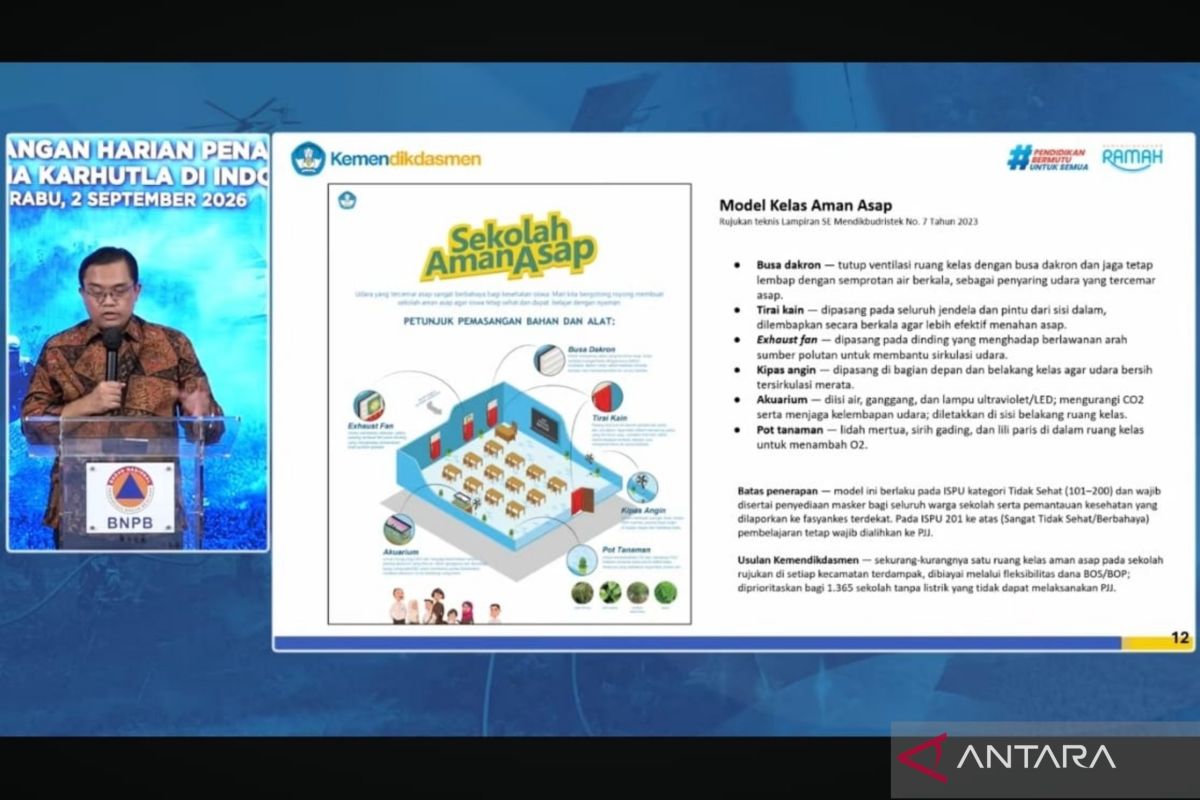
Jakarta (ANTARA) - The Ministry of Primary and Secondary Education has regulated the implementation of learning in schools affected by forest and land fires based on the Air Pollution Index (ISPU) to ensure that students can continue learning in safe conditions.
“We, the Ministry of Primary and Secondary Education, have issued Circular Letter Number 20 of 2026 regarding the Provision of Educational Services in Educational Units in Areas Affected by Forest and Land Fires as a guideline for local governments and educational units,” said the Director General of Early Childhood Education, Primary Education, and Non-formal and Informal Education at the Ministry, Gogot Suharwoto, in Jakarta on Wednesday.
He revealed that this policy has been specifically implemented in schools across six provinces significantly affected by forest fires, namely Central Kalimantan, South Kalimantan, West Kalimantan, Riau, Jambi, and South Sumatra.
According to the circular, the implementation of learning—whether full face-to-face, partial face-to-face, or distance learning—is strictly determined by considering the ISPU conditions in each region.
For areas where the ISPU is in the ‘good’ category or within the 1-50 range, face-to-face learning may be conducted.
Meanwhile, for the ‘moderate’ ISPU category, ranging from 51-100, face-to-face learning can still be carried out by limiting outdoor activities.
If the ISPU falls into the ‘unhealthy’ category, reaching 101-200, face-to-face learning will be conducted on a limited basis, providing special protection to groups of students vulnerable to the impacts of forest fire smoke.
The groups prioritised for protection include early childhood education (PAUD) students, primary school students from grades 1 to 3, as well as students in special education schools (SLB) and children with special needs.
“They are directed to participate in learning online or from home,” he stated.
Furthermore, he added that if the ISPU exceeds 200, the Ministry directs that learning be conducted entirely through distance learning. In such conditions, teachers who continue to carry out activities from school must also be ensured to be in a safe and protected condition.
Gogot emphasised that schools that still require teachers to be present during high ISPU levels must provide spaces that are safe from smoke exposure and ensure that teachers use necessary protection, including masks.
For early childhood, primary, and junior high school education, the determination of learning policies falls under the authority of the Regent or Mayor, which can be delegated to the Head of the Education Office in coordination with the Regional Disaster Management Agency (BPBD) and referring to the ISPU conditions in their respective regions.
“Meanwhile, the learning policy for Senior High School (SMA), Vocational High School (SMK), and Special Education Schools (SLB) is determined by the provincial government, while still considering air pollution conditions and the safety of students and educators,” he emphasised.
Source: jawawa.id (https://jawawa.id/newsitem/ministry-of-primary-and-secondary-education-air-pollution-index-to-serve-as-indicator-for-schools-in-forest-1788361733)
Originally published by Antara (Indonesian) (https://www.antaranews.com/berita/5723220/kemendikdasmen-ispu-jadi-indikator-sekolah-di-daerah-karhutla), translated from Indonesian