
Ministry of MSMEs Makes Unhas an Entrepreneurship Ecosystem Hub, Targeting a 3.6 Per Cent Ratio
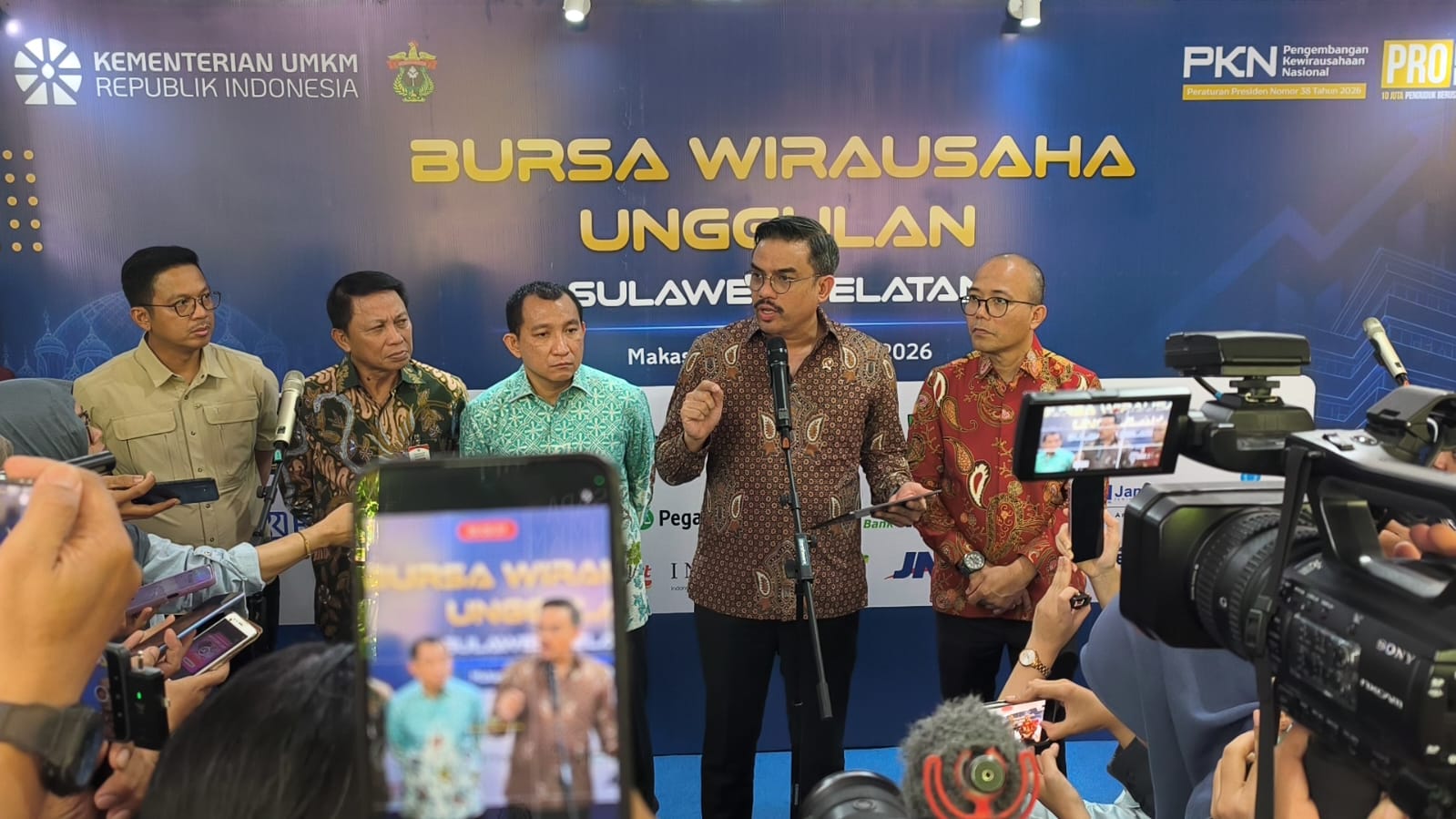
The Outstanding Entrepreneur Exchange (BWU) South Sulawesi 2026 is far more than a ceremony. Held at Baruga Andi Pangerang Pettarani, Hasanuddin University, Makassar, South Sulawesi, on Tuesday (15/9), the event brought together aspiring entrepreneurs and MSMEs with 31 partner institutions, five KUR channeling banks, incubators, universities, state-owned enterprises, private companies and digital platforms.
Among its main agendas were a mass signing of People’s Business Credit (KUR) for MSMEs, pitches by eight selected entrepreneurs, and the strengthening of the ecosystem towards a target entrepreneurship ratio of 3.6 per cent by 2029 and 8 per cent by 2045.
The Ministry of Micro, Small and Medium Enterprises (MSMEs) emphasised that BWU is not a ceremonial affair, but a series of incubation, mentoring and business-connection activities.
Carrying the spirit of “Dare to Start, Keep Growing, Ready to Make an Impact”, the event connected entrepreneurs and MSME enablers with strategic partners, incubators, universities, banks, financing institutions, private companies, state-owned enterprises, digital platforms and market partners.
MSME Minister Maman Abdurrahman said entrepreneurship is a strategic choice for creating added value, opening jobs and driving the economy.
“Entrepreneurship has become a strategic choice for creating solutions, generating added value, opening jobs and driving the economy. This is the meaning of the theme ‘Dare to Start, Keep Growing, Ready to Make an Impact’,” said Maman in his address.
According to him, entrepreneurship development cannot proceed in isolation or stop at ceremonies. The government is targeting an entrepreneurship ratio of 3.6 per cent by 2029 and 8 per cent by 2045.
To this end, the government has issued Presidential Regulation No. 38 of 2026 on National Entrepreneurship Development as an umbrella for collaboration between central and regional governments, universities, the business community, financing institutions, incubators, communities and other stakeholders.
Maman also stressed the importance of business owners not working alone. The Ministry of MSMEs has developed SAPA UMKM as a platform connecting entrepreneurs with legality services, capacity building, financing, standardisation, certification, technology, partnerships and marketing.
“Legality builds trust, bookkeeping opens access to financing, certification widens markets, technology raises productivity, while partnerships help MSMEs scale up their businesses,” he explained.
Riza Damanik, Deputy for Entrepreneurship at the Ministry of MSMEs, reported that BWU South Sulawesi 2026 involved around 1,000 micro, small and medium enterprises, aspiring entrepreneurs and start-up founders. The event collaborated with seven ministries and agencies, 14 partner institutions, five universities and 30 incubators involving 200 tenants.
“BWU is not merely ceremonial. It is a series of incubation and mentoring efforts carried out systematically,” said Riza.
Of more than 600 participants entering curation, 414 passed and are ready to access financing. Some 62 per cent are in the production sector, with the remainder in non-production, dominated by processing industries, agriculture, livestock and fisheries.
Several tenants showcased innovations such as a Smart Aquaculture System, Sipun E-Commerce, an EduTech platform, as well as the downstreaming of seaweed, candlenut, sago and areca nut. On site, participants could access financing zones, partnership and market zones, licensing and legality zones, and incubator and tenant zones. The event was also complemented by matchmaking sessions, inspirational talks and entrepreneur pitching sessions.
Eight selected entrepreneurs presented their business models, products and business development needs before strategic partners, investors, financing institutions and incubators.
One of the main agendas of BWU South Sulawesi 2026 was a mass KUR signing for MSMEs through five channeling institutions: BPD Sulselbar, Bank Mandiri, BRI, BSI and Pegadaian Syariah.
Nationally, Maman said KUR disbursement in 2026 has reached Rp221 trillion to 3.44 million MSMEs, with 65.5 per cent, or around Rp145 trillion, channelled to the production sector. For South Sulawesi specifically, KUR disbursement has reached Rp12.53 trillion to 189,000 MSMEs, with 73 per cent going to the production sector.
“These figures show the huge potential and financing needs of business owners in South Sulawesi, as well as the importance of ensuring that financing is accompanied by mentoring and capacity building,” he said.
The staging of BWU at Hasanuddin University affirms the role of universities in the entrepreneurship ecosystem. Unhas Vice-Rector V, Prof. Amir Ilyas, said campuses are now being pushed to produce not only graduates and publications, but also to ensure that research innovations can be commercialised.
“It is no longer about generating innovations whose findings remain mere prototypes and never proceed to market,” he said.
Unhas is preparing the development of a Maritime Science Techno Park as part of its flagship product ecosystem. The collaboration is also supported by several incubators in South Sulawesi, including the Unhas Directorate of Downstreaming, Commercialisation and Science Techno Park, the Makassar City MSME Incubator, the IKIP Ujung Pandang IKB PPSP MSME Business Incubator, the Kalla Institute, UMI, and Inbistek UNDIPA Makassar.
Andi Darmawan Bintang, Assistant II for Economic and Development Affairs at the Regional Secretariat of South Sulawesi Province, said South Sulawesi possesses great entrepreneurial capital. Data from the South Sulawesi Cooperatives and SMEs Office for 2025 records around 1,087,000 MSMEs, with micro-enterprises accounting for 99.3 per cent.
“Behind these figures are millions of people whose livelihoods and incomes depend on their businesses,” he said.
The South Sulawesi Provincial Government continues to provide facilitation for business identification numbers (NIB), PIRT permits, trademarks, halal certification, equipment assistance, packaging, productive business facilities, management mentoring, product curation, digitalisation training, vocational training, and mentoring through PLUT. Flagship sectors such as food, coffee, spices and fisheries are considered to have strong markets both domestically and overseas.