
Ministry of Marine Affairs and Fisheries pushes Gracilaria seaweed downstreaming to attract investment
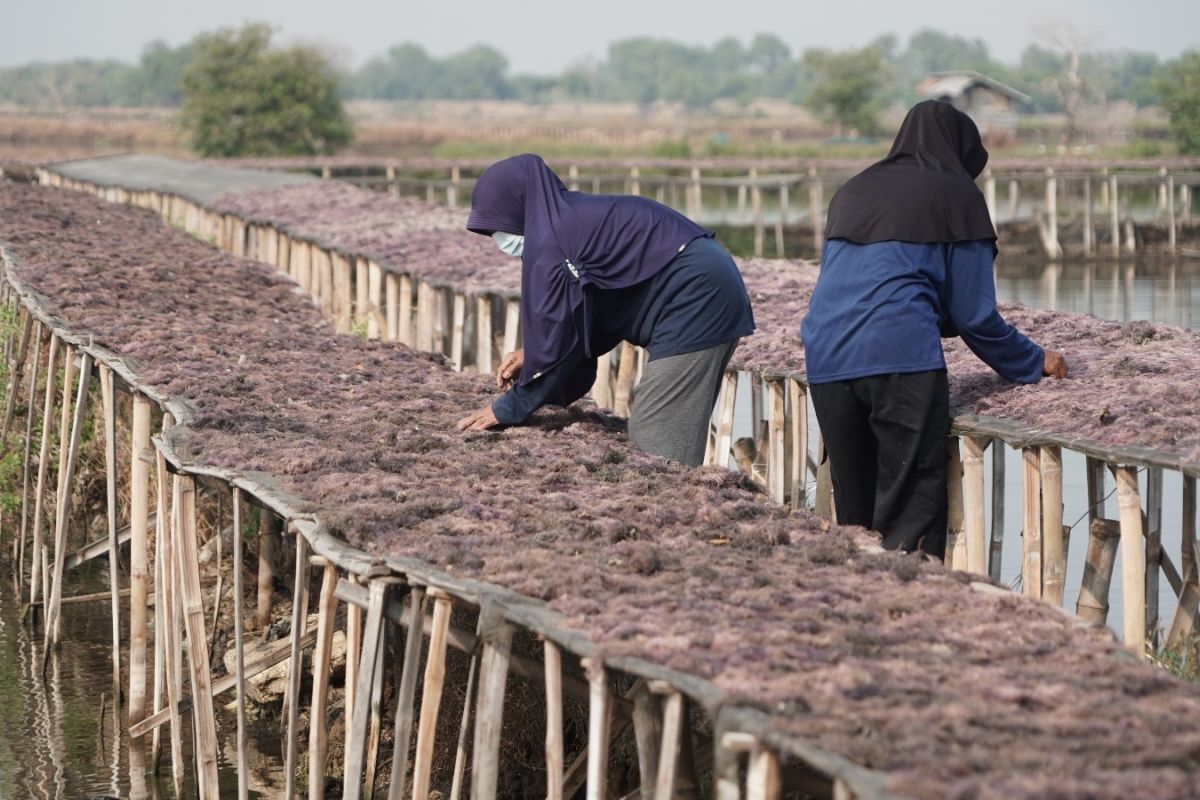
The potential does not stop at production. The upstream sector must be strengthened, and downstreaming must be continuously encouraged so that investment and processing industries emerge, providing greater added value.
Jakarta (ANTARA) - The Ministry of Marine Affairs and Dis Fisheries (KKP) is encouraging the strengthening of Gracilaria seaweed downstreaming in Sidoarjo, East Java, to attract processing industry investment and increase added value for cultivators.
Director General of Aquaculture at KKP, Tb Haeru Rahayu, stated that the development of Gracilaria seaweed should not be limited to production alone but must be accompanied by the strengthening of the processing industry at the downstream level.
“The potential does not stop at production. The upstream must be strengthened, and downstreaming also needs to be continuously pushed so that investment and processing industries emerge, which can provide greater added value,” Haeru said in an official statement in Jakarta on Wednesday.
Haeru noted that the development of Gracilaria aquaculture holds great prospects, as global demand for seaweed is projected to reach 40–43 million tonnes by 2029.
KKP records show that Indonesia is currently the world’s second-largest seaweed producer, with production volume in 2024 reaching 9.8 million tonnes. Of this amount, Gracilaria contributes approximately 16.5 per cent of production across 15 major producing provinces.
Currently, Gracilaria production in East Java reaches 31,947 tonnes, produced through a polyculture system alongside milkfish.
To bolster production, Haeru mentioned that KKP has provided several forms of support to cultivators, including two excavator units for pond repairs, superior Gracilaria seeds, milkfish fingerlings, and financial assistance.
Furthermore, KKP has directed two technical implementation units (UPT) of the Directorate General of Aquaculture in Java—namely the Situbondo Brackishwater Aquaculture Fisheries Centre (BPBAP) and the Jepara Brackishwater Aquaculture Fisheries Centre (BBPBAP)—to develop spore-based Gracilaria seedling technology.
The development of this technology is expected to bring high-quality seed sources closer to seaweed production centres on Java Island. Previously, spore-based seedling technology was developed by the Takalar Brackishwater Aquaculture Fisheries Centre in South Sulawesi.
Head of the Takalar Brackishwater Aquaculture Fisheries Centre, Boyun Handoyo, stated that approximately two tonnes of Gracilaria seedlings produced via spore technology have been sent to Sidoarjo this year.
“This year, about 2 tonnes of Gracilaria seedlings resulting from spore technology have been sent to Sidoarjo. The hope is that these seeds can continue to be developed and multiplied so that cultivators have access to high-quality seed sources,” he said.
Source: jawawa.id (https://jawawa.id/newsitem/ministry-of-marine-affairs-and-fisheries-pushes-gracilaria-seaweed-downstreaming-to-attract-investment-1790165195)
Originally published by Antara (Indonesian) (https://www.antaranews.com/berita/5754871/kkp-dorong-hilirisasi-rumput-laut-gracilaria-untuk-tarik-investasi), translated from Indonesian