
Ministry of Manpower reaffirms pro-worker policies through employment programmes
Jakarta (ANTARA) - The government, through the Ministry of Manpower (Kemnaker), has reaffirmed its commitment to continuously strengthening the protection of workers and improving their welfare through pro-worker policies that balance the interests of the labour force, business continuity, and national competitiveness.
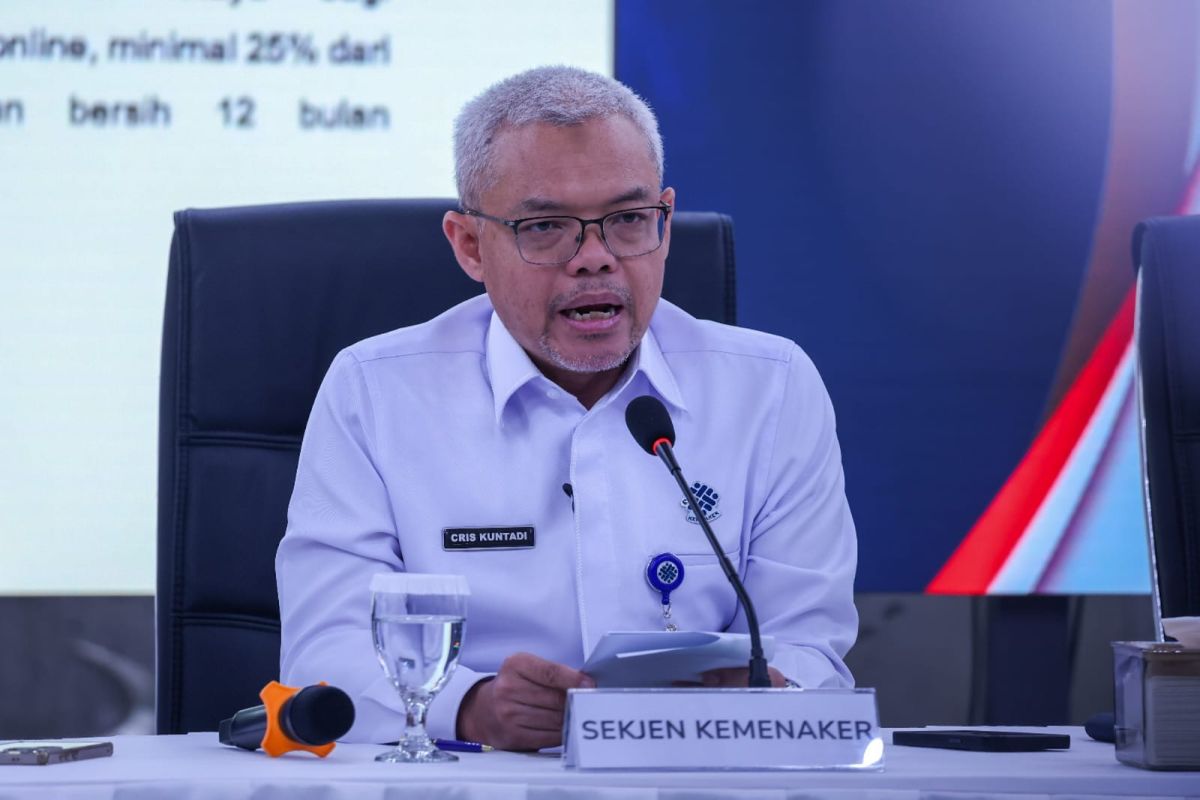
“That is why the government continues to introduce policies that favour workers, while maintaining a healthy, productive, and competitive business climate,” said Secretary General of Kemnaker, Cris Kuntadi, in his statement in Jakarta on Thursday.
One concrete step taken is the determination of the 2026 Minimum Wage (UM) by considering the needs of a decent living, economic growth, and the inflation rate in each region.
The government, he said, is also reorganising the regulation of sectoral minimum wages to create fairness for workers in sectors with different characteristics and levels of work risk.
In the digital economy sector, the government is further strengthening protections for online drivers and couriers through an increase in the Holiday Bonus (BHR).
The amount of BHR is set at a minimum of 25 per cent of the average net income over the last 12 months as a form of appreciation for the contributions of digital platform workers to the national economy.
“Social protection for informal workers is also continuously expanded through policies providing relief on contributions to Work Accident Insurance (JKK) and Death Insurance (JKM) by 50 per cent for Non-Wage Recipients (BPU). This policy covers online drivers, couriers, farmers, fishermen, traders, and livestock breeders,” Cris explained.
The government, he continued, is strengthening the benefits of the Job Loss Guarantee Programme (JKP) for workers affected by termination of employment.
Meanwhile, in the housing sector, more than 274,000 subsidised housing units are being prepared so that workers have access to decent and affordable housing.
In the regulatory field, the government together with the House of Representatives (DPR RI) has completed discussions on the Draft Law on the Protection of Domestic Workers (PPRT).
Facing global economic challenges, the government is preparing integrated mitigation steps through the establishment of the Debottlenecking Task Force, strengthening the early warning system for layoffs, and increasing monitoring of affected sectors.
In addition, improving the quality of human resources is being strengthened through a national vocational training programme for 70,000 high school/SMK/MA graduates in 2026, as well as a National Internship programme for 100,000 university graduates to accelerate the transition to the workforce.
The government is also providing free productivity training and General K3 Expert certification for 4,000 workers, as well as expanding job opportunities through assistance for Independent Labour (TKM), placement of workers for persons with disabilities, and development of worker cooperatives as an alternative for economic strengthening.