
Ministry of Law: Strengthening International Humanitarian Law Must Not Wait for Conflict
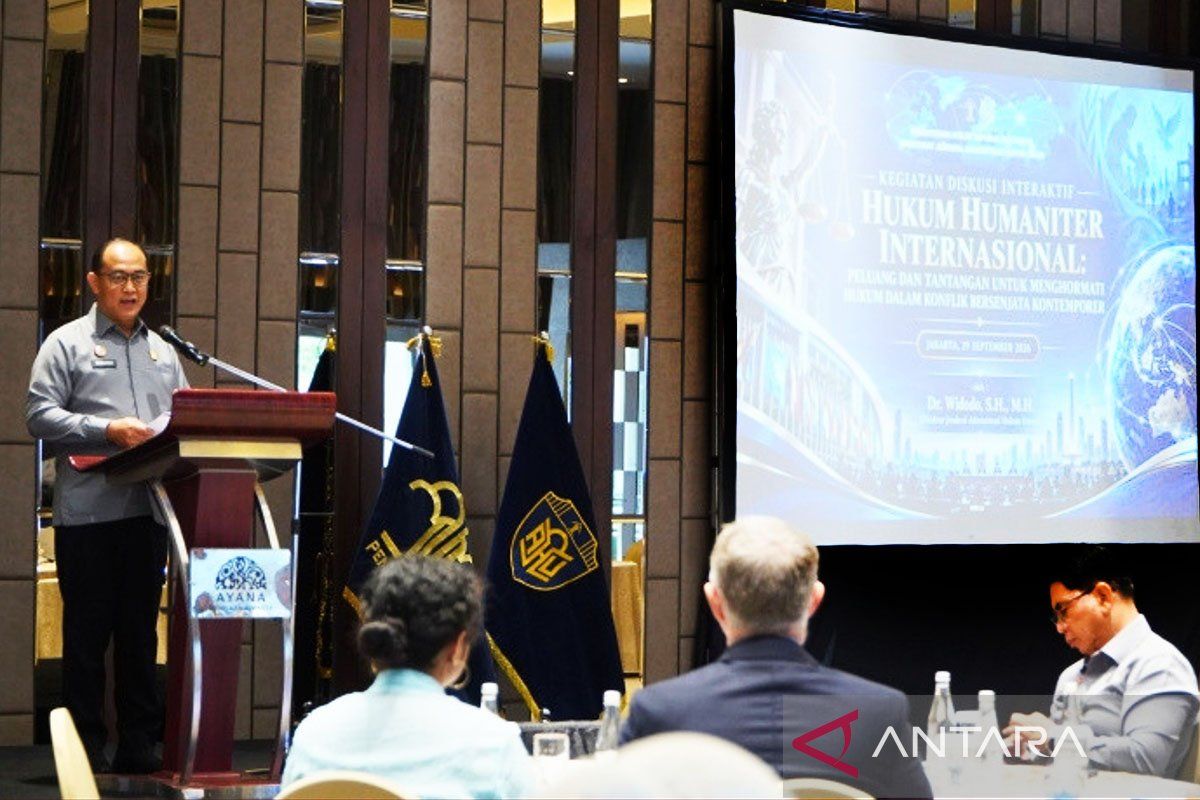
Jakarta (ANTARA) - The Ministry of Law (Kemenkum) has emphasised that the strengthening of International Humanitarian Law (IHL) must not wait for conflicts to occur.
During an interactive discussion in Jakarta on Tuesday (29/9), the Director General of General Legal Administration (AHU) of the Ministry of Law, Widodo, stated that national readiness must be built through understanding, coordination, and early implementation.
“The strength of international humanitarian law is determined not only by how complete our regulations are, but also by how consistently those rules are understood, applied, and respected,” said Widodo, as quoted from a statement confirmed in Jakarta on Wednesday.
International humanitarian law is a set of rules established for humanitarian reasons to limit suffering and regulate the conduct of parties involved in armed conflicts.
He noted that IHL was born from the awareness that even within armed conflicts, there are boundaries that must be respected to protect humanity.
According to him, the challenges facing IHL are growing as global conflicts become increasingly complex. Data from the International Committee of the Red Cross (ICRC) recorded more than 130 armed conflicts occurring worldwide in 2025.
He stated that technological advancements are changing the face of armed conflict, ranging from long-range attacks, artificial intelligence (AI), and cyber warfare, to the use of civilian infrastructure for military purposes.
“However, one thing must not change, which is that the boundaries to protect humanity must continue to be respected,” he said.
He mentioned that technological changes are also giving rise to new issues, meaning that the principles of distinction, proportionality, and precaution must remain the boundaries in every conflict to protect populations and civilian objects.
Thus, he said, the question is not merely whether the law can keep pace with technological developments and methods of conflict, but how to ensure that such developments remain within the corridors of law and humanity.
Widodo reaffirmed that Indonesia has a long-standing commitment to the application of IHL, including since becoming a party to the 1949 Geneva Conventions.
It was stated that this commitment is strengthened through the Standing Committee for the Application and Research of International Humanitarian Law (PANTAP).
He assessed that the application of IHL requires collaborative efforts between the government, academics, and other stakeholders.
Widodo noted that Indonesia is also active in international forums, such as the Global Initiative to Galvanise Political Commitment to International Humanitarian Law, through the Naval Warfare Workstream, which is co-chaired with Egypt.
As an archipelagic nation, he continued, Indonesia views maritime conflict issues as strategic. The impacts can extend to coastal communities, the marine environment, shipping, connectivity, and infrastructure.
“The strengthening of international humanitarian law in the context of naval warfare needs to be continuously developed,” said Widodo.
Therefore, Widodo expressed his hope that the discussion would produce actionable recommendations, rather than being merely an exchange of knowledge.
Source: jawawa.id (https://jawawa.id/newsitem/ministry-of-law-strengthening-international-humanitarian-law-must-not-wait-for-conflict-1790787602)
Originally published by Antara (Indonesian) (https://www.antaranews.com/berita/5765593/kemenkum-penguatan-hukum-humaniter-internasional-tak-menunggu-konflik), translated from Indonesian