
Ministry of Industry asserts PMI return to expansion proves industrial resilience
Jakarta (ANTARA) - The Ministry of Industry (Kemenperin) has asserted that the return of Indonesia’s manufacturing Purchasing Managers’ Index (PMI) to the expansion zone in May 2026 serves as evidence of the national industry’s resilience in facing various global challenges.
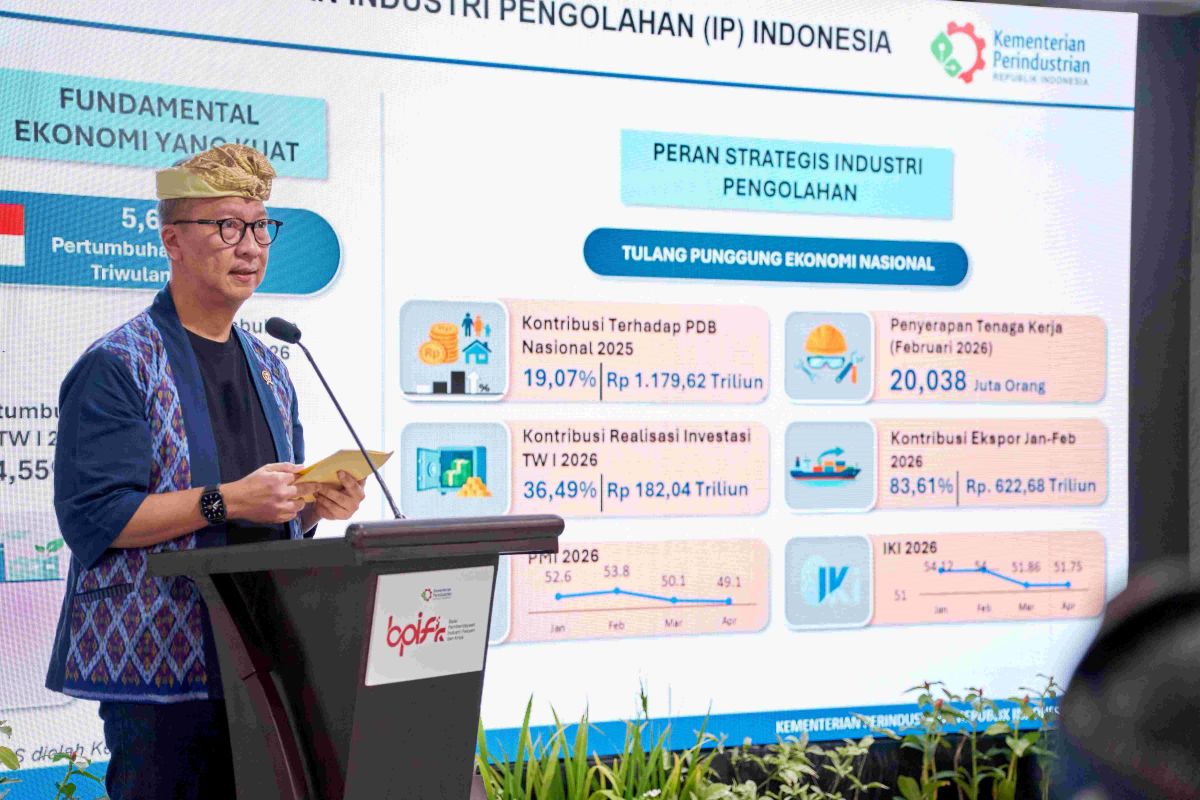
Data from S&P Global shows that Indonesia’s manufacturing PMI in May 2026 stood at an expansion level of 50.0, an increase from April 2026, which was recorded at 4-9.1, representing a contraction zone.
In a statement confirmed in Jakarta on Tuesday, the Minister of Industry, Agus Gumiwang Kartasasmita, stated that the improvement in the manufacturing PMI reflects the ability of industrial players to maintain production continuity amidst global economic dynamics.
“The increase in Indonesia’s manufacturing PMI in May 2026 reflects the industry’s response to maintaining production continuity amidst ongoing global dynamics. Industrial players are taking anticipatory steps by strengthening raw material stocks to ensure that production activities continue in the coming months,” said the Minister.
According to Agus, the rise in the PMI in May needs to be understood comprehensively. One factor driving the improvement in the index is the increase in raw material inventories by the manufacturing industry as a mitigation step against potential supply disruptions and rising prices of imported raw materials.
“Indonesia’s current import structure consists of approximately 70 per cent raw materials and auxiliary materials, about 15 per cent capital goods such as machinery and equipment, while the remainder consists of consumer goods. Given the challenges of global logistics and increasing uncertainty in access to imported raw materials, industries are choosing to increase raw material stocks to maintain operational continuity,” he explained.
He revealed that while industries previously held raw material inventories for approximately three months, many companies have now increased their reserves to enough to support operations for the next six months.
This step is considered vital, particularly for industries characterised by continuous production processes. In the petrochemical industry, for example, production facilities must operate at a minimum capacity of 50 to 60 per cent to avoid a total shutdown.
“If production facilities such as petrochemicals are shut down entirely, the time required to return to normal capacity can be quite long, at least about two weeks. Similar conditions occur in industries that use furnaces, such as the ceramics, glass, and nickel processing industries. Therefore, maintaining the availability of raw materials is crucial,” he said.
In addition to maintaining production continuity, the increase in raw material stocks is also being implemented as an anticipatory measure against potential future increases in raw material prices.
He assessed that manufacturing companies cannot directly adjust product selling prices because the market requires time to adapt.
“Manufacturing companies must maintain a balance between production sustainability and product price competitiveness. When raw material prices have the potential to increase, they choose to secure supplies first because adjustments to selling prices in the market cannot be done instantaneously,” he said.
The Ministry of Industry noted that the manufacturing PMI achievement in May 2026 is also in line with the positive performance of the Industrial Survey Index (IKI), which reached 53.56, a significant increase compared to April 2026 at 51.75.
The increase in the IKI indicates optimism among industrial players regarding business conditions and the prospects of improving domestic demand.
“The simultaneous movement of the PMI and IKI upwards in May 2026 serves as a signal that the national manufacturing sector still possesses strong resilience. The industry continues to maintain its production activities while anticipating various risks arising from external factors,” said the Minister.
According to the S&P Global report, the increase in Indonesia’s Manufacturing PMI in May 2026 was also supported by faster growth in new orders compared to the previous month, particularly from the domestic market.
Nevertheless, production cost pressures and raw material supply disruptions remain the primary challenges facing the manufacturing sector.
The Ministry of Industry stated it will continue to strengthen coordination with industrial players to ensure the smooth supply of raw materials, maintain national production continuity, and enhance the competitiveness of Indonesian manufacturing amidst global economic dynamics.