
Ministry of Immigration and Correctional Services Strengthens Public Service Governance through Evaluation-to-Action
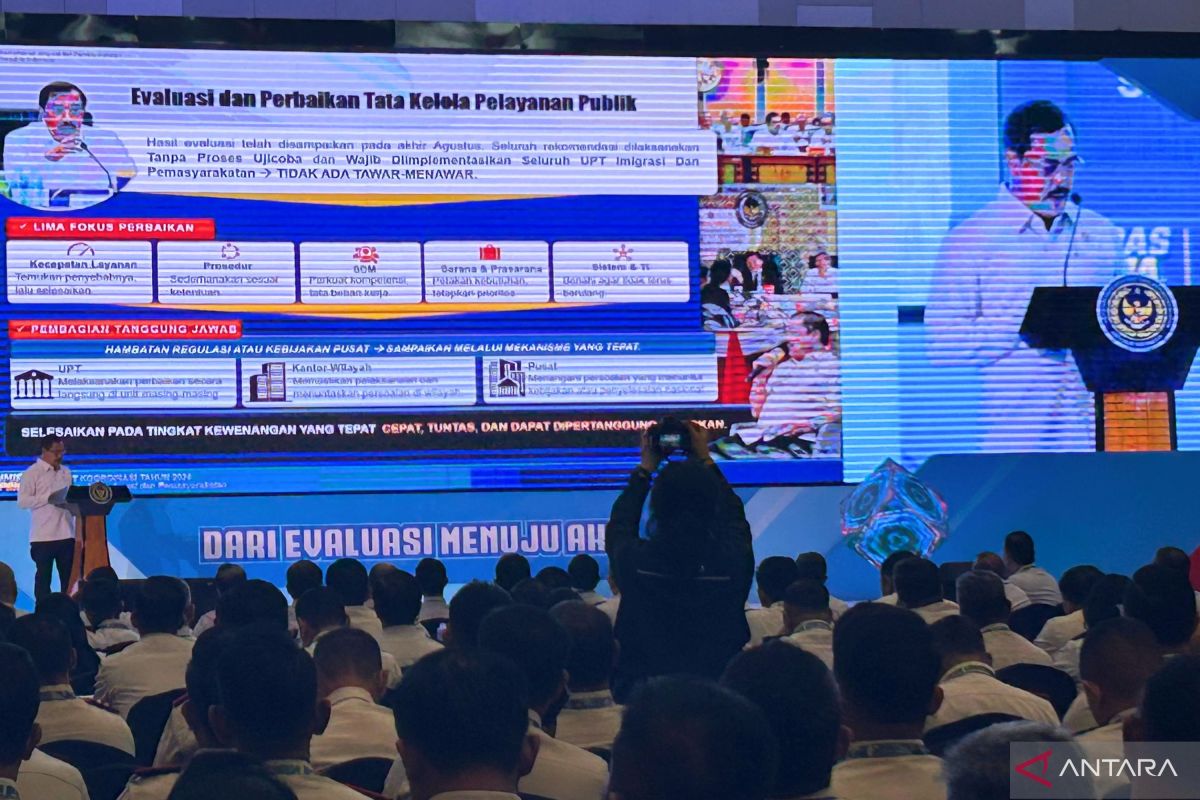
Jakarta (ANTARA) - The Ministry of Immigration and Correctional Services (Kemenimipas) is strengthening public service governance through an ‘evaluation-to-action’ approach, as announced during the 2026 Kemenimipas Coordination Meeting in Jakarta on Monday.
Minister of Immigration and Correctional Services, Agus Andrianto, urged a comprehensive overhaul of public service governance within the immigration and correctional sectors.
“Our measure of success is when the community experiences better services, gains certainty, and sees that the Ministry of Immigration and
Correctional Services acts as a solution-oriented entity for the duties and functions entrusted to us,” said Agus during the opening of the meeting.
In the correctional sector, he stated that the evaluation began with mapping 52 types of services. After filtering based on urgency, impact on inmate rights, governance risks, problem intensity, and the need for improvement, eight high-leverage services were identified.
From these eight services, Agus noted that the evaluation established three ‘quick wins’: assimilation, conditional release, conditional leave, and leave prior to release; community research; and the correctional database system.
It was noted that observations and spot checks across five regions and 18 Technical Implementation Units (UPT) showed that service challenges were not solely related to processing duration. Instead, the evaluation revealed a need to strengthen time certainty, the division of authority, standardisation of decision-making, and data traceability.
Meanwhile, in the immigration sector, the Minister stated that evaluations were conducted on 99 services under three technical directorates. The screening process was based on leverage, risk levels, dependence on automation, intensity of interaction with the public and foreign nationals, and the impact on sovereignty, security, and state revenue, resulting in three priority services.
These three services include passport issuance and renewal via M-Paspor, residence permit services via Molina, and inspections at Immigration Checkpoints (TPI) through automatic gates (autogate) and manual gates.
He revealed that the immigration evaluation was carried out through observations and spot checks across six regions and 13 UPTs between 21 July and 8 August 2026.
From this process, Kemenimipas formulated several improvement steps, including ensuring certainty and accelerating passport services, resolving passport issues through a single window, accelerating risk-based residence permits, risk-based monitoring of foreign nationals, and establishing fast lanes at immigration checkpoints based on risk levels.
It was explained that both evaluations demonstrate the importance of directing improvements towards the system rather than just individual implementers.
In the correctional sector, he mentioned that changes are directed from uncertain service times to measurable standard times, from uncontrollable community research burdens to baseline-based resolution and workload redistribution, and from untraceable data changes to transactions using individual accounts and audit trails.
In the immigration sector, strengthening will be achieved through six ‘enablers’ or cross-service facilitators, including human resource management based on workload and risk, segregation of authority, strengthening systems and data integration, infrastructure enhancement, risk intelligence, and the strengthening of integrity and internal supervision.
Agus stated that various Kemenimipas public services are implementations of 15 action programmes that are continuously monitored and reported through STAR Proaksi. This application serves as both a channel and a dashboard projected to become the single data source for the 15 Action Programmes. STAR Proaksi was also launched during the 2026 Kemenimipas Coordination Meeting.
He instructed all Kemenimipas personnel not to treat this coordination meeting as a mere formality, but as a turning point in improving performance and the quality of service to the public.
Following the meeting, he expressed hope that every leader would have clarity on what needs to be done, who is responsible, when it must be completed, how success can be measured, and how results should be reported.
“Do not go home carrying only presentation materials; bring home work that must be completed and changes that can be realised,” he said.
Through the momentum of turning evaluations into real action, Kemenimipas remains committed to strengthening public service governance. The strategic coordination meeting, held from 20–23 September 2026, serves as a drive for all Kemenimipas ranks—including central units, regional offices, and Technical Implementation Units—to continuously improve and remain oriented towards providing the best service to the community.
Source: jawawa.id (https://jawawa.id/newsitem/ministry-of-immigration-and-correctional-services-strengthens-public-service-governance-through-evaluation-to-1789981273)
Originally published by Antara (Indonesian) (https://www.antaranews.com/berita/5751023/kemenimipas-perkuat-tata-kelola-pelayanan-publik-lewat-evaluasi-aksi), translated from Indonesian