
Ministry of Home Affairs Urges Data-Driven Approach to Managing Government Communication Crises
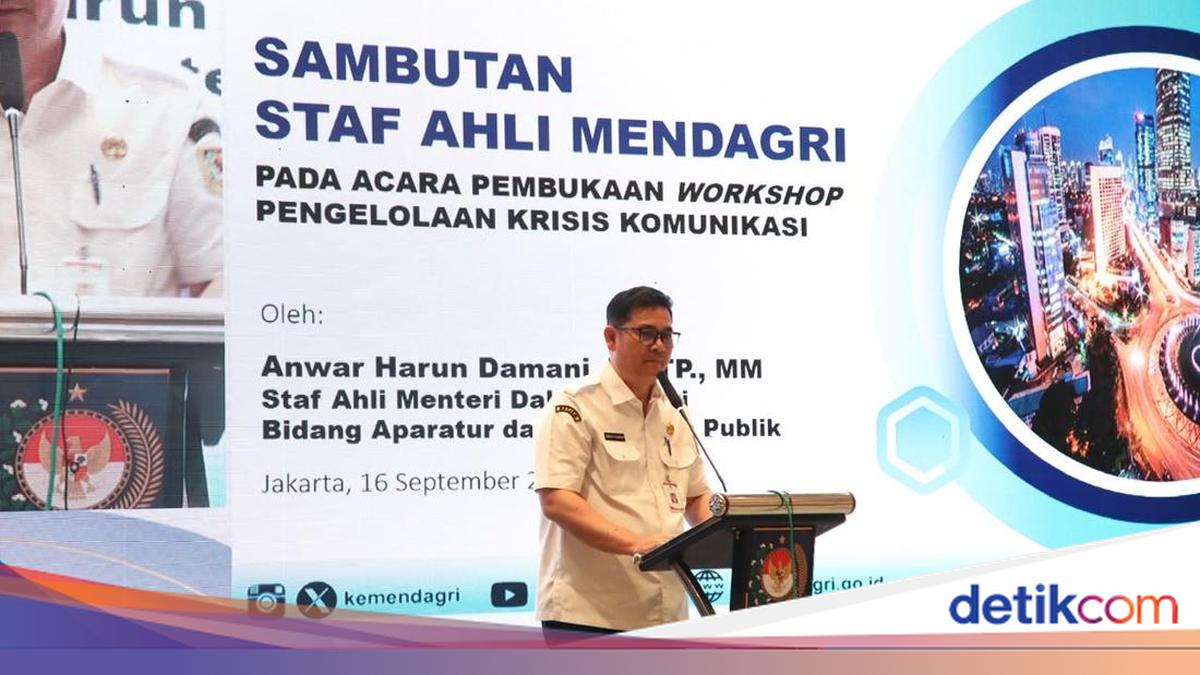
The Ministry of Home Affairs (Kemendagri) is encouraging the management of government communication crises to be conducted swiftly, accurately, and based on data. This effort is considered vital to increasing the readiness of officials in detecting, analysing, and responding to communication issues amidst the rapid flow of information.
This was stated by the Expert Staff to the Minister for Apparatus and Public Services at the Ministry of Home Affairs, Anwar Harun Damanik, while opening the Communication Crisis Management Workshop at the Grand Orchardz Hotel Kemayor, Jakarta, on Wednesday (16/9). The event is scheduled to take place from 15 to 18 September 2026.
“Crisis management must be carried out systematically through stages of detection, verification, coordination, amplification, and evaluation. Crisis handling must be fast, accurate, data-driven, consistent, and remain contextual,” said Anwar in a written statement on Thursday (17/9/2026).
Anwar explained that communication crises do not always originate from major issues. Errors in delivering information, inaccurate data, or internal organisational conflicts can evolve into issues that affect public perception if not addressed immediately.
Therefore, officials performing public communication functions are required to be responsive and adaptive to technological developments. Communication patterns that rely solely on conventional methods and wait for problems to arise are deemed inadequate for facing the dynamics of information in the digital space.
“When delivering a statement, whether via social media or directly in person, such as during a doorstop interview, answers must be provided. Do not rely on assumptions,” he emphasised.
Anwar stressed that every piece of information delivered to the public must be supported by accountable data. Accuracy of information is necessary so that government communication remains consistent while preventing the emergence of new problems.
Furthermore, managing communication crises also requires coordination between various government components, including between the central and regional governments. Regional governments (Pemda) are considered to hold a strategic position because they interact directly with the community. Therefore, the development of issues in the regions needs to be communicated to the central government according to their respective authorities.
Anwar also reminded that managing communication crises is not the sole responsibility of Public Relations units. Delivering information to the public requires support from data and substance from relevant units that understand the issues and possess the authority for their resolution.
“Public trust is a very important asset for every institution. That trust is not formed merely by providing a large amount of information, but through consistency between policy, action, and government communication,” he said.
Through this workshop, Anwar hopes that participants can apply the knowledge and skills obtained in their respective agencies to strengthen public communication capacity and readiness to face potential communication crises within the government environment.
Source: jawawa.id (https://jawawa.id/newsitem/ministry-of-home-affairs-urges-data-driven-approach-to-managing-government-communication-crises-1789628572)
Originally published by detikcom (https://news.detik.com/berita/d-8666712/kemendagri-minta-krisis-komunikasi-pemerintah-ditangani-berbasis-data), translated from Indonesian