
Ministry of Home Affairs Discusses Strengthening Local Food via Free Nutritious Meal Programme in Frontier Regions
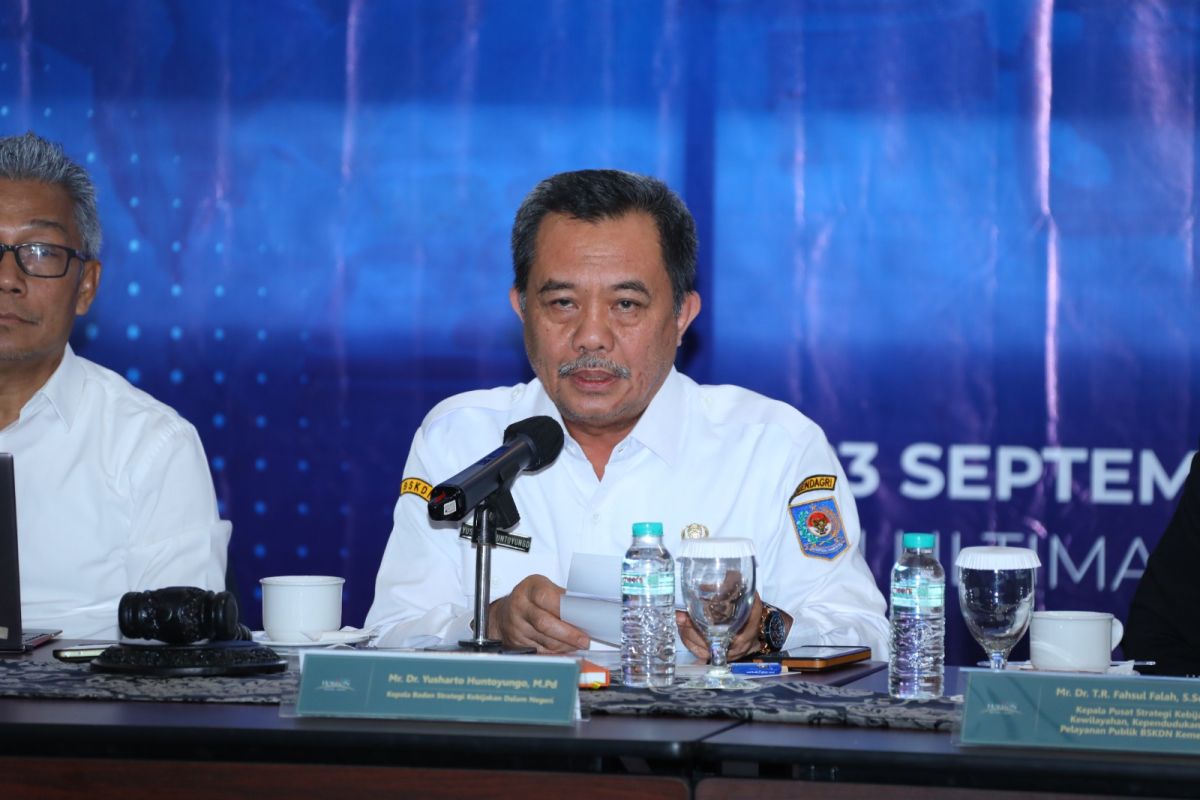
The Agency for Domestic Policy Strategy (BSKDN) of the Ministry of Home Affairs has emphasised the importance of strengthening the implementation and utilisation of the Free Nutritious Meal (MBG) programme to support local food systems in underdeveloped, frontier, and outermost (3T) regions.
In a statement in Jakarta on Wednesday, the Head of BSKDN, Yushlagarto Huntoyungo, stated that the implementation of the MBG programme in 3T areas requires an adaptive and inclusive approach, taking into account geographical, social, economic, and infrastructural conditions, as well as regional price indices. Consequently, the acceleration of the programme must be achieved through collaboration across ministries, agencies, and local governments.
“On this occasion, I specifically invite the Ministry of Villages, Development of Disadvantaged Regions (Kemendes PDT), which oversees underdeveloped areas; the National Border Management Agency (BNPP), which guards frontier regions; the National Nutrition Agency (BGN); and other relevant agencies to form synergy in terms of programmes, data, and guidance,” he said.
At the same event, the Director General for the Acceleration of Development of Disadvantaged Regions at Kemendes PDT, Samsul Widodo, noted that the MBG programme in 3T areas offers a broader opportunity to strengthen community food systems. He argued that developing local food is essential so that the programme does not merely focus on nutritional intake, but also builds community capacity and stimulates local economic activity.
“The MBG is not just about providing nutrition; there is something much deeper we are fighting for. These underdeveloped areas must be prioritised,” he stated. He explained that Kemendes PDT is currently developing food systems in Papua, including through the strengthening of ‘local champions’—local leaders at the village level who can assist communities in developing agriculture and processing local food ingredients. “Regardless of the debates surrounding the MBG, for me, this is a momentum; it is about how we utilise this momentum for food industrialisation,” added Samsul.
Meanwhile, public policy observer and community empowerment specialist Gatot Tri Laksono suggested that the implementation of the MBG in 3T regions should be positioned as part of integrated human development. He believes the programme can be directed to support nutritional and health interventions while simultaneously strengthening food security and local economic empowerment. He noted that food procurement for the MBG should prioritise local commodities to create opportunities for farmers, fishermen, livestock breeders, MSMEs, village-owned enterprises (BUMDes), and village cooperatives to participate in the food supply chain.
Gatot proposed several principles for implementation, including maintaining national standards for nutritional quality, food safety, and accountability; adjusting production and logistics to geographical conditions; prioritising local procurement; strengthening collaborative governance from central to village levels; ensuring data-driven approaches; and providing affirmative action for regions with limited access.
From a border region perspective, the Assistant Deputy for Government Infrastructure at BNPP, Bakri Siddified, emphasised the importance of ensuring the MBG programme reaches communities in the outermost regions. He stated that equal access must be part of the state’s presence in border areas.
“Our hope is that in these border areas—since we have agreed to make our national borders a showcase, a front porch, and a symbol of national dignity—the state must be present at the edges of the country,” said Bakri. He also warned that distance and distribution access must be considered to ensure that the food provided to the community remains fit for consumption. “We hope the distance is a maximum of 5 kilometres from the Integrated Border Posts (PLBN) so that the distance for transporting food can be managed and, of course, to prevent food from spoiling or becoming unsuitable,” he concluded.
Source: jawawa.id (https://jawawa.id/newsitem/ministry-of-home-affairs-discusses-strengthening-local-food-via-free-nutritious-meal-programme-in-frontier-1790158358)
Originally published by Antara (Indonesian) (https://www.antaranews.com/berita/5754656/bskdn-kemendagri-bahas-penguatan-pangan-lokal-melalui-mbg-di-daerah-3t), translated from Indonesian