
Ministry of Forestry Prepares 46 Drone Pilots to Strengthen Law Enforcement Intelligence Centre
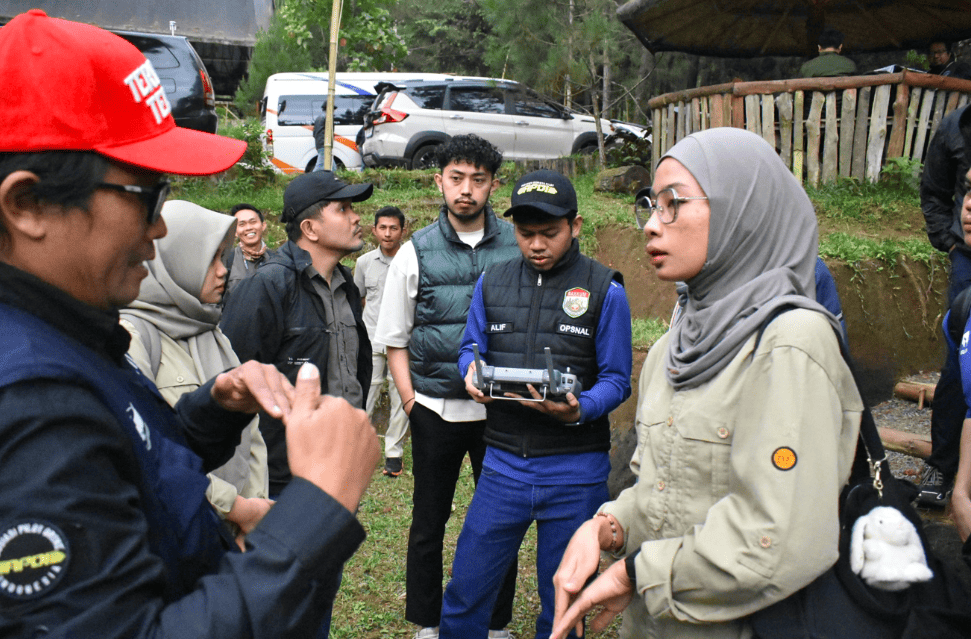
The Ministry of Forestry (Kemenhut), through the Directorate General of Forestry Law Enforcement (Gakkum), is enhancing the capabilities of 46 Intelligence Centre personnel in the use and operation of drone technology, or Unmanned Aerial Vehicles (UAVs). This capacity building is aimed at supporting intelligence activities, forest area monitoring, field verification, and the collection of evidence based on spatial data in a faster, more accurate, and measurable manner.
The technical training was held from 7 to 12 July 2026 at the Green Forest Hotel in Lembang, West Bandung Regency, West Java. Participants came from the Directorate General’s Secretariat, all technical directorates, and all Forestry Law Enforcement Offices. This activity is part of the Directorate General of Forestry Law Enforcement’s efforts to address the increasingly complex development of forestry crimes, which are now more organised, utilise technology, and span vast and hard-to-reach areas. These conditions demand that forestry law enforcement no longer rely solely on conventional methods but be strengthened through monitoring and information-gathering technology that can effectively cover the field.
Director General of Forestry Law Enforcement, Dwi Januanto Nugroho, asserted that drone technology has evolved into an important instrument in supporting forestry law enforcement operations. “Drones are no longer just documentation tools. This technology is a strategic instrument to strengthen intelligence work, supervision of forest area management, and field verification, in order to obtain spatial data and evidence quickly and accurately for law enforcement purposes,” he stated on Sunday (12/7).
Director of Prevention and Complaint Handling, Yazid Nurhuda, said the vastness of Indonesia’s forest areas and the increasingly complex modes of forestry crime must not hinder law enforcement efforts, making the need for adaptive, professional officers who can utilise technology responsibly an absolute necessity. He added that drone monitoring data must be integrated with the Intelligence Centre to serve as a basis for decision-making in forestry law enforcement. “After this training, these skills must be immediately applied in your respective work units. The spatial data from drone monitoring must be entered and integrated into the Intelligence Centre, so that decisions regarding intelligence activities, supervision, complaint handling, field verification, and the collection of materials and information can be made based on accurate and correct information,” Yazid said.
Participants received instruction on regulations for operating small unmanned aircraft systems, flight safety, Aeronautical Decision Making, Crew Resource Management, risk management, the use of the SIDOPI GO application, and field mapping practices. Participants also underwent a certification test as part of the effort to increase the number of law enforcement officers who have official competence and certificates as drone pilots. The materials and training were provided by professionals from the Directorate of Airworthiness and Aircraft Operations and the Directorate of Aviation Navigation of the Directorate General of Civil Aviation at the Ministry of Transportation, the Indonesian Drone Pilots Association, and AirNav Indonesia.
The strengthening of Intelligence Centre personnel capabilities is expected to have a direct impact on data and information collection activities, early detection of forest area disturbances, monitoring of illegal activities, operational planning, and the substantiation of forestry cases. The use of drones can also help officers identify field conditions before an operation is carried out, making personnel movement more effective and reducing safety risks.
The Ministry of Forestry continues to encourage the transformation of forestry law enforcement based on technology, data, and information. Equipment modernisation must go hand in hand with improving the integrity, competence, discipline, and professionalism of officers. Indonesia’s forests span a vast landscape and face ever-changing threats. The state must be able to see faster, read changes more sharply, and act more precisely. “The use of drone technology is a concrete step to strengthen the state’s presence in protecting forests as a living space for communities, a source of water, a safety buffer, and a heritage for future generations,” he concluded.
Source: jawawa.id (https://jawawa.id/newsitem/ministry-of-forestry-prepares-46-drone-pilots-to-strengthen-law-enforcement-intelligence-centre-1783853432)
Originally published by Media Indonesia (https://mediaindonesia.com/humaniora/910068/kemenhut-siapkan-46-pilot-drone-perkuat-intelegence-center-gakkum), translated from Indonesian