
Ministry of Environment Boosts Journalistic Skills in the Era of Swipe and Scroll
The media and public communication landscape has changed rapidly. The flow of information is relentless: people open their phones, scroll through their feeds, click on a headline that sparks curiosity, then swipe to the next article — all within seconds.
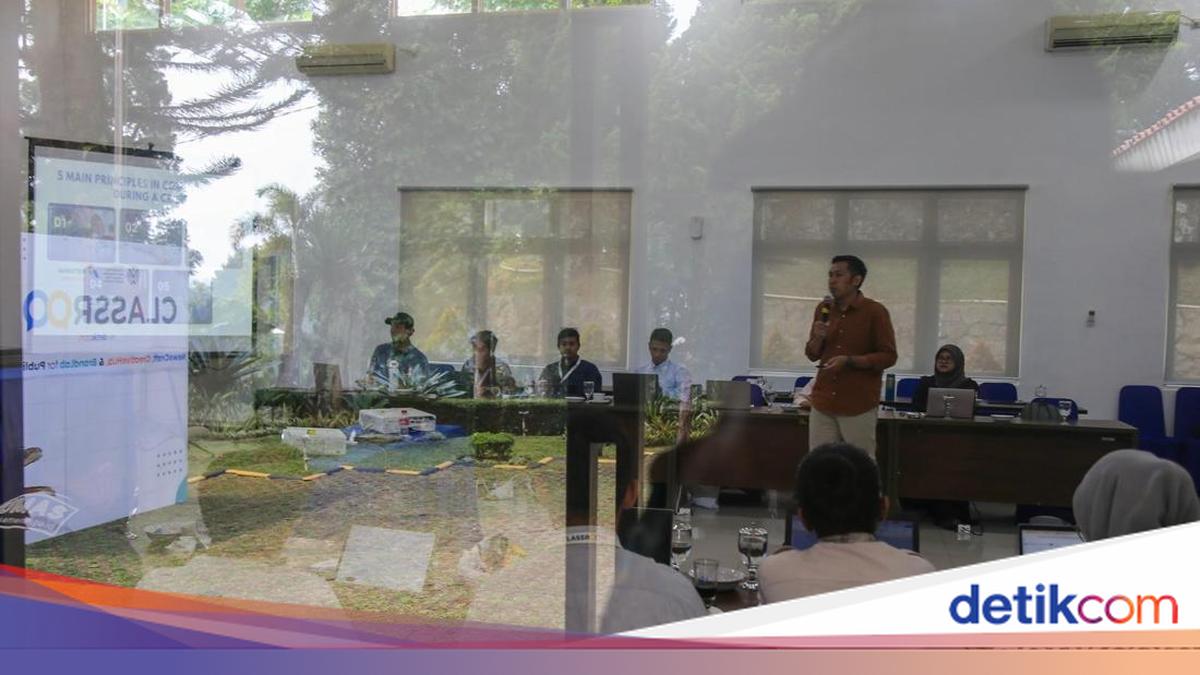
This was emphasised by Angga Aliya ZRF, Executive Editor of detikFinance, when opening the NewsCraft+ session titled ‘Journalism in the Click, Swipe & Scroll Era’ at The Classroom Batch 3. The event was organised by the Ministry of Environment/Environmental Control Agency (KLH/BPLH) together with detikcom.
Held from 14-16 July 2026 at Wisma PGN Megamendung in Bogor, West Java, the programme was attended by 36 members of the KLH/BPLH team from working units across Indonesia, ranging from the Environmental Control Centre to the Directorate of Environmental Criminal Law Enforcement.
According to Angga, the mass media has evolved from print to online and now social media. Whereas the public once relied on conventional media or mainstream news applications, social media has now become the primary gateway for information seeking.
‘Nowadays people don’t look for news from just one source. In the past, people read the newspaper or opened the detik app; now they search everywhere, including on social media like Instagram and TikTok,’ he said on Wednesday (15 July 2026).
This has triggered an ‘information explosion’ for the public. On the one hand, people find it easier to access information on social media; on the other, not all the information they receive can be held accountable for its accuracy.
‘There is now an information explosion, making it harder for people to find credible information… which raises the question of whether the mass media will still exist alongside social media,’ he said.
Angga stressed that the mass media will not disappear. The two complement each other, with social media acting as a distribution bridge for the more credible information produced by the mass media.
‘So the mass media will always exist; only its form is changing, because ultimately social media becomes the medium that delivers information from the mass media,’ he explained.
Even so, he said, the difference now is that editors at mass media outlets are no longer fully empowered to determine what the public should read. Readers now hold full control over the information they want.
‘In the past it was editor-driven, meaning editors decided which news the public should read — the editor decided what deserved the front page. That no longer applies. Now we have shifted to audience-driven, meaning we must be able to deliver the information that netizens actually want,’ he explained.
This shift in focus towards the audience has a direct impact on the lifecycle of a news story or viral content. Whereas an issue once stayed hot for months, its duration is now increasingly short.
‘If you observe the viral cycle, in the past people would still be discussing the same issue a month or two months later — in earlier times it could last up to a year, in the era before TikTok videos. Now it gets shorter and shorter, so what goes viral this week is replaced by something else the next,’ he said.
He added that the current challenge is how to break through the algorithm-based systems of social media, which confine users’ interests within their own information bubbles.
‘Because it is algorithm-based, each person lives in their own bubble. For example, if I like basketball, that’s all that keeps appearing; if I rarely open content about the environment, environmental content may never appear. This becomes a challenge for us — how to get information into the bubbles of these people,’ he explained.
Writing from Scratch to Crisis Management
In response to these conditions, Angga emphasised the importance of writing news that captures attention. The KLH/BPLH team was asked to write based on news values and adhere to the 5W+1H principle. In addition, the language used must be simple and easy to understand.
Unlike previous editions, which focused mainly on theory and text analysis, The Classroom Batch 3 was designed with a far more tactical and applicable training method.
‘So the current material still covers news writing, plus a bit on communication crisis management, but the emphasis now is on practice. Previously we only dissected press releases; now we truly start from zero,’ he explained.
Participants from the KLH/BPLH team were required to practise the full news production process from the beginning, distilling leadership policy directives into material ready for public consumption. Through these simulations, the KLH/BPLH team is expected to develop fast and strategic communication reflexes, particularly when facing crises or issues in the field.
‘The hope is that they can make decisions more quickly when producing content or press releases in any form of communication — that they can determine whether an event constitutes a crisis or a minor issue, and can devise the strategies the ministry needs in specific situations,’ he said.
Audio-Visual Content Production
Beyond equipping participants with news writing and crisis management skills, The Classroom Batch 3 also paid attention to audio-visual content production through CreativeHub+. The second session was led by Okta Marfianto, Head of Brandstudio at detikcom.
According to Okta, the most common mistake in the field during creative video production is skipping the planning phase and jumping straight into filming. This often leaves teams directionless on location.
‘They need to know what they want to create and how the storyline is developed. Usually, when making a video, this is what is most often forgotten — we go straight to coverage and filming, and once on location we forget or don’t know what we’re supposed to do. That’s why in this third batch I’m emphasising the pre-production process: how they generate ideas, how those ideas emerge, what the steps are, what needs to be considered in creating a storyline, and what the production process looks like,’ he explained.
To help the KLH/BPLH participants understand, Okta likened the video production flow — from pre-production, production, to post-production — to a chef preparing a dish. The three stages form an integrated whole that together determine the quality of the final result.
‘The most important thing is understanding the step-by-step process of making a video, from pre-production, production, and post-production — these three lines are equally important. To use an analogy, it’s like a chef: in pre-production, we plan what we will cook; in production, we buy the ingredients and choose them wisely; and in post-production, the chef prepares a delicious dish that, at the end of the day, we can recommend to a wide audience,’ he said.
Through this analogy and the deepening of the material, it is hoped that the KLH/BPLH team will not simply shoot footage, but be able to design visual works with a strong message that reaches the audience effectively.
‘What I want to emphasise is that I have high hopes for the importance of these three processes, explained in greater detail so they understand and know what to do when creating a video,’ he asserted.
Capacity Building and Internal Synergy within KLH/BPLH
Meanwhile, Hadi Winanto, Coordinator of the Information and Data Centre at KLH/BPLH, outlined the progress and benefits gained by participants throughout the series of classes. As a ministry now standing on its own, improving communication capacity has become a crucial agenda.
‘We have seen the communication benefits across these three batches. KLH has only recently separated from the Forestry Ministry and genuinely needs capacity building. We can see that colleagues who have taken part in this training are more confident and engage better with the public when they are out in the community,’ he said.
Amid the onslaught of the digital era, Hadi also stressed the importance of staff mastering contemporary communication styles so that messages about the environment are well received by the wider public.
‘Given today’s developments, communication is not only direct but also digital, so we need to know the terms and language that must be adapted to the situation. That is why this improvement in communication is necessary,’ he said.
Beyond its impact on individual staff members’ ability to communicate with the public, the training has also triggered positive effects internally. Synergy and information flows between working units within KLH/BPLH are now far smoother.
‘One of the most crucial things is communication between units within the environment ministry; the interconnectedness and communication built between working units will improve further, especially in public relations — when we need information and documentation from those units, it will be easier for us to gather and collect it,’ he said.
Finally, Hadi expressed deep appreciation to the programme’s collaborators. He expressed hope that the programme can continue on a larger scale in the future.
‘We thank detik and PGN for supporting this activity, because frankly, across these three batches our participants have improved. Hopefully next year, if the state permits, we can have even more participants,’ he concluded.
Source: jawawa.id (https://jawawa.id/newsitem/ministry-of-environment-boosts-journalistic-skills-in-the-era-of-swipe-and-scroll-1784814877)
Originally published by detikcom (https://news.detik.com/berita/d-8587464/tim-klh-bplh-genjot-skill-jurnalistik-di-era-swipe-dan-scroll), translated from Indonesian