
Ministry of Environment and Forestry Integrates Local Wisdom and Youth Innovation into FOLU Net Sink
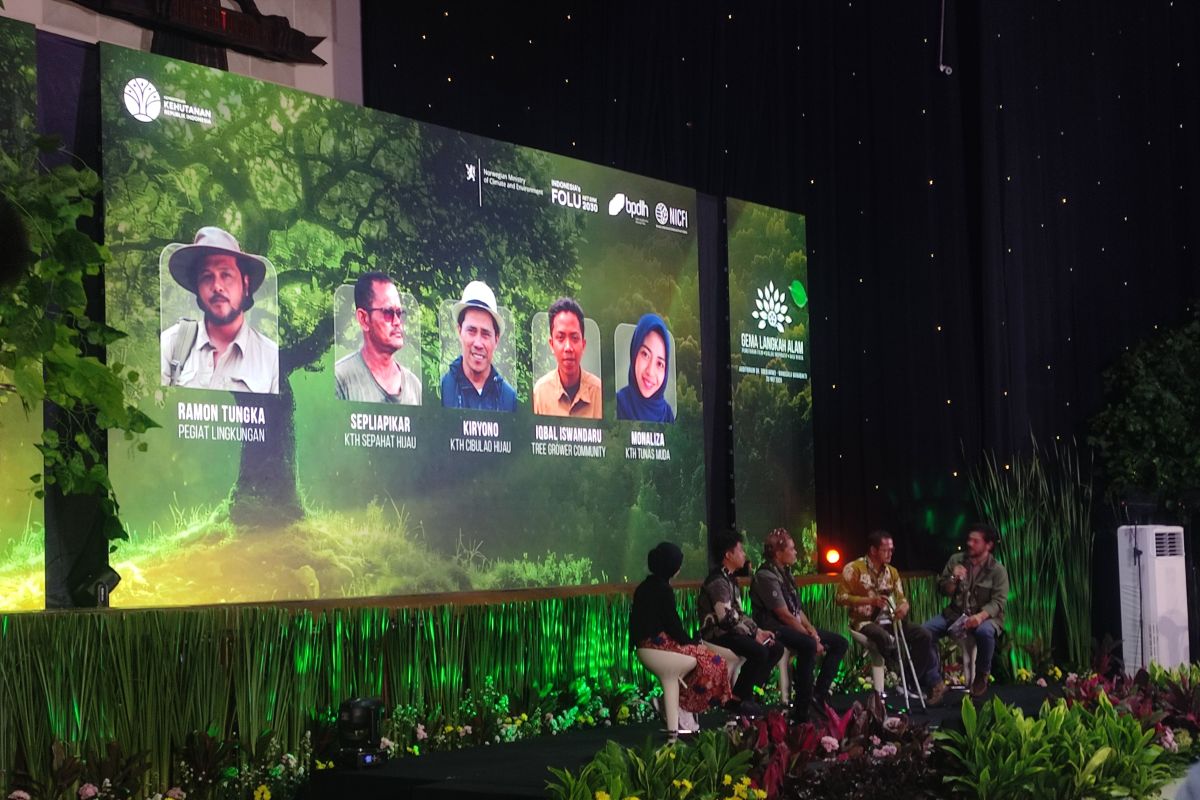
The Ministry of Environment and Forestry (Kementerian Lingkungan Hidup dan Kehutanan), is committed to integrating the local wisdom of indigenous communities and innovations by young people as a key pillar to supporting the achievement of greenhouse gas emission reductions through Indonesia’s Forestry and Other Land Uses (FOLU) Net Sink 2030 programme.
Indra Exploitasia Semiawan, head of the Agency for Extension and Human Resources Development (BP2SDM) of the ministry, said in Jakarta on Wednesday that this integration is an important strategy to ensure that environmental restoration targets are not only successful on paper but yield real ground-level impact.
One aspect of this commitment was visualised through the launch of an environmental documentary film titled “Merawat Esok” (Caring for Tomorrow), which records the efforts of local figures and young people in protecting forests through self-reliant means.
“The launch of the film ‘Merawat Esok’, which coincides with National Awakening Day, is a moment when our responsibility towards nature is not only held by environmental leaders but becomes our shared duty to prepare for future livelihoods,” said Indra, after the premiere screening at the Ministry of Environment and Forestry office in Jakarta.
Indra explained that through the momentum of the event, supported by the Government of Norway, the ministry also showcased various agroforestry innovations nurtured by young people, such as coffee production and forest honey.
The move aims to demonstrate that protecting forests can run parallel to improving local economic conditions.
The ministry is optimistic that protection of ecosystems as crucial as forests, peatlands, and mangroves can be more inclusive and sustainable through synergy between government policy, the power of local wisdom, and youth creativity—as depicted in the documentary.
In a discussion session accompanying the launch, the urgency of involving indigenous communities and grassroots farmer groups in climate change mitigation—particularly against extreme events like the El Niño phenomenon—re-emerged.
Ramon Y. Tungka, an environmental activist and a performer in the film, explained that indigenous communities across Indonesia have long held traditional wisdom for preserving nature even before climate crises became a global issue.
“The community members in indigenous groups have formulated local wisdom for nature conservation for a long time. Initiatives that favour nature will be most effective if formally adopted and involves all sectors,” he said in response to questions from IPB University academic Alif Nur Hidayat about the presence of local communities in the digital era.
Similarly, Kiryono, representing the Forest Farmers Group (KTH) Cibulao Hijau in West Java, added that grassroots commitment to maintaining ecosystem balance has never faded and is inherently autonomous.
“With or without programmes, if we already have commitment, we continue to do what is necessary for the environment. Through the solidarity of farmer groups, we move together to conserve on the ground,” he added.